THE BOSS’S SON

Who, though in God’s form, did not regard his equality with God as something he [Jesus] ought to exploit. Instead, he emptied himself, and received the form of a slave, being born in the likeness of humans. And then, having human appearance, he humbled himself, and became obedient even to death, yes, even the death of the cross. [Philippians 2:6-8 (NTE)]
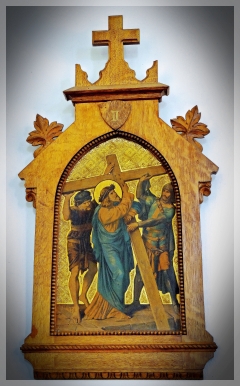
station of the cross II

My son is the third generation to run the family business. Although he is now its CEO, he didn’t begin that way. As his father had done before him, he started by sweeping floors and emptying trash.

The business expanded when my husband purchased a company in another town. With manufacturing processes that were unfamiliar, our son needed to learn new fabrication procedures and started working in the new facility. When he began, only his supervisor knew his relationship to the business’s new owner. He may have been the boss’s son but, to everyone else, he was just Jim, the new guy on the line. In his work shirt and steel-toed shoes, he looked like everyone else, kept the same hours, followed the same rules, and made the same money. What he didn’t do was pull rank or take advantage of his identity.

Although our son originally thought he could learn everything he needed by reading about it, a few days operating the machinery and getting his hands dirty told him there was nothing like first-hand experience! Now that he’s the boss, his employees recognize that he understands and appreciates the challenges they face in doing their jobs.

I tell this story to help us understand what it was like when Jesus put on human flesh and lived as a man. Clothed in work clothes, my son looked like every other hourly employee on the line. Although Jesus is often depicted with a halo, when He was clothed in human flesh, there was no halo and He looked like any other man. Instead of giving up coat and tie for overalls, Jesus gave up His immortal perfect form and took on the aches, indignities, and illnesses that come with a mortal body.

Just as my boy remained the boss’s son but gave up any status or privileges that came from that, Jesus remained God’s son but gave up the benefits that came with His divinity. Of course, Jesus gave up far more than did my son! He set aside the glory of heaven for life on earth and relinquished the divine life He had in heaven to be an itinerant rabbi in Galilee. Even though equal with His Father, Jesus chose to submit to Him as an earthly son does to his father.

Just as our boy never stopped being the boss’s son, Jesus remained fully God while fully man. Just as his co-workers didn’t know our boy’s real identity, people had trouble recognizing Jesus as God’s Son. While my son did what he did so he could learn the family business, Jesus did what He did to take away the sins of the world. Our son may have humbled himself by starting at the bottom but Jesus humbled himself by deliberately choosing to die a torturous death as a criminal on the cross!

My son knows what it means to be one of his employees and he’s a better boss because of it. Jesus knows what it’s like to be human and we are better because of that! Jesus knows what it is to hurt, be disappointed, suffer, struggle, get tired, thirst, feel hungry, bleed, hope, love and die. Because He lived as one of us, we can come to Him confidently and without fear; instead of condemnation, we will receive God’s grace and mercy!

Well, then, since we have a great high priest who has gone right through the heavens, Jesus, God’s son, let us hold on firmly to our confession of faith. For we don’t have a high priest who is unable to sympathize with our weaknesses, but one who has been tempted in every way just as we are, yet without sin. Let us then come boldly to the throne of grace, so that we may receive mercy, and may find grace to help us at the moment when we need it. [Hebrews 4:14-16 (NTE)]

Copyright ©2020 jsjdevotions. All rights reserved.

DIAMOND MINING

Some of his [Paul’s] comments are hard to understand, and those who are ignorant and unstable have twisted his letters to mean something quite different, just as they do with other parts of Scripture. And this will result in their destruction. [2 Peter 3:16 (NLT)]

butterfly weed“You have to drill through mud and water to get oil; you have to sift through sand and silt to get gold; you have to chop and hack through stone to get diamonds. So why do so many people feel that the treasure of ideas should come to them with little or no effort?” asked Sydney J. Harris. Even though he wasn’t referring to the Bible, the journalist’s words made me think of the way we often approach Scripture; complaining that it’s too hard to understand, we simply don’t study it!

If we’ll put forth effort to perfect our golf or tennis swing, train for a marathon, master chess or bridge, plant a garden, or become a gourmet cook, I wonder why we think understanding Scripture should be effortless. It’s only natural that words penned by 40 (or more) people, between 1400 BC to 90 AD, in a wide variety of genres, in another language, and shaped by different cultures and traditions, require some work to comprehend. Scripture’s words were God breathed by the One who created words and thoughts! He is greater than any novelist or journalist so we should expect His words and ideas to be more difficult to understand than theirs! But, because of the effort required to understand them, many of us don’t bother and stick to a few favorite stories, verses and Psalms.

During this sheltering in place, our church conducted an online Bible study and, after thirteen weeks of video lectures given by Biblical scholar N. T. Wright, we finally completed our study of Philippians. In some sessions, Professor Wright walked us through as few as five verses, but the way he shed light on Paul’s circumstances, the Philippians’ society and environment, the political situation of the time, the original Greek meaning of many of the words, the way Paul’s words in Philippians related to his other letters, and what the Apostle’s words meant to us, was immensely rewarding. It was like taking a beautiful old piece of heavily tarnished silver and polishing it. Before this study, I appreciated Philippians the way I might the tarnished silver piece. After studying the epistle in depth, however, the profoundness of Paul’s words were uncovered the same way silver’s true beauty is revealed when it’s polished! Polishing silver, however, takes “elbow grease” and comprehending Scripture takes effort, as well.

Admittedly, understanding Bible passages and spiritual concepts can be challenging but that shouldn’t discourage or surprise us. Even the Apostle Peter admitted the difficulty of comprehending Paul’s words! Nevertheless, the Apostle knew the importance of trying to understand Scripture to avoid being misled. Peter was concerned about teachers who claimed that Christ’s followers could still live immoral lives. Today’s false teachers may be spouting other nonsense but, without our making the effort to study Scripture, we won’t recognize their errors.

Since each Bible study on Philippians lasted about 45 minutes, we spent around 585 minutes on four chapters. That sounds like a lot of time until we consider the 52 billion-plus minutes of The Office that were streamed by Netflix users in 2018 or the 437 billion minutes spent watching NFL and college football’s regular seasons that same year.

For the last several years, I’ve devoted a part of every day to studying Scripture. I still can’t quote chapter and verse, but my life is fuller and more purposeful because of its words. It’s worth the effort because, like mining for diamonds, each time I dig deep into God’s word, another beautiful gem appears.

The book to read is not the one which thinks for you, but the one which makes you think. No book in the world equals the Bible for that. [Harper Lee]

All Scripture is inspired by God and is useful to teach us what is true and to make us realize what is wrong in our lives. It corrects us when we are wrong and teaches us to do what is right. God uses it to prepare and equip his people to do every good work. [2 Timothy 3:16-17 (NLT)]

Copyright ©2020 jsjdevotions. All rights reserved.

THE “TERRIBLE PETITION”

Blessings on the merciful! You’ll receive mercy yourselves. [Matthew 5:7 (NTE)]

Yes: if you forgive people the wrong they have done, your heavenly father will forgive you as well. But if you don’t forgive people, neither will your heavenly father forgive you what you have done wrong.’ [Matthew 6:14-15 (NTE)]

large striped swordtail butterflyWhen our pastor did a sermon series on “Dangerous Prayers,” he didn’t mention one many of us pray regularly: “Forgive us our trespasses as we forgive those who trespass against us.” After giving the disciples “The Lord’s Prayer,” Jesus elaborated on this single petition by categorically stating, “If you don’t forgive people, neither will your heavenly father forgive you what you have done wrong.”  The parable of the unforgiving debtor told in Matthew 18 leaves no room for ambiguity on this point. After the servant refuses to forgive the debt of a fellow servant, the angry king rescinds his forgiveness of the unforgiving man and sends him to be tortured in prison until the debt is paid. His debt (equivalent to several billion dollars today) was insurmountable and that torture would never end. Jesus warned his listeners that the same thing would happen to them if they withheld forgiveness.


Asking God to forgive us in the same way we extend forgiveness to others is dangerous. We are asking God to forgive us by the standard that we set—to deal with us as we deal with others! Called the “terrible petition” by St. Augustine, we’re actually asking God not to forgive us if we harbor any unforgiveness in our hearts! For some of us, could these words be a petition for condemnation rather than salvation, ones for death rather than everlasting life? If we’re unwilling to forgive, I suppose they are!

Paul’s words to the Ephesians tell us to get rid of bitterness, rage, anger, and harsh words and to “forgive one another, just as God forgave you in the king.” [4:31-32] Without a doubt, forgiveness is a difficult process and time is needed between our being hurt and our ability to forgive. The struggle to forgive, however, isn’t the sin; it’s the decision not to forgive, to hold onto our bitterness, that is!

Fortunately, forgiveness is a fruit of the Spirit! Jesus said that good trees produce good fruit and that every tree failing to produce good fruit would be cut down and burned. Clarifying that people are identified by their actions, Jesus warned that only those who actually did the will of the Father would enter the kingdom of heaven! From His words, it seems that profession of faith alone does not equal salvation. While salvation is not earned by works, our faith is evidenced by them: by our willingness to do the Father’s will! Can there be an unforgiven Christian? I don’t think so. But, if we refuse to forgive, are we true disciples of Christ or merely hypocrites who say we are?

No part of His teaching is clearer: and there are no exceptions to it. He doesn’t say that we are to forgive other people’s sins provided they are not too frightful, or provided there are extenuating circumstances, or anything or that sort. We are to forgive them all, however spiteful, however mean, however often they are repeated. If we don’t, we shall be forgiven none of our own. [C.S. Lewis]

Actually, good trees can’t produce bad fruit, nor can bad ones produce good fruit! Every tree that doesn’t produce good fruit is cut down and thrown on the fire. So: you must recognize them by their fruits. Not everyone who says to me, “Master, Master” will enter the kingdom of heaven; only people who do the will of my father in heaven. [Matthew 7:18-21 (NTE)]

Copyright ©2020 jsjdevotions. All rights reserved.

CLEAN GARMENTS

If God is for us, who can ever be against us? Since he did not spare even his own Son but gave him up for us all, won’t he also give us everything else? Who dares accuse us whom God has chosen for his own? No one—for God himself has given us right standing with himself. Who then will condemn us? No one—for Christ Jesus died for us and was raised to life for us, and he is sitting in the place of honor at God’s right hand, pleading for us. [Romans 8:31-34 (NLT)]

star jasmine

Around 520 BC, the prophet Zechariah revealed God’s future deliverance through the Messiah to the Jews who had just returned to Jerusalem from Babylonian captivity. In Zechariah’s fourth vision, the high priest Jeshua stood before an angel of the Lord. Instead of being attired in the spotless white linen robe and turban of a priest, Jeshua’s clothing was filthy (the Hebrew word used was tsow’ and referred to the filth of excrement). Standing to the angel’s right, in a court prosecutor’s position, was Satan. The Hebrew word śāṭān means “accuser” or “adversary” and Satan was living up to his name by making accusations that the unclean priest was unworthy of standing before the Lord. Calling the priest “a burning stick that has been snatched from the fire,” the Lord rejected the accuser’s charges.

In Zechariah’s vision, Jeshua symbolized the nation of Israel, his foul clothing the sins of the people, and his rescue from the coals the nation’s release from their Babylonian exile. Satan, of course, had a vested interest in his accusations; if he could get God to reject Israel, God’s plan of redemption would be thwarted. It wasn’t as if God didn’t recognize Israel’s sin; they’d been punished with seventy years of captivity. God, however, hadn’t turned from His people because of their sins; having delivered them back to Jerusalem, they were still His people.

After the angels around Jeshua took off his filthy garments, the priest was told that his sins were removed and he was given new clothes and a clean turban. On the front of the priest’s turban would have been a medallion with the words “Holy to the Lord.” Just as Jeshua was reinstated as a priest with his clean priestly attire, the nation of Israel was cleansed and restored as a priestly nation and made holy to the Lord! What an amazing image this is. The filthy robe of sins was removed and replaced with garments of God’s righteousness.

What followed was a Messianic vision in which the Lord of Heaven’s Armies promised the coming of a servant called “the Branch,” the removal of all the land’s sins in a single day, and an era of peace and blessings when “each of you will invite your neighbor to sit with you peacefully under your own grapevine and fig tree.” [3:10]

What do Zachariah’s words from over 2,500 years ago mean to us? God’s chosen servant was Jesus; He was the promised Branch stemming from Adam, Abraham, and David. The day Jesus died on the cross was the single day when all our sins were removed! Although Satan continues to accuse us, Jesus is now at God’s right hand and, instead of indicting us, He is pleading for us!

Just as God didn’t reject Israel, He hasn’t rejected us. Because of God’s grace, like Jeshua, we can hand off our sin-covered garments to the Lord and have robes of righteousness returned. Our robes, however, are washed in the blood of the Lamb. Social distancing may have kept us from sitting under a tree with our neighbors, but that promised day of peace and plenty will happen when Jesus returns and reigns as King.

God will not lightly or easily lose His people. He has provided well for us: blood to wash us in; a Priest to pray for us, that we may be made to persevere; and, in case we foully fall, an Advocate to plead our cause. [John Bunyan]

They have washed their robes in the blood of the Lamb and made them white. They will never again be hungry or thirsty; they will never be scorched by the heat of the sun. For the Lamb on the throne will be their Shepherd. He will lead them to springs of life-giving water. And God will wipe every tear from their eyes.” [Revelation 7:14,16-17 (NLT)]

Copyright ©2020 jsjdevotions. All rights reserved.

LIKE A CHILD

“I’m telling you the truth,” he said. “Unless you turn inside out and become like children, you will never, ever, get into the kingdom of heaven. So if any of you make yourselves humble like this child, you will be great in the kingdom of heaven.” [Matthew 18:3-4 (NTE)]

kiboni school - arusha - tanzaniaI used the NTE version of today’s verse because it better captures the original meaning with the words “turn inside out.” Usually translated as change, turn, or convert, the original Greek was strephō which meant more than a slight change of direction. It meant being turned (even from one thing into another) which requires submission. Far more than a mental acknowledgment or intellectual assent to certain ideas, it’s a turning of one’s whole life and person toward God. The kind of conversion or turning meant in strephō is like having one’s life turned inside out.

When Jesus said to become like children, He wasn’t telling us to act childish but to come to Him as would a child. When thinking of some of today’s often spoiled and demanding children, it’s easy to question His words. Children in His day, however, were far less presumptuous, self-sufficient, disrespectful or defiant than today’s youngsters. They were more like a little girl I encountered in Tanzania. She walked across the schoolyard, stopped, looked up at me and, with a shy smile, presented me with her foot. Her shoe needed tying and, as I knelt down in the dust to tie it, she was a perfect example of Jesus words. Knowing she wasn’t self-sufficient, she openly and humbly depended upon someone older and wiser. Trusting and unpretentious, this beautiful child came to me with a faith and simplicity that we adults don’t seem to have.

A child knows when he or she needs help and will freely ask and accept it. Adults, on the other hand, rarely admit their needs or weakness for fear of appearing vulnerable. We want to be in control but, if we’re ever going to enter into God’s Kingdom and enjoy His peace, we have to turn ourselves inside out, cede control and admit our powerlessness.

Any 12-step recovery program begins with admitting our helplessness but we don’t need to have an addiction or compulsive behavior to have our lives spin out of control. Without Jesus, we are broken beings separated from God and powerless over sin. We may be incapable of saving ourselves, but Jesus is not. What He won’t do, however, is force Himself upon us or chase after every loosened shoelace to tie it. It’s up to us to admit our need and turn to Him, as that child did to me.

I will always remember that brief encounter with a little girl who showed me what it means to turn and be like a child: with humility, trust, openness and a lack of self-sufficiency. The kingdom of God is not earned by human effort but is received in childlike trust as a gift through the mercy and grace of God.

With time, that little girl will become more self-sufficient and won’t need someone to tie her shoes. I pray, however, that she always will be willing to acknowledge her weakness and needs to God.

And this is what he said to me: “My grace is enough for you; my power comes to perfection in weakness.” So I will be all the more pleased to boast of my weaknesses, so that the Messiah’s power may rest upon me. [2 Corinthians 12:9 (NTE)]

Copyright ©2020 jsjdevotions. All rights reserved.

GRIEF IS PERSONAL

The thought of my suffering and homelessness is bitter beyond words. I will never forget this awful time, as I grieve over my loss. Yet I still dare to hope when I remember this: The faithful love of the Lord never ends! His mercies never cease. Great is his faithfulness; his mercies begin afresh each morning. I say to myself, “The Lord is my inheritance; therefore, I will hope in him!” [Lamentation 3:19-24 (NLT)]

gardenias“Once, when my feet were bare, and I had not the means of obtaining shoes, I came to the chief of Kufah in a state of much dejection, and saw there a man who had no feet. I returned thanks to God and acknowledged his mercies, and endured my want of shoes with patience.” The Persian poet Sadi wrote those words in 1258 AD and his words are the source of the adage, “I was unhappy about having no shoes until I met a man who had no feet.” When unsympathetic to what I considered my children’s trivial grievances, I often uttered those words or something similar.

While praying for a husband and wife who’d lost their son to COVID-19 and couldn’t even attend his funeral because they were hospitalized with the same virus, I remembered that old maxim. Thinking of all they’d suffered, I rebuked myself for the tears I’d shed over the small things I’ve lost to this pandemic. Then I remembered a book I read about loss that spoke of the importance of not comparing grief. We are one of a kind and the way we experience emotions, whether grief, love, or joy, differs from person to person. Our unique pasts, along with our hopes, dreams and expectations for tomorrow, profoundly affect how we experience today; what distresses one person may seem but a drop in the bucket to another.

What I’d missed when unsympathetic to my children’s complaints was that their grievances were real to them at the time. While missing senior skip, picnic and award days along with cancelled prom, parties and graduation seems heartbreaking for today’s high school seniors, it’s not the end of the world; but try telling that to an eighteen-year old whose prom dress remains unworn in her closet because of COVID-19. While some people grieve not being able to attend ball games or see their new grandbaby, others grieve not being able to visit their parent in a nursing home or attend a friend’s funeral. Some couples grieve the loss of their wedding and honeymoon, others grieve the loss of their jobs or homes, and still others grieve the loss of a loved one. We may grieve things like spontaneity, travel, feeling safe in stores, family gatherings, working as a team, worshiping together, or not seeing smiles because they’re concealed by masks. As we adjust to our incredibly abnormal “new normal,” we all grieve in one way or another and the things we grieve are as different as the ways we do it. While some grieve with tears, others are stoic; some grieve with busyness, others with lethargy; and some grieve with anger while others with dark humor.

Saying, “I was unhappy about having no shoes until I met a man who had no feet!” helps remind us to appreciate the value of what we have but it fails to acknowledge our feelings. We must never compare the things we grieve or the way we do it with other people’s grief because grief is experienced at 100%, whether it’s over missing one’s senior year of high school, losing a breast to cancer, not being able to visit one’s family, or losing a child to COVID. Our feelings are ours alone and the way we handle them is as unique as our fingerprints.

Because grief of any kind is a personal journey, we should respect our grief as well as that of others, even if ours seems trivial by comparison. If you are grieving right now, your sorrow is real. Rather than berating yourself for it, accept it. It is only by experiencing our grief that we can come to terms with whatever we’ve lost and move on to our new normal, whatever that may be. We have a God who understands sorrow; after all, even though He knew He’d raise Lazarus from the dead, Jesus wept at the man’s grave. We are told that there is, “A time to cry and a time to laugh. A time to grieve and a time to dance.” [Ecclesiastes 3:4] Let us not be hesitant to do both!

You have turned my mourning into joyful dancing. You have taken away my clothes of mourning and clothed me with joy, that I might sing praises to you and not be silent. O Lord my God, I will give you thanks forever! [Psalm 30:11-12 (NLT)]

God blesses those who are poor and realize their need for him, for the Kingdom of Heaven is theirs. God blesses those who mourn, for they will be comforted. [Matthew 5:3-4 (NLT)]

Copyright ©2020 jsjdevotions. All rights reserved.