
On that day life-giving waters will flow out from Jerusalem, half toward the Dead Sea and half toward the Mediterranean, flowing continuously in both summer and winter. And the Lord will be king over all the earth. On that day there will be one Lord—his name alone will be worshiped. [Zechariah 14:8-9 (NLT)]
Is anyone thirsty? Come and drink—even if you have no money! Come, take your choice of wine or milk—it’s all free! … Seek the Lord while you can find him. Call on him now while he is near. [Isaiah 55:1,6 (NLT)]
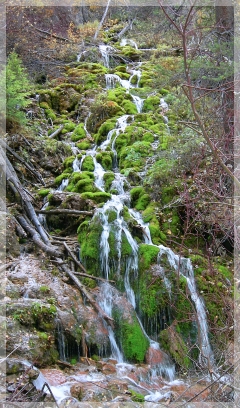 Living in a country where clean water readily flows out of a faucet, we don’t fully understand the concept of “living water” or mayim chaim. Ancient Israel was an arid land where fresh water was precious. Because it only rained a few months of the year, rain was stored in cisterns and grew stagnant. In contrast, living water came directly from God either by rain or a natural spring. Unlike sea water and the hypersaline Dead Sea, which looked refreshing but were poisonous and made the surrounding land barren, mayim chaim brought life. Throughout Scripture, “living water” was associated with God.
During the harvest festival of the Feast of Booths (Hag Sukkot), the Jews were called to remember God’s providential care for them during the forty years of wandering in the wilderness before coming to the Promised Land. God commanded Israel to observe this festival by leaving their homes and living in temporary shelters (sukkot) as they had done during the exodus.
By the time of Jesus, several rituals had been added to enrich the celebration. As a way of remembering the water God supplied when Moses struck the rock with his staff, the Hoshana Rabbah (meaning “please save”) was performed on the last day of the feast. With great ceremony, the priests filled a golden container with water from the pool of Siloam, brought it to the Temple, and circled the altar seven times. Prophecies from Ezekiel 47 and Zechariah 14 were read and, after three trumpet blasts, the priests poured out the water. The water spilling onto the ground signified God’s salvation through water and the prophets’ promises that, in the time of restoration, rivers of living water would flow from the temple and Jerusalem. As the water poured down, words from Psalm 18:25-26 were chanted: “Please Lord, save us …. Bless the one who comes in the name of the Lord.”
It was on the last day of Sukkot, when the courts of the Temple would have been packed with people, that Jesus stood and shouted to the crowds: “Anyone who is thirsty may come to me! Anyone who believes in me may come and drink! For the Scriptures declare, ‘Rivers of living water will flow from his heart.’”[John 7:37-38] Whether Jesus spoke while the priests poured out the water, during the chanting of “Save Us,” or while people dismantled their shelters, we don’t know but the connection between this ceremony and Jesus’ declaration that He was the living water caused a tremendous disturbance. Referring to the Spirit and eternal life rather than drinking water, Jesus was claiming to be the Messiah.
Some of those who heard Jesus’s words thought Him to be the Messiah. Others, knowing the prophecies but not knowing His birthplace, argued Jesus couldn’t be the Messiah since He wasn’t born in Bethlehem. Some believed Him to be a prophet and others wanted Him arrested for blasphemy. Indeed, if Jesus hadn’t been the Messiah, His words would have been blasphemous.
When Jesus spoke that day, He was repeating God’s invitation to salvation found in Isaiah 55. By saying that rivers of living water flowed from Him, Jesus’ words fulfilled all that the Festival of Booths signified. As the mayim chaim, Jesus would satisfy people’s thirst for God.
 So, since God wants us to be prosperous, we’ll get 100 acres of land for every acre we give up or a return of $10,000 for every $100? Sounds too good to be true and it is. Logic tells us Matthew 19:29 can’t be taken literally—we can’t have one hundred fathers and none of us want one hundred children or wives! To make sure the disciples understood, Jesus made it clear that God is not our heavenly banker who dispenses gifts (especially monetary ones) to the most deserving with His parable of the Gracious Landowner. “Do I not have the right to do what I want to do with my own money? Does your eye make you want more because I am good?” asked the landowner. Jesus explained: “So those who are last will be first and the first will be last.” [Matthew 20:15-16] His message was clear: God’s grace can’t be earned or controlled. Moreover, the word often translated as “prosper” in Jeremiah 29:11 is shalom, meaning completeness, soundness, welfare, and peace rather than wealth. Biblical prosperity and prosperity theology are not the same!
 The barking dog came charging down the driveway toward me before skidding to a halt. “Thank you, God, for invisible fences,” was my relieved thought. Unwilling to cross that invisible barrier, the fiercely barking dog followed me from his yard while keeping his distance. A bed of beautiful African iris was between us and I debated about stepping closer to get a photo of their blossoms. While the threat of his collar deterred the dog as long as I remained where I was, I wasn’t sure what he’d do if I ventured any closer. My stepping on his turf could have proven too much temptation for the fellow and he may have been willing to take the punishment for a chance to show me who was boss. My flower picture could wait until another day.
 As a child, I loved the way fairy tales always ended with these words: “and they lived happily ever after.” Real life, however, is anything but a fairy tale. I suspect that after Cinderella and the Prince had two kids, she went right back to cooking and cleaning all day and never went to another ball. Prince Eric’s fondness for ahi tuna sushi and sashimi led to his divorce from Ariel for irreconcilable differences. Snow White ended up under arrest for dwarf exploitation and trafficking in blood diamonds while Barbie, who turned 60 last year, keeps undergoing plastic surgery in an unsuccessful attempt to regain her youth. Because of Ken’s bad investments, their dream house went into foreclosure and their dream cars, boat and motor home were repossessed. In real life, no fairy godmother shows up with a magic wand to turn pumpkins into carriages, mice into horses, and our sweetest dreams into reality.
 “Haven’t they ever seen this show? They’re sure to fail!” I exclaimed as we watched the two chefs attempt to make panna cotta in the final round of Chopped. An Italian dessert made of sweetened cream, gelatin, and flavorings, panna cotta usually requires a minimum of four hours to set. In spite of chefs using quick process gelatin, liquid nitrogen, or the blast chiller to speed things up, I don’t think there’s ever been a successful panna cotta on the show. In fact, Chopped judge chef Alex Guarnaschelli calls panna cotta “Chopped suicide!” Nevertheless, these two chefs were sure they would be the ones who could pull it off in the allotted 30-minutes. As expected, instead of ending up with a dessert resembling a Jell-O mold made with cream, they both served something more like melted ice cream. I wondered what made them think they were that much better than any of the other chefs in the twelve years the show has aired. Apparently, competitive chefs tend to be a little short in the humility department!
 John 21 records Jesus telling Peter to feed His flock three times. The word translated as “feed” in verse 16 is poimaino which refers to the entire process of tending the sheep: feeding, leading, guarding, doctoring, and bringing them into the sheep fold. Although the food of which Jesus is speaking appears to be the word of God, in verses 15 and 17 the word translated as “feed” is bosko, which exclusively meant to feed. Jesus gave Peter these instructions immediately after He’d fed the disciples a breakfast of grilled fish and bread. Could He also have been speaking of providing actual food?
 Devotions of the Heart