
Then, calling the crowd to join his disciples, he said, “If any of you wants to be my follower, you must give up your own way, take up your cross, and follow me.” [Mark 8:34 (NLT)]
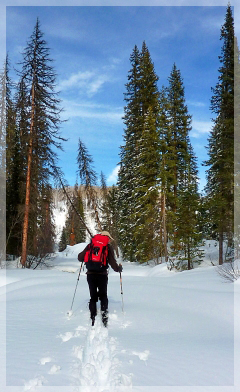 Our pastor recently did a sermon series called “Following Jesus” which reminded me of our first time backcountry skiing in Colorado more than forty years ago. As novices, we knew enough not to venture into the wilderness by ourselves so we hired Wyatt to be our guide. Insisting we delay our trek several days until we’d acclimated to the high altitude and were ready for such a trip, he gave us a long list of items we had to carry in our packs. When I asked why we needed all the survival gear along with additional food, water, and clothing, he said we had to be prepared to spend the night. Protesting that I didn’t want to spend the night out in the cold and snow, he explained, “Neither do I, but we better be prepared to do it.”
Before starting out, Wyatt examined our backpacks to make sure we had everything on his list. Our packs were heavy but his was much heavier with a tent, extra ski tips, ax, first aid kit, shovel, and more. Because falling in several feet of Colorado powder is far different than falling in a few inches of Midwest snow, Wyatt insisted on teaching us a new way of getting up after a fall and made us practice the technique several times before we began.
Once we got started, Wyatt did the hard part by breaking trail in the deep snow and keeping us clear of any slopes posing avalanche danger. To allow us to fully experience the wilderness, we waited until the skier ahead was just out of sight before starting out. Winding our way through both open meadows and woods in this great expanse of white, we would have been hopelessly lost if we hadn’t been following Wyatt’s tracks. Without seeing each other, I felt alone in the wilderness but I never was. Wyatt frequently stopped to check on us and made us rest and hydrate before continuing. We followed his tracks to a picturesque spot for lunch where he showed us how to stomp out a place for a fire and use our skis as chairs. As pleasant as our lunch in the forest was, Wyatt didn’t let us linger too long since he wanted us back to our car before dusk.
Late that afternoon, some tired but happy skiers made their way back toward the road. Just as we caught sight of our car, a winter storm blew in and, by the time we’d stowed our gear, our tracks were completely covered by snow. Caught in that unexpected whiteout, I finally understood why Wyatt had insisted we be prepared to spend the night in the mountains. Had we started out a half hour later, lingered over lunch, or skied back a little slower, we would have been caught in the blinding storm and might well have spent the night on the mountain. Without his guidance, what should have been a delightful day up on the pass could have had a bad ending but, because we followed a good guide, we returned safely home that night.
Even though Wyatt merely guided us on a high mountain pass and Jesus guides us through life, I can’t help but see parallels between following a mountain guide and following Jesus. In either case, we must recognize our inability to make the journey on our own and submit to the guide’s directions, requirements, and timeline. Both prepare us for the challenges ahead, point out hazards, teach us new skills, and never take us beyond our ability. Knowing we’ll fall, they show us how to get up again and, while we may carry a heavy pack, they carry the heaviest one and do most of the work. Keeping us from danger, both mountain guide and Jesus lead the way so we can follow in their footsteps. Even when we feel alone and can’t see them, we can have faith in both guide and Jesus, secure in the knowledge that neither will ever abandon us. Although they’ll make us rest, they’ll urge us on when we should get moving. Most important, just as our choice to follow Wyatt meant the difference between a good or bad outcome, our choice to follow Jesus means the difference between life and death.
There are, of course, some major differences between a mountain guide and Jesus. Even a guide as experienced as Wyatt can get lost but Jesus never will! To Wyatt, we were just paying customers but, to Jesus, we are beloved friends and children of God! Jesus wants us to follow Him, weather every storm, and arrive safely home not because it’s His job, but because He loves us! Through the years, we took several more backcountry tours until we learned enough to venture into the wilderness without a guide but we know that we’ll never be skilled enough to journey through life without following Jesus!
Hang this question up in your homes – “What would Jesus do?” and then think of another – “How would Jesus do it?” For what Jesus would do, and how He would do it, may always stand as the best guide to us. [Charles Spurgeon]
 When Robert Louis Stevenson was just a boy, he was gazing out the window one evening and saw the lamplighter lighting the street lights. The future poet is reported to have said, “Look, Nanny! That man is putting holes in the darkness.” While it makes for a good sermon illustration, a more accurate version of his words is found in an essay he wrote in 1878, “A Plea for Gas Lamps,” in which the man expressed his opposition to the “ugly blinding glare” of the electric lights that were beginning to replace the gas lamps of Edinburgh. After asking God to bless the lamplighter, the poet described him as “speeding up the street and, at measured intervals, knocking another luminous hole into the dusk.” The lamplighter, said Stevenson, “distributed starlight, and, as soon as the need was over, re-collected it.”
 When my little grands came to play, I’d dig out the Fisher-Price “little people” village that had been their parents. Being from the early 70s, it included a free standing phone booth and I had to explain what it was and why pay phones were necessary. Phone booths are so scarce now that I suspect Superman needs to find another changing room! I can’t remember when last I dialed a phone, let alone filled a fountain pen, used carbon paper or even a typewriter. Mimeograph machines, 45s, rabbit-ear antennas, 8-track, VHS, and cassette tapes are all long forgotten. 35 mm film has been replaced by digital technology, dictionaries by spell check, and that cumbersome 26 volume encyclopedia by search engines. If you don’t understand my references, you probably don’t have a landline phone or use an alarm clock, address book, pocket calendar or travel agent. You stream your music rather than play CDs, use a GPS rather than maps, and get your news on the Internet! It’s amazing how many things have become antiquated in just my lifetime. There is, however, one thing that hasn’t become obsolete in 3,500 years: the Bible!
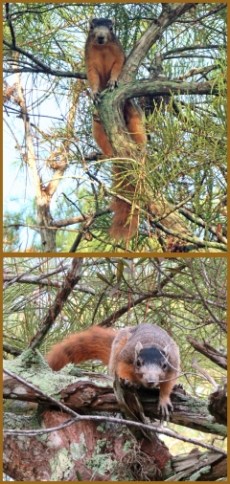 Saturday mornings we usually walk through a nearby park that is home to a unique subspecies of squirrel found here in southwest Florida: the Big Cypress fox squirrel (or BCFS for short). Larger than a common gray squirrel, the BCFS has a black head and back, buff sides and belly, white ears and nose, and a long bushy tail.
 Then Jesus, full of the Holy Spirit, returned from the Jordan River. He was led by the Spirit in the wilderness, where he was tempted by the devil for forty days. [Luke 4:1-2a (NLT)]
 What is the most important moment in your Sunday service? If your church follows a liturgy, perhaps it is the confession, absolution, or thanksgiving. Singing praise music, hearing an inspiring sermon or sharing in the Lord’s Supper may be the highlight of your worship. Reciting the Creed, saying the Lord’s Prayer, greeting one another, communal prayer—all are important parts of the day’s worship service but are they the most important part of it? I wonder if the holiest moment of our Sunday morning occurs when the service is over and we leave the sanctuary (or turn off the computer) and go into the world. When the service has concluded, instead of our obligation to God being over for the week, could it just be starting? Could the next six days and twenty-three hours be more critical than that hour or so we spent at church?
 Devotions of the Heart