THE ANCHOR

So God has given both his promise and his oath. These two things are unchangeable because it is impossible for God to lie. Therefore, we who have fled to him for refuge can have great confidence as we hold to the hope that lies before us. This hope is a strong and trustworthy anchor for our souls. It leads us through the curtain into God’s inner sanctuary. [Hebrews 6:18-19 (NLT)]
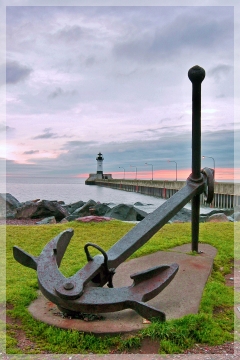
duluth MN harbor - anchorThe sign in front of a nearby church read, “Our hope is anchored in the Lord,” which got me thinking about anchors. I’d never given them much thought until we took a Windjammer cruise off the coast of Maine many years ago. Accompanied by four friends and a crew of two, we sailed for a week. At dusk, we’d lower the sails and anchor in a harbor for the night. After breakfast, we’d pull up anchor for another relaxing day of sailing by lighthouses, granite cliffs, fishing villages, and even a few seals. One day, however, gale force winds replaced the gentle breeze and the calm sea turned violent. The sky darkened as rain and hail poured down on us. We immediately pulled into the nearest inlet, lowered the sails, and dropped two anchors to keep from being blown into the rocks! If we’d had two more anchors (as did the sailors in Acts 27), I suspect we would have dropped them, as well. After donning my life jacket and slicker, all I could do was pray and hope those anchors held. You really don’t appreciate the worth of an anchor until you’ve needed one in a storm!

Since the anchor symbolized hope in the ancient secular world, the recipients of the letter to the Hebrews would have understood the author’s use of the anchor as a metaphor for hope. It is a vivid picture of what keeps us steady and safe in the storms of life—times of trial, danger, hardship, anxiety and uncertainty. An anchor, however, is only as secure as that to which it is fastened. The anchor of hope is not buried in sand or hooked onto a rock that might pull loose. The believer’s hope in Christ is secure, because it is fixed in the very presence of the Almighty.

When the epistle writer says that hope “leads us through the curtain into God’s inner sanctuary,” he’s referring to the Holy of Holies—the inner room of the Temple holding the Ark of the Covenant. Only the high priest could go into this holy place (anyone else would be killed). The priest entered just one day a year, on the Day of Atonement, and only to offer a blood sacrifice. The Holy of Holies was the special dwelling place of God and the curtain emphasized His inaccessibility because of man’s sins. When Jesus died, the curtain tore in half, symbolizing that the way to God was now open to all.

Just as a boat’s anchor holds it safely in position, a Christian’s hope keeps him safe and secure. Like an anchor, God will keep us steady in the storms of life—when the wind of fear blows, suffering rains down, opposition crashes into us, trials threaten us, and uncertainty rocks us to and fro. A boat’s anchor goes down and digs into the bottom of the sea but a Christian’s hope goes up to the heavenly sanctuary and attaches itself to God!

What an anchor is to a vessel in its tossings, so the hope is to us in our times of trial, difficulty and stress. The anchor is outside the ship, is connected with it, and keeps it secure. [W.E. Vine]

Let us hold tightly without wavering to the hope we affirm, for God can be trusted to keep his promise. [Hebrews 10:23 (NLT)]

I pray that God, the source of hope, will fill you completely with joy and peace because you trust in him. Then you will overflow with confident hope through the power of the Holy Spirit. [Romans 15:13 (NLT)]

Copyright ©2021 jsjdevotions. All rights reserved.


DAILY MAINTENANCE – VALENTINE’S DAY

Relish life with the spouse you love each and every day of your precarious life. [Ecclesiastes 9:9 (MSG)]

in the hammock

When getting out a chip n’ dip bowl for some Super Bowl noshing, I noticed the heavy tarnish on the silver candle holders. Because COVID and social distancing have kept us from entertaining, they’ve been ignored in the back of the cupboard for nearly a year. Feeling guilty about letting them get so black, I started polishing off the tarnish. They were a wedding gift to my parents more than 80 years ago and my thoughts turned to marriage as I worked. It’s easy it is to allow our marriages to grow as dull as those candlesticks had. Marriages, like silver, shouldn’t be ignored or neglected.

A pastor friend once remarked that the relationship we have with our spouse is probably the one thing in our lives about which we truly care but which we regularly neglect. We care about our houses, so we paint, repair, renovate, remodel, vacuum, dust, mop, and mow the lawn to maintain them. When we value our health, we take vitamins, get vaccinated, eat healthy food, and exercise. If our children’s education is important to us, we volunteer at school, help with homework, drill them on their spelling, and shuffle them to assorted activities. When we care about our community, we vote, attend meetings, volunteer, or even run for office. If church is important, we tithe, regularly worship, attend Bible study, and serve on committees. Although we usually work at preserving or bettering anything we hold precious, we tend to take the relationship with our spouse for granted.

Marriage is the second most important relationship we have (God, of course, being first) and yet it’s often neglected. Unless we’re experiencing serious marital difficulties, most of us do little to consciously improve it. In fact, we probably spend more time perusing the catalogues and magazines that fill our mailboxes, watching our favorite television programs, or browsing the internet than we do on consciously bettering our marriages. Just because we’re secure in a relationship doesn’t mean we shouldn’t put a little shine on it.

It isn’t that we’re not spending time with one another! Because of this pandemic, couples probably spend more time together than they ever expected. Instead of kissing each other before leaving for work, they just clear off the kitchen counter or move to the dinner table and open their computers. The lines between jobs, home, school, family, entertainment, and leisure have become blurred. Yet, in spite of all the time we’re spending with our loved one (or perhaps because of it), we may have settled into a routine where we’ve stopped noticing one another. We don’t have to ask how their day went or what they did because we already know! Even though we’re together all day in the same house, our lives are more parallel than intersecting.

Sunday is Valentine’s Day—a day we traditionally celebrate romance and love. Even a marriage of more than 50 years needs some tweaking occasionally. Candlelight dinners aren’t just for newlyweds or guests and celebrating pandemic style doesn’t have to be fancy. Like shining silver, it just takes a little effort to shine up a relationship. It can be as simple as grocery store flowers, playing a game together, an unexpected kindness, changing out of the sweat pants, a love note, shaving or putting on make-up, skipping Netflix for a night, taking a walk together while holding hands, having a picnic in the park (or in front of the fireplace), or dancing to slow music (even if it’s in the kitchen and the kids are there). It’s noticing, listening, caring, encouraging, sharing and praying together and often takes less effort than polishing silver. Marriages may be made in heaven but their maintenance work is done here on earth!

Rather than put those now polished candlesticks back into the cupboard, I put them out on the table. They’ve gotten a few dents over the years, just as marriages do, but the dents remind me that marriage is beautiful even when it’s less than perfect. Any tarnish that appears on them will remind me that a good marriage takes effort. While God should be our first priority, our spouse needs to be our second one and not just on Valentine’s Day! Our significant others should be of significance every day; let us be sure to let them know it!

 Remember that children, marriages and flower gardens reflect the kind of care they get. [H. Jackson Brown, Jr.]

Summing up: Be agreeable, be sympathetic, be loving, be compassionate, be humble. That goes for all of you, no exceptions. No retaliation. No sharp-tongued sarcasm. Instead, bless—that’s your job, to bless. You’ll be a blessing and also get a blessing. [1 Peter 3:8-9 (MSG)]

Copyright ©2021 jsjdevotions. All rights reserved.

YOKE OR EASY BUTTON?

yoke - easy button

Then Jesus said, “Come to me, all of you who are weary and carry heavy burdens, and I will give you rest. Take my yoke upon you. Let me teach you, because I am humble and gentle at heart, and you will find rest for your souls. For my yoke is easy to bear, and the burden I give you is light.”  [Matthew 11:28-30 (NLT)]

Several years ago, an office supply company featured an “easy” button in its advertisements and you still can purchase one for less than $9. “Don’t stress it; press it,” their web site suggests. Apparently, when placed on your desk, you can show others how easy it is to find solutions to their problems. Wouldn’t it be nice if all we had to do was push a button to make things easy (or at least easier)?

Rather than a button, however, Jesus offers us a yoke: a wooden frame used as a sort of harness to join two draft animals so they can work together. Among assorted farm implements that once decorated our mountain home, we had the yoke pictured above. It hung upside down but that heavy wooden beam actually rested on the animals’ necks. Without any padding, it doesn’t look that easy to bear! If it is all the same to God, I’d much rather push an easy button than take on anything like a yoke! Fortunately, Jesus was speaking figuratively.

The heavy burden to which Jesus was referring was that of the Pharisees and their legalistic law-keeping that went far beyond God’s demands. For example, there were 39 major categories with hundreds of subcategories defining what constituted work on the Sabbath. While the Jewish way offered the yoke of the law without the power to be obedient, Jesus offered a yoke of faith empowered by the Holy Spirit!

Nevertheless, this passage also can be interpreted as Jesus being our burden sharer. While many things are too heavy for us to bear alone, nothing is too great for Him. By taking His yoke, we give up trying to do life on our own; instead of finding rest in a method, we find rest in a person: Jesus! His yoke is better than an easy button because it actually works! When yoked to Him our burdens are no longer our own!

Can you think of any kinder words than Jesus asking us to come to Him to find rest? Life isn’t easy but God never promised that it would be. Rather than an easy button, we have Jesus and His promise that life is doable with Him. Unlike the yoke that hung on our wall, His yoke is easy to bear and the burden is light. We never have to carry the heavy load of life on our own because He will share it with us. Better yet, since He is so much stronger, most of the weight will be on His heavenly shoulders.

Today, as I take on Jesus’ yoke and share life’s weight with Him, I recall the old Swedish proverb that says, “Shared joy is a double joy; shared sorrow is half a sorrow.”  Wearing His yoke will make my life much brighter and my burdens much lighter.

Give your burdens to the Lord, and he will take care of you. He will not permit the godly to slip and fall. [Psalm 55:22 (NLT)]

Don’t be afraid, for I am with you. Don’t be discouraged, for I am your God. I will strengthen you and help you. I will hold you up with my victorious right hand. [Isaiah 41:10 (NLT)]

Copyright ©2021 jsjdevotions. All rights reserved.

FORGIVENESS CAME FIRST (Part 3)

He personally carried our sins in his body on the cross so that we can be dead to sin and live for what is right. By his wounds you are healed. [1 Peter 2:24 (NLT)]

tri-colored heronIn all three accounts of Jesus healing the paralytic whose friends carried him to the Lord, Jesus forgave the man before healing him. While the combination of both forgiveness and healing demonstrated Jesus’ power over both sin and disease, His offer of forgiveness before healing might lead us to think there is a causal relationship between sin and sickness or forgiveness and physical healing.

Connecting sin with disease goes as far back as Job and their cause-and-effect/retribution theology is part of what got Job’s friends in trouble with God. Nevertheless, associating calamity and suffering with sin continued to be a common point of view in 1st century Judah. Thinking sin and misfortune related, even Jesus’ disciples asked Him whether it was the sins of the blind man or his parents that caused him to be born sightless. Jesus’ answer clarified that sin had nothing to do with the man’s blindness. Later, when Jesus heard about Pilate’s ruthless execution of some Galileans, He made it clear that the murdered men, like eighteen others who died when a wall collapsed on them, were no worse sinners than any other people. Rather than explaining the why of such tragedies, Jesus pointed out that all people are sinners—sinners who should repent so they’re ready for the eternity following their unpredictable lives.

While illness can be caused by God (as it was in the case of King Uzziah’s leprosy, Nebuchadnezzar’s madness, and Herod’s worms), we must remember that we live in a fallen world. While all suffering is due to man’s fall into sin, not all suffering is because of a specific sin on the part of that individual. While some afflictions may be the specific consequences of sin, for the most part, sickness is just part and parcel of living in this fallen world of ours—a world where all creation “groans” under the consequences of our sin.

By forgiving the paralytic before healing him, Jesus wasn’t implying his paralysis was the direct result of his sins. Rather than seeing a man with a paralyzed body, Jesus saw a man with a troubled heart whose greatest need wasn’t mobility but forgiveness! What good would the ability to walk do for a man who remained spiritually broken? The paralyzed man’s most pressing need was forgiveness and, regardless of our physical ailments, forgiveness is our most pressing need, as well. Jesus didn’t die to heal our bodies; He died to heal our souls!

So we praise God for the glorious grace he has poured out on us who belong to his dear Son. He is so rich in kindness and grace that he purchased our freedom with the blood of his Son and forgave our sins. [Ephesians 1:6-7 (NLT)]

He forgives all my sins and heals all my diseases. He redeems me from death and crowns me with love and tender mercies. [Psalm 103:2 (NLT)]

Copyright ©2021 jsjdevotions. All rights reserved.

HE FORGAVE (Part 2)

And he took a cup, and when he had given thanks he gave it to them, saying, “Drink of it, all of you, for this is my blood of the covenant, which is poured out for many for the forgiveness of sins.” [Matthew 26:27-28 (ESV)]

roseWhen Jesus forgave the unnamed woman’s sins, he caused quite a stir among the Pharisees and religious leaders who were His fellow dinner guests. People can forgive an offense against them, but they can’t forgive an offense against someone else or God! While I can forgive your $10 debt to me, I have neither the right nor the power to say you don’t have to pay the $150,000 you also owe the Bank of America, Sallie Mae, Capital One and Chase for your mortgage, college loan, car financing, and credit card purchases. A person can’t do that but God can! Because only God has the authority to forgive people’s sins, implied in Jesus’ forgiveness of the woman’s sins, is a claim that He is God.

This wasn’t the only time Jesus shocked the Pharisees by forgiving sins. On another occasion, a paralyzed man’s friends brought him to Jesus for healing. When Jesus told the man, “Your sins are forgiven,” the religious leaders accused Him of blasphemy. The Hebrew Scripture made it clear that only God has the prerogative to pronounce forgiveness. The book of Leviticus laid out an elaborate temple system of offerings for intentional and unintentional sins, with different animals offered for different kinds of sins. Every year, there was a special Day of Atonement, Yom Kippur, with its elaborate forgiveness ritual in which the nation’s sins were paid for with the sacrifice of a goat and the people’s forgiven sins were laid on another goat (the scapegoat) and sent into the wilderness. To the Pharisees, Jesus daring to pronounce forgiveness without being a high priest or making a sacrifice was a blasphemous claim to divinity. His actions would have been blasphemous had He not been God. As both the Great High Priest and the final sin sacrifice, however, Jesus was the fulfillment of the Law.

Knowing their concerns, Jesus addressed the religious leaders and asked whether it was easier to pronounce forgiveness or heal. He then told the man to pick up his mat and go home! As the man arose and started walking, the crowd was astonished. By healing the man, Jesus confirmed His authority to forgive. The physical healing was as much for the religious leaders as for the paralytic. Although the man’s forgiveness couldn’t be proven or disproven, his healing was obvious to all and there was only one being who could both forgive sins and heal broken bodies—God!

Jesus’ healings were observable acts that identified Him as the Messiah and yet the very people who should have recognized Him seemed to deliberately turn a blind eye and deaf ear. When Jesus healed the paralyzed man, gave sight to the blind, hearing to the deaf, or a voice to the mute, He was fulfilling Isaiah’s Messianic prophecy of salvation made some 700 years earlier.

Say to those who have an anxious heart, “Be strong; fear not! Behold, your God will come with vengeance, with the recompense of God. He will come and save you.” Then the eyes of the blind shall be opened, and the ears of the deaf unstopped; then shall the lame man leap like a deer, and the tongue of the mute sing for joy. [Isaiah 35:4-6 (ESV)]

Copyright ©2021 jsjdevotions. All rights reserved.

THE UNNAMED WOMAN (Part 1)

And behold, a woman of the city, who was a sinner, when she learned that he was reclining at table in the Pharisee’s house, brought an alabaster flask of ointment, and standing behind him at his feet, weeping, she began to wet his feet with her tears and wiped them with the hair of her head and kissed his feet and anointed them with the ointment. [Luke 7:37-38 (ESV)]

hibiscusWhen entering someone’s home, while we might be offered some hand sanitizer or asked to remove our shoes, none of us expect the host to provide us with water to wash our feet. Back in Biblical times, however, hospitality was quite different. No one wore socks and the shoes and sandals bore little resemblance to the Nikes, Tevas, and Keens of today. Between the dusty roads and the oxen, horse, donkey and camel droppings on them, people’s feet were filthy. Foot washing was an expected sign of hospitality and a good host always offered water so a guest could wash his own feet. If the host were rich enough, his servant did the washing and, if the guests were honored enough, the host might do the washing. For example, both Abraham and Lot offered foot washing to their heavenly visitors and, before feeding them, Laban provided Abraham’s servant and men water for foot washing. On the last night of His life, Jesus took on the role of a servant and washed the feet of His disciples.

More than just a common courtesy, foot washing showed acceptance of the guest and the absence of any hostility on the part of the host. Anointing one’s guests with oil was another act of hospitality, honor, and respect. The most intimate form of greeting was an embrace and a kiss—the way way Laban greeted Jacob and Jonathon and David greeted one another. Simon the Pharisee, however, was not a gracious host and violated the customs of hospitality. Although he invited Jesus to dinner, he offered no foot washing, oil or embrace. I suspect his motive for the dinner invitation wasn’t to learn more about Jesus but rather to demean the itinerant rabbi. Even if Jesus had been a mere man, Simon’s behavior was inexcusable. Jesus, however, was the Son of God. The Messiah had come for dinner and Simon had insulted him in the most disrespectful and offensive way possible.

The Pharisee’s dinner party was disrupted by an uninvited guest—an unnamed woman who was “a sinner.” Hers must have been a notorious life since Simon knew her reputation. It was this woman, a woman with a sinful past, who washed Jesus’ feet, not with water, but with her tears. Then, in a remarkable act of both humility and intimacy, she wiped his feet with her hair, kissed them, and anointed them with her perfume.

The woman who knew she was a sinner demonstrated her love and faith in Jesus when the Pharisee, who was unwilling to recognize and admit his sinfulness, couldn’t recognize the Messiah sitting at his table. What an extraordinary contrast—the sinner who honored Jesus who was forgiven and the self-righteous Pharisee, blind to his own sins and disrespectful of Jesus, who was not.

The unnamed sinful woman performed an unselfish act of worship by pouring out her most precious possession and offering both her tears and love. Perhaps it is no mistake that her name is not recorded. Without an identity, she represents each and every one of us. When we come to Jesus as humble and repentant sinners, He will welcome us as graciously as He welcomed her and He will forgive us as generously as He forgave her.

If you could see what I once was, If you could go with me
Back to where I started from Then I know you would see.
A miracle of love that took me In its sweet embrace
And made me what I am today, Just an old sinner… saved by grace.
[Mitch Humphries, William and Gloria Gaither]

And he said to her, “Your sins are forgiven.” Then those who were at table with him began to say among themselves, “Who is this, who even forgives sins?” And he said to the woman, “Your faith has saved you; go in peace.” [Luke 7:48-50 (ESV)]

Copyright ©2021 jsjdevotions. All rights reserved.