
NEVER ASKED

monarch butterflyAnd if someone asks about your hope as a believer, always be ready to explain it. But do this in a gentle and respectful way. Keep your conscience clear. Then if people speak against you, they will be ashamed when they see what a good life you live because you belong to Christ. [1 Peter 3:15b-16 (NLT)]

In the epistle we know as 1 Peter (written between 60 and 64 AD), the Apostle offered encouragement to early Christians who were encountering persecution for their unorthodox beliefs. Rather than being intimidated by people or afraid of their hostility, Peter counseled them to acknowledge Jesus as the Lord of their lives and ruler of their hearts. Although that acknowledgement was in their hearts, he warned these believers to be ready with their answer should they could be called upon to explain the source of their hope and faith. The Greek word used was apologia which meant a speech in defense and was the term for making a legal defense in court. As if they were in a court of law, Christ’s followers were to be ready with a well-reasoned reply that adequately addressed the issue at hand while doing it in a humble and respectful way. Throughout his letter, the Apostle also addressed the conduct of Christians regarding their relationship with God, government, business, society, family, and the church. He advised his readers to live their lives in a way that would prove their opponents’ accusations unfounded.

I used to wonder how I would answer someone if they wanted to know the reason for my faith or the source of my hope. Should I keep religious tracts in my purse or a couple of pertinent Bible verses handy? I then remembered an old joke about the little boy who asked his father where he came from. The dad hemmed and hawed as he struggled with a rather long-winded and confusing explanation of the birds and bees. When done, the little boy looked at his father quizzically and said, “I was just wondering since Billy says he’s from Baltimore.” As the father learned, sometimes the simplest answer is the best one. If ever asked, the only explanation I’d need is that my hope comes from Jesus, from trusting in God’s promises, and from my conviction that God’s plans for me are for good and not disaster. Moreover, if and when such a question arises, I’m sure the Holy Spirit will be there to put His words in my mouth.

Thinking about Peter’s words, I realize that nobody has ever asked about the source of my hope or reason for my faith. While I’ve had people compliment the little diamond cross I usually wear, no one has ever asked why I wear it. I’ve had people ask where I purchased an outfit, who cuts my hair, what make of shoes I’m wearing, the kind of camera I use, and even the brand perfume I wear. Although I’ve been a walking advertisement for Tommy Bahama, Mimi’s Salon, Naot Shoes, Canon, and Prada’s Infusion d’Iris, I doubt that my devotion to Jesus is as discernable.

Perhaps, instead of worrying about how I would answer a question about the source of my faith, hope or love, I should be more concerned with why I’ve never been asked such a question. I wonder if it’s because, while my appearance (and even my scent) are evident, my faith in Jesus, my hope in God’s promises of forgiveness and salvation, and my love for God and my neighbor aren’t nearly so obvious in the way I conduct my life. They should be!

Your love for one another will prove to the world that you are my disciples. [John 13:35 (NLT)]

Live wisely among those who are not believers, and make the most of every opportunity. Let your conversation be gracious and attractive so that you will have the right response for everyone.[Colossians 4:5-6 (NLT)]

Copyright ©2021 jsjdevotions. All rights reserved.

A GOOD SERMON

Preach the word of God. Be prepared, whether the time is favorable or not. Patiently correct, rebuke and encourage your people with good teaching. They will follow their own desires and will look for teachers who will tell them whatever their itching ears want to hear. They will reject the truth and chase after myths. … Work at telling the Good News and fully carry out the ministry God has given you. [2 Timothy 4:2-4,5b (NLT)]

fish vreek falls - COIn a Dennis the Menace comic strip (drawn by Marcus Hamilton), Dennis is sitting next to his father at church. As their offering envelope is dropped in the plate, he asks his father, “Can we get a refund if the sermon isn’t that good?” For Dennis and many church-goers, a good sermon is one that is pleasant and entertaining. Unlike movies and concerts, however, sermons aren’t meant to be entertainment. The Christian church is neither the “church of what’s happening now” nor the church of “anything goes.” While many messages can make us feel good, feeling good is not the purpose of the Good News.

As much as the Romans, Ephesians, Philippians, Colossians and others looked forward to hearing from the Apostle Paul, I doubt any of the early churches were entertained by his letters while they were read to the congregation. While he always had words of encouragement for the church, the intense Apostle appears to have had no sense of humor and his words were often ones of conviction and correction. False ideologies were corrected, sins of immorality were confronted, and proper behavior was addressed. Corinthian church members probably squirmed in their seats when Paul’s letters took them to task for infighting, abusing the Lord’s Supper, and their wanton behavior. When Paul told the Galatians they’d perverted the gospel of grace, surely not everyone welcomed his words. He unreservedly admonished the new churches for such things as false beliefs, divisiveness, lax morals, and questionable motives in preaching.

Although Paul’s words in his epistles are knowledgeable, articulate, and passionate, he admitted that he was a poor speaker [2 Cor. 11:6]. Some of the Corinthians even complained about his weak appearance and worthless speeches! [2 Cor. 10:10] Paul wasn’t an eloquent orator or an imposing figure and he probably wouldn’t have won a popularity with his messages. Nevertheless, apart from Jesus Himself, no one influenced the history of the Christian church more than Paul. Because of his words, the early church not only survived but thrived through persecution and troubled times. The 21st Century church faces many of those same problems—internal conflict, hypocrisy, questionable doctrine, arrogance, and a dumbing down instead of raising up. Without some tough love from our pulpits, can we survive and thrive?

Watered-down “feel good” messages that don’t condemn sin or challenge us to grow more like Christ are not the sort of epistles Paul would have written. They certainly aren’t the sort of messages Jesus gave. Yes, He spoke of peace, love and forgiveness, but Jesus also made people uneasy when He spoke of things like sacrifice, hypocrisy, obedience, repentance, taking up one’s cross, future persecution, and God’s judgment. With a sermon like that, Dennis might choose to demand a refund.

Let’s never forget that a good pastor is as zealous as was the Apostle Paul. His job is to shepherd his flock—to warn, correct, educate, rescue, convict, set goals, lead, and protect as well as to comfort, nurture and encourage. His job is not to make us happy; it is to guide us on the path to salvation. His job isn’t to preach only good news; it is to preach the gospel which is the Good News of Christ. It may not always be the news we want to hear; nevertheless, it is the news we need to hear.

It is far better to be plain in speech, yet walking openly and consistently with the gospel, than to be admired by thousands, and be lifted up in pride… [Matthew Henry]

Now these are the gifts Christ gave to the church: the apostles, the prophets, the evangelists, and the pastors and teachers. Their responsibility is to equip God’s people to do his work and build up the church, the body of Christ. This will continue until we all come to such unity in our faith and knowledge of God’s son that we will be mature in the Lord, measuring up to the full and complete standard of Christ. [Philippians 4:11-13 (NLT)]

Copyright ©2021 jsjdevotions. All rights reserved.

TOO HEAVY

My thoughts are nothing like your thoughts,” says the Lord. “And my ways are far beyond anything you could imagine. For just as the heavens are higher than the earth, so my ways are higher than your ways and my thoughts higher than your thoughts. [Isaiah 55:8-9 (NLT)]

mockingbirdAfter Jane Marczweski’s stunning performance on America’s Got Talent last June, I posted a devotion (It’s Okay) about her. Known as Nightbirde, the 30-year-old vocalist (and three-time cancer survivor) sang an original song called “It’s Okay” and received the “golden buzzer” from judge Simon Cowell. Last week, the brave young woman had to withdraw from the competition because her health has taken a turn for the worse. In an interview on CNN with Chris Cuomo, she shared that her metastatic breast cancer has now invaded both lungs and liver and her fight with cancer is demanding all of her energy and attention.
When we see a young person like Nightbirde, a beautiful person both inside and out who seems so deserving of good future, it’s easy to ask the age-old question of “Why?” Why do some of the best people, the ones with the most to offer, seem to suffer the most or have their futures cut short when many of the worst and worthless seem to breeze along without a problem? Why, when life begins to look up does God so often pull out the rug? “Life doesn’t always give breaks to those that deserve it,” said the singer while adding, “but we knew that already.” Indeed, we did; nevertheless, we don’t like it!

When Cuomo asked Nightbirde if she ever wonders, “Why?” the young woman replied, “I try not to occupy myself with questions that are too big for myself to answer. It’s a waste of time. You know, just because it’s a mystery doesn’t mean it’s the absence of meaning. Sometimes, the mystery means there is more meaning there than we can even understand and so I accept that and I let go of the question because it’s too heavy.”

Indeed, much in our lives seems inexplicable and far beyond our comprehension. But, as the young singer pointed out, incomprehensible or unknowable doesn’t mean meaningless or pointless. It’s a mystery why Nightbirde’s promising future probably will be cut short; then again, it’s a mystery why my mother died when I was fifteen, why my brother was struck with inoperable cancer at the moment his life finally took an upturn after years of trouble, and why the God-fearing believers on my prayer list have been burdened with things like mesothelioma, Alzheimer’s, Parkinson’s, MS, schizophrenia, and chronic pain. This young woman’s words remind us all that our lack of understanding of God’s purpose doesn’t mean that what happens is without meaning.

I can’t understand quantum physics any more than I can understand the ways of God. The difference between the two is that, given enough time, effort, and tutoring, I eventually could understand quantum physics but I will never be able to fully understand God. While we can come to know and love Him, we never will be able to comprehend His mysterious ways. Indeed, some questions are so weighty that we’d never make sense of God’s answer even if He explained it to us!

This optimistic young woman says she’s planning for her future rather than her legacy and says, “I want to be the bird that sings in anticipation of the good things that I trust are coming.” As a Christian, Nightbirde doesn’t need to ask God “Why?” because she knows good things are coming, whether in this world or the next!

Oh, how great are God’s riches and wisdom and knowledge! How impossible it is for us to understand his decisions and his ways! For who can know the Lord’s thoughts? Who knows enough to give him advice? And who has given him so much that he needs to pay it back? For everything comes from him and exists by his power and is intended for his glory. All glory to him forever! Amen. [Romans 11:33-36 (NLT)]

Copyright ©2021 jsjdevotions. All rights reserved.

DRY BONES

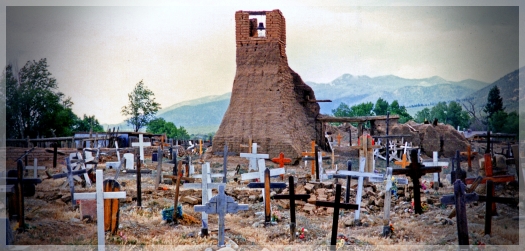
Taos NMThen he said to me, “Speak a prophetic message to these bones and say, ‘Dry bones, listen to the word of the Lord! This is what the Sovereign Lord says: Look! I am going to put breath into you and make you live again! I will put flesh and muscles on you and cover you with skin. I will put breath into you, and you will come to life. Then you will know that I am the Lord.’” [Ezekiel 37:4-6 (NLT)]

The Jewish people were in despair. Jerusalem was in ruins and the Temple destroyed. Exiled to Babylon, they were without a king, homeland, or hope. God’s promise of Israel’s restoration is depicted in Ezekiel 37 when the prophet is transported in a vision to a valley filled with desiccated bones. The Lord instructs Ezekiel to speak a prophecy over the dry bones that the Lord will bring them back to life. As the prophet begins to speak God’s words, the bones start rattling and coming together as skeletons. The prophet watches as muscles, tendons, and skin cover the bones until they became fully formed bodies. Although the bodies look alive, they are no more than unbreathing corpses until the Lord instructs Ezekiel to tell the four winds to breathe life into the lifeless beings. As the prophet speaks God’s words, he witnesses the once dead bodies come alive, stand erect, and become a great army. The initial meaning is pretty obvious: the bones coming back together illustrate Israel’s restoration and the wind or breath entering the dead bodies illustrate spiritual renewal or rebirth.

Be that as it may, as a Sunday schooler who didn’t understand the story behind Ezekiel’s somewhat eerie vision, picturing those dry bones rattling and rising up gave me the creeps. Perhaps it was because of the children’s song Dem Dry Bones. Even though we sang it in Sunday school, the song was associated more with Halloween (and its ghosts and goblins) than Biblical prophecy. Sometimes, a second verse was added in which Ezekiel, after connecting those bones, disconnected them—not a pleasant visual for any child! Perhaps I’d simply seen too many Saturday matinees with zombies, mummies, or other creatures of the night. Not understanding the context behind Ezekiel’s prophecy, the whole vision seemed as macabre as does the Body Worlds exhibit that features real skinless corpses preserved in plastic.

Yesterday’s devotion mentioned how I enjoy listening to worship music on my frequent trips to and from my doctor’s appointments. When I first heard Elevation Worship’s Rattle, with its words, “And the bones began to rattle, rattle, rattle, rattle…This is the sound of dry bones rattling,” I initially thought of Ezekiel’s vision. The thought of hearing dry bones rattling immediately brought up the old ghoulish images from childhood. But, as I listened to the rest of their words, those bones weren’t the dry ones in Ezekiel’s vision. As they sang, “Saturday was silent, Surely it was through. … Friday’s disappointment is Sunday’s empty tomb,” I understood they were singing about Jesus rising from the grave and the renewal of life for those who are restored by His power.

Today, I returned to Ezekiel 37 and saw his vision as more than a simple prophecy of the people’s return from their exile in Babylon, the reconstitution of the modern state of Israel, and/or the end times and the second coming of Christ. I saw it as a beautiful story of hope and rebirth. Although the prophecy was for Israel, I see Ezekiel’s vision as an illustration of what God can do for and with us right now—the life-giving power of His word to put back together the pieces of our broken lives and the power of the Spirit’s breath to bring us back to spiritual life! No longer will I cringe at the thought of dry bones rattling and rising. They tell me that no one ever is beyond restoration—no one is ever so spiritually dead that he or she can’t come alive again. The rattle of dry bones will remind me that, without the resurrection power of Jesus and the breath of the Spirit, we are little more than dry bones in a valley.

No difficulties in your case can baffle him, no dwarfing of your growth in years that are past, no apparent dryness of your inward springs of life, no crookedness or deformity in any of your past development, can in the least mar the perfect work that he will accomplish, if you will only put yourselves absolutely into his hands and let him have his own way with you. [ Hannah Whitall Smith]

Jesus told her, “I am the resurrection and the life. Anyone who believes in me will live, even after dying. Everyone who lives in me and believes in me will never ever die. [John 11:25-26 (NLT)]

Copyright ©2021 jsjdevotions. All rights reserved.

FAITHFUL AND ABLE

God is not a man, so he does not lie. He is not human, so he does not change his mind. Has he ever spoken and failed to act? Has he ever promised and not carried it through? [Numbers 23:19 (NLT)]

 I will look up for there is none above you;
I will bow down to tell you that I need you.
Jesus, Lord of all; Jesus, Lord of all!
I will look back and see that you are faithful;
I look ahead believing you are able.
Jesus, Lord of all; Jesus, Lord of All!
[I Will Look Up (Redman, Ingram, Joye, Brown, Brock)]

columbineIn our family, the car’s driver controls the music. Since my husband usually drives, that tends to be ‘50s and ‘60s rock. My thrice weekly chiropractor appointments, however, have given me the opportunity to listen to worship music rather than golden oldies. Last week, while alone in the car, I joined with Elevation Worship as they sang of laying the worries of the world, the needs of their loved ones, their hopes and dreams, and every anxious thought at God’s feet. “I will look back and see that you are faithful; I look ahead believing you are able!” Those words are so true and yet I frequently forget to look back to God’s past provision or ahead with trust that He is able to provide exactly what is needed.

Singing, “All my life is in your hands,” I wondered if we truly believe that. After laying our worries at His feet, do we ever doubt His faithfulness and ability, pick them up, and take them back again? Do we have reservations about our incredibly faithful and overwhelmingly able God because we know how fallible and incompetent we often are? My life is filled with a series of mishaps, misunderstandings, and failures and I suspect yours is, too. We misplace our phones and have to call ourselves to find them. We read the words “dry clean only” but toss the sweater into the washer. We proof-read a dozen times only to find mistakes in the finished product and write grocery lists but leave them at home. We miss appointments, arrive late, and don’t return calls. We mean to do a task but forget and often claim to know what we’re doing when we haven’t a clue. We promise but disappoint, plan but fail to carry out, and our repairs frequently make the problem worse. We say we’ll pray for someone and don’t, intend to write a letter but never get around to it, or get exasperated when we mean to be calm. That’s not even mentioning the other assorted betrayals, deceit, debacles, and transgressions of which we’re all capable. Knowing how incredibly unreliable and faithless we can be, we often doubt God. God, however, is perfect—we, most certainly, are not!

Hearing the words, “I will look back and see He is faithful,” I did just that. I looked back and saw God’s faithfulness to me in every crisis and dark valley I’ve encountered. From Genesis through Revelation, we see God’s faithfulness to His children and, in the life, death, and resurrection of Jesus we see His promises fulfilled. Flawed beings that we are, we’re often unfaithful to our promises or unable to fulfill them but our perfect God is both faithful to His promises and more than able to fulfill every one! Although I’ve failed the ones I love and, at times, they’ve failed me, God never has and never will!

Understand, therefore, that the Lord your God is indeed God. He is the faithful God who keeps his covenant for a thousand generations and lavishes his unfailing love on those who love him and obey his commands. [Deuteronomy 7:9 (NLT)]

Your eternal word, O Lord, stands firm in heaven. Your faithfulness extends to every generation, as enduring as the earth you created. [Psalm 119:89-90 (NLT)]

Copyright ©2021 jsjdevotions. All rights reserved.

IMITATION LOVE

Treat other people exactly as you would like to be treated by them—this is the essence of all true religion. [Matthew 7:12 (PHLLIPS)]

turtleOnce upon a time, a father gave his daughter a painted turtle. One morning, she ran to her father in tears and sobbed, “My turtle died!”  Wanting to bring a smile back to his little girl’s face, Dad promised the reptile a lovely funeral after which he’d take her to their favorite fast-food spot for a happy meal and toy. When that did nothing to stop the flow of tears, he upped the ante by proposing to follow lunch with the latest Disney princess movie. As the sobbing slowed, he then promised they’d stop at the mall where she could ride on the merry-go-round and Ferris wheel. With only a few whimpers remaining, Dad topped off his offer with a promise to stop on the way home for a double scoop ice cream cone. Thrilled to finally see a smile on his daughter’s face, the relieved father reached into the tank to remove the dead turtle only to discover that it was alive and well and just had been enjoying a turtle nap. When he joyfully reported, “He’s not dead!” the disappointed girl’s response was, “Then can we kill it?”

Kids are naturally selfish and self-centered—just watch toddlers play and notice how often you hear the words “mine” and “gimme.” Children are self-absorbed little creatures, but so are adults—we’re just a bit more civilized in our selfishness. We may not grab, hit, or throw temper tantrums, but we still tend to put ourselves and our wants first. Since that unfortunate day in Eden, mankind has shown a preference for self-interest. We typically see the world only from our viewpoint rather than that of others or, more important, with the eyes of Jesus.

As members of the body of Christ, it is the lives of others that are to concern us. We are advised to share in both the joy and sorrow of our brothers and sisters. Sometimes, however, it seems easier to share in other people’s sorrow than in their joy. Just as the turtle’s fortuitous awakening meant the little girl lost her afternoon of fun, it’s rarely easy to rejoice in other people’s good fortune when we don’t share in it. Jealously, envy and resentment can rear their ugly heads. It’s especially difficult to rejoice when another person got the job we wanted, someone else’s child got the award, another person won the match, a co-worker got the praise or raise, or a friend heard the word “benign” when we heard the words “malignant” or “inoperable.” Nevertheless, regardless of our situations, other people’s good news should always be a reason for our joy.

“Genuine krab meat” isn’t truly crab; it’s an assortment of fish that has been skinned, boned, minced, and rinsed before being formed into the paste known as surimi. Fillers, flavor and color are added and the mixture is shaped into chunks or tubes and cut into blocks or sticks and cooked. Once cut up, it may look like a bit like the real thing, but there is nothing genuine about it. We’re called to love genuinely, even if it means we might have to skip the happy meal, movie, and ice cream. Let there be no imitation Christian love around here—it’s as tasteless and disagreeable to God as imitation crab.

Let us have no imitation Christian love. Let us have a genuine break with evil and a real devotion to good. Let us have real warm affection for one another as between brothers, and a willingness to let the other man have the credit. … Share the happiness of those who are happy, the sorrow of those who are sad. [Romans 12:9-10,15 (PHILLIPS)]

Copyright ©2021 jsjdevotions. All rights reserved.