Please Pray for the People of Afghanistan

I am forwarding this request from Franklin Graham. Please join with us in making today a day of prayer for the people of Afghanistan.

Dear Friend,

Thousands of people, including up to 15,000 Americans, are desperately trying to escape from Afghanistan after the country’s fall to the Taliban.

These Islamic extremists, who have now taken Afghanistan back by force, have a history of brutality, including beheadings and public executions. Time is short and the need is urgent, and that is why I am calling for a day of prayer this Sunday, Aug. 22.

With the Taliban blocking access to the airport and all exit routes, this is a life-or-death situation for Christians and other religious minorities, and all those who worked with or for America over the past two decades. There is no hope for these people to get out safely—apart from a miracle from the hand of God—and that’s what we need to pray for.

Samaritan’s Purse is doing what we can through partners working to help people get out of the country. It is a difficult and tragic situation. Will you please join me in praying for God to intervene in a mighty way?

Sincerely,

Franklin Graham
President, Samaritan’s Purse

The earnest prayer of a righteous person has great power and produces wonderful results. [James 5:16 (NLT)]

GETTING OUT OF THE PIT

Dear brothers and sisters, when troubles of any kind come your way, consider it an opportunity for great joy. For you know that when your faith is tested, your endurance has a chance to grow. So let it grow, for when your endurance is fully developed, you will be perfect and complete, needing nothing. … God blesses those who patiently endure testing and temptation. Afterward they will receive the crown of life that God has promised to those who love him. [James 1:2-4,12 (NLT)]

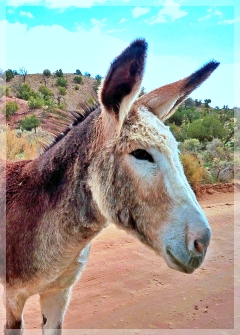
donkeyThe story is told of a donkey who fell into a deep pit. Unable to get out, the animal brayed loudly until the farmer came to investigate. Seeing no way to get his donkey out of the pit, the farmer decided the only thing he could do was to put the poor animal out of its misery. Since the pit needed to be filled anyway, he got a spade and started to shovel dirt into it. When the donkey felt those first clods of dirt on his back, he lost all hope of rescue and brayed even louder. As he shook the dirt off his back, however, he discovered a growing mound of dirt beneath his feet. Seeing a possible solution, the donkey grew silent as he continued to shake dirt off his back and started tamping it down with his hooves. As the dirt piled up beneath his feet, the donkey got higher and higher in the pit. Paying no attention to the now silent animal, the farmer kept shoveling until he finally stopped for a rest. When he turned around, the man was shocked to see the donkey step out of the pit and trot away. The animal could have chosen to wallow in his misery—simply hung his head and let that dirt cover him up—but he didn’t. Instead, he took steps to change his situation.

Giving up is often our first response when we get buried in our troubles. Deciding the marriage can’t be saved, the situation is hopeless, we’ll never beat the addiction, we’re worthless sinners, we failed, no one understands, or that the pain will never end, we don’t even try to find a fix! That, however, means we’ve ceded control of our lives to something or someone other than God. By giving up, we’ve stopped living God’s will because we’re not letting Him shape and mold us in our circumstances. God’s not done with us until He says so!

When I look back at some of my worst experiences, heaviest trials, and most heartbreaking times, I see my greatest emotional and spiritual development. Growth seems to occur in the valleys (or pits) rather than on the hilltops. Perhaps that’s because we want to maintain the status quo in the good times; when all is going smoothly, we certainly don’t want to rock the boat with any change. Bad times, however, make us as uncomfortable as that trapped animal. Like the donkey, when we are buried in trouble, we have a choice: wallow in misery or make a change.

Instead of letting the dirt bury him, the donkey turned it into a gift. We can see our troubles as penalties or gifts, endings or beginnings, impediments or opportunities. The choice is ours. Life is always going to try to weigh us down; the trick is in deciding to get out of the pit. The donkey did it by shaking off the dirt. As people of hope who know that Jesus can do within us that which we can’t do for ourselves; let us do the same!

We are always on the anvil; by trials God is shaping us for higher things. [Henry Ward Beecher]

We can rejoice, too, when we run into problems and trials, for we know that they help us develop endurance. And endurance develops strength of character, and character strengthens our confident hope of salvation. And this hope will not lead to disappointment. For we know how dearly God loves us, because he has given us the Holy Spirit to fill our hearts with his love. [Romans 5:3-5 (NLT)]

Copyright ©2021 jsjdevotions. All rights reserved.

THE RAINBOW’S END

And I am convinced that nothing can ever separate us from God’s love. Neither death nor life, neither angels nor demons, neither our fears for today nor our worries about tomorrow—not even the powers of hell can separate us from God’s love. No power in the sky above or in the earth below—indeed, nothing in all creation will ever be able to separate us from the love of God that is revealed in Christ Jesus our Lord. [Romans 8:38-39 (NLT)]

rainbowDays bled into weeks, weeks into months, and every day seemed the same for much of the last eighteen months. Life became a series of postponements, rebookings, cancelations, setbacks, inconveniences, letdowns, and disappointments. Visiting Grandma meant waving at her through a window, final farewells were FaceTime calls on a nurse’s cell phone, and we mourned from a distance while attending celebrations of life virtually. Weddings were postponed, family reunions put on hold, shut-downs and travel restrictions kept loved ones apart, theaters and concert halls went dark, vacations were delayed, businesses closed, jobs were lost, and junior year abroad became junior year on Zoom.

Many of us had something specific to which we looked forward in the COVID-free future. It was anticipation of that reward that helped sustain us through the dreary months. When vaccines rolled out and numbers dropped, we began to think the end was in sight and we finally saw the end of the rainbow! Plans resumed for family reunions, the delayed semester abroad, or the cruise of a lifetime. Vacations were scheduled, wedding venues rebooked, businesses set dates for returning to the office, and nursing homes and hospitals again allowed visitors. With the surge in cases and the return of restrictions, however, many of those plans have been pushed back yet again or cancelled altogether. We’re frustrated and disappointed because the future we hoped for isn’t the one we got!

In C.S. Lewis’ The Screwtape Letters, the demon Screwtape strategizes with his nephew Wormwood on methods of capturing a young man’s soul. The senior demon suggests using time as a weapon. Screwtape explains that the “enemy” (God) wants man to focus on only two times: eternity (which means attending to God) or the present in meditation, obedience, service, receiving grace, or giving thanks. Having found tempting someone to live in the past to be of “limited value,” Screwtape advises a far better approach is to tempt the man to attend to the future. God, he says, “does not want men to give the future their hearts, to place their treasure in it,” but the demons definitely do! He adds that, “We want a whole race perpetually in pursuit of the rainbow’s end.” Rather than being faithful, kind, happy, or thankful in the present, the demons want people to miss the gifts of the present day while looking for them in the future. “Gratitude,” says Screwtape, “looks to the past and love to the present,” but, the demon adds, it is things like fear, desire, greed, materialism, and ambition that look to the future.

As Christians, we can’t let our disappointment in the future we’d anticipated dominate our life or cause us to lose hope. Keeping our eyes on the real hope found in eternity with God, let’s not allow our disappointment in tomorrow steal today’s joy. As followers of Jesus, we live with a hope that isn’t dependent on pandemics, positivity rates, restrictions, weather, or finances because we know how the story ends. Yes, we’re disappointed now but, ultimately, we won’t be disappointed by what God has waiting for us.

Yesterday is gone. Tomorrow has not yet come. We have only today. Let us begin.  [Mother Teresa]

That is why we never give up. Though our bodies are dying, our spirits are being renewed every day. For our present troubles are small and won’t last very long. Yet they produce for us a glory that vastly outweighs them and will last forever! So we don’t look at the troubles we can see now; rather, we fix our gaze on things that cannot be seen. For the things we see now will soon be gone, but the things we cannot see will last forever. [2 Corinthians 4:16-18 (NLT)]

Copyright ©2020 jsjdevotions. All rights reserved.

LOVE CASTS OUT FEAR

dragonflyWhen all the people in the synagogue heard these things, they became very angry. They got up, forced Jesus out of town, and took him to the edge of the cliff on which the town was built. They planned to throw him off the edge, but Jesus walked through the crowd and went on his way. [Luke 4:28-30 (NCV)]

For love to be real, for it to grow deep inside, it must not give in to fear. It is not afraid to give, to risk, to chance, even if it hurts. Love believes. It is faith moving forward. Fear holds us back. It makes us stop or turn and run. [Chris Fabry]

While writing yesterday’s devotion about selfishness being the opposite of love, I found several authors who suggested that fear is the opposite of love. This gave me pause; can something be the opposite of more than one thing?

From day one, when Mary and Joseph fled with Him to Egypt, Jesus had plenty of reasons to be fearful and yet fear never prevented Him from speaking, healing, pointing out hypocrisy and evil, or going to the cross. He didn’t give in to fear when, after speaking of God’s grace to Gentiles, the people of His own hometown tried to force him off a cliff. Angry mobs, religious leaders, and Rome never intimidated Jesus or kept Him from challenging the corrupt political and religious system of His day. He knew a warrant was issued for His arrest and that the cross awaited Him in Jerusalem but fear didn’t stop Jesus from boldly riding into the city while being hailed as a king. He knew Judas would betray Him and yet the Lord shared His last meal with him. Jesus didn’t plead for mercy or justice at his trial and His last words weren’t ones of fear or selfishness; they were words of loving forgiveness. Nothing Jesus said or did speaks of fear but everything He said and did speaks of love.

Afraid of commitment, rejection, manipulation, the opinions of others, insufficiency, injury, ineptitude, failure, or that there won’t be enough left over for us, we don’t love. Afraid of being vulnerable, we protect ourselves by not getting involved, not going all-out, not sharing, and not caring. So, like the priest and Levite in the Good Samaritan parable, we walk away, keep to ourselves and our interests, pretend we don’t notice, or make excuses.

Fear happens when we look at ourselves rather than trust in God. Perhaps fear and selfishness are two sides of the same coin. When we’re fearful, we become selfish and, when we’re selfish, it’s likely we’re afraid of something or someone. Love, however, is the antidote to both afflictions. God is love and where God’s love is, there is neither selfishness nor fear.

The call of Jesus is a call to take heart, to have courage, to stand tall in the name of love. The daily invitation that the risen Christ extends to us is to be a people who refuse, in love, to step to the tune of fear. [Bishop Robert O’Neill]

Where God’s love is, there is no fear, because God’s perfect love drives out fear. It is punishment that makes a person fear, so love is not made perfect in the person who fears. [1 John 4:18 (NCV)]

God did not give us a spirit that makes us afraid but a spirit of power and love and self-control. [2 Timothy 1:7 (NCV)]

Copyright ©2021 jsjdevotions. All rights reserved.

THE OPPOSITE OF LOVE

This is my commandment: Love each other in the same way I have loved you. There is no greater love than to lay down one’s life for one’s friends. [John 15:12-13 (NLT)]

climbing asterWhile every thesaurus says that hate is the opposite of love, I’m not so sure. Authors like Wilhelm Stekel, John Le Carré, Rollo May, Elie Wiesel, and George Bernard Shaw have said that indifference (or apathy) is the opposite of love. Disagreeing, Reverend Billy Graham said the opposite of love is selfishness.

Hate, apathy, or selfishness? Since apathy is lack of concern or interest in anything and selfishness is lack of concern or interest in anything but oneself, I thought back to Jesus’ parable of the Good Samaritan. Although its purpose was to define the identity of one’s “neighbor” to the lawyer who asked, the parable also illustrates what it means to love.

Let’s start with the bandits. They probably didn’t hate the man they attacked and, had they simply been indifferent to him, they would have ignored him. While they weren’t interested in his well-being, they were very interested his property and they wanted it. Rather than hate or apathy, it was selfishness that made them take everything the man possessed. Their self-centered attitude was “What’s yours is mine, and I’ll take it!”

We then come to the priest and Levite. We have no reason to suspect they knew the victim and hated him. But, had they truly been disinterested, the priest wouldn’t have crossed to the other side of the road upon seeing the wounded man nor would the Levite deliberately have walked over to look at him. Both men took an interest in the wounded man and then deliberately chose to ignore him. Rather than hate-filled or apathetic, they refused to help the man out of selfishness. More concerned about themselves and their journey than the welfare of a dying man along the side of the road, their self-centered attitude was, “What’s mine is mine, and I’m going to keep it.”

Then we come to the Samaritan. As a Samaritan, he certainly had reason to hate the Jewish victim, but he didn’t. Rather than being indifferent to the man’s condition or selfish with his time and resources, he was generous. His philosophy was that of love: “What’s mine is yours and I will share it.”

When thinking of hate or even apathy as the opposite of love, like the priest and Levite, we can tell ourselves that, as long as we didn’t hurt someone, we obeyed the command to love. But, when we think of selfishness as the opposite of love, far more is asked of us. No longer passive, love demands more than simply not hating or harming someone. Love requires effort; it is a giving up of self and a giving of self to another.

After writing that selfishness was the opposite of love, Billy Graham asked, “Will you ask the Holy Spirit to free your life from selfishness and fill you instead with His love?” Will you?

The first question which the priest and the Levite asked was: “If I stop to help this man, what will happen to me?” but the good Samaritan reversed the question: “If I do not stop to help this man, what will happen to him?” [Martin Luther King, Jr.]

Dear children, let’s not merely say we love each other; let us show the truth by our actions. [1 John 3:18 (NLT)]

Copyright ©2021 jsjdevotions. All rights reserved.

CRUEL WORDS

I call on the Lord in my distress, and he answers me. Save me, Lord, from lying lips and from deceitful tongues. [Psalm 120:1-2 (NIV)]

canna - bandana of the evergladesFeeling wounded by an unwarranted condemnation, I was struggling with forgiving what to me were slanderous words. The peace that accompanies true forgiveness eluded me as the memory of the accusation haunted me. In comparison to the betrayals, deception, and abuse I’ve managed to forgive in my 74 years, this barely qualified as a misdemeanor. Nevertheless, my integrity had been called into question. Wounded in a way I never expected, I struggled to forgive.

I kept scratching at those hurtful words the way a child does a mosquito bite and, every time I did, it just got worse. Granted, there are far worse things than a false accusation but, sometimes, it’s the little things that are hardest to forgive. That my accuser hadn’t apologized helped fuel my resentment. Bringing my problem to God, I asked why I couldn’t let this slight go. Why was I allowing someone else to make me miserable over what really wasn’t worth losing sleep over?

As I prayed about it, God brought me to Charles Spurgeon’s commentary on Psalm 120 and his words about slander: “Those who have felt the edge of a cruel tongue know assuredly that it is sharper than the sword.” Aimed at our sense of honor, slurs and disparagement can be shot privately, polished up, and delivered with subtlety; nevertheless, they are tipped with poison. “We could ward off the strokes of a cutlass, but we have no shield against a liar’s tongue,” continued the famed 19th century preacher.

Pointing out that stirring up the allegation only makes it spread, Spurgeon continued: “Silence to man and prayer to God are the best cures for the evil of slander.” The Apostle Paul tells us that, “When we are cursed, we bless; when we are persecuted, we endure it; when we are slandered, we answer kindly.” [1 Cor. 4:12-13] Heeding the words of both Charles Spurgeon and Paul, I chose silence and prayer. My best response to the attack was quiet integrity rather than any of the sharp retorts filling my mind because the only One who needed to know the truth about me already did!

As for that missing apology—when Jesus told Peter to forgive seventy times seven times, He never set an apology as a prerequisite! As Christians, we are to have forgiving hearts, regardless of the circumstances. We must forgive with as much grace as God has forgiven us! We can’t do so on our own power but we can with God’s! As I resolved to be a peacemaker, God empowered me to forgive the offender.

When we are slandered it is a joy that the Lord knows us, and cannot be made to doubt our uprightness: he will not hear the lie against us, but he will hear our prayer against the lie. [Charles Spurgeon]

Blessed are the peacemakers, for they will be called children of God. Blessed are those who are persecuted because of righteousness, for theirs is the kingdom of heaven. Blessed are you when people insult you, persecute you and falsely say all kinds of evil against you because of me. [Matthew 5:9-11 (NIV)]

Copyright ©2021 jsjdevotions. All rights reserved.