AT THE CROSS

Now, most people would not be willing to die for an upright person, though someone might perhaps be willing to die for a person who is especially good. But God showed his great love for us by sending Christ to die for us while we were still sinners. [Romans 5:7-8 (NLT)]
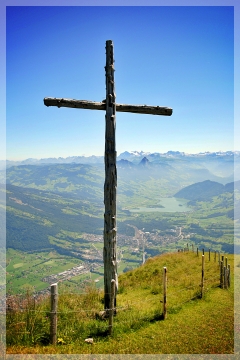
Mt. Rigi crossWhen driving on I-70 near Effingham, Illinois, you can’t miss seeing the 198-feet tall, 180-ton cross erected near the highway. Once America’s largest cross, its builders call it “a beacon of hope” to the over 50,000 travelers who pass by it each day. In 2018, Effingham’s cross was outdone when a 218-feet high cross was erected in Walnut Shade, Missouri. Near Branson and visible from Highway 65, because of its height, the FAA requires beacons on it. These two crosses, however, are small when compared to the world’s largest cross—the 500-feet tall Holy Cross from the Valley of the Fallen (Valle de los Caídos) in Spain or the 300-feet high Shrine of Valor in the Philippines.

Crucifixion was an extremely cruel form of execution that forced the condemned to suffer a prolonged agonizing death; it was such a horrible way to die that the Romans rarely used it on their own citizens. The disgrace and shame of crucifixion was used primarily for slaves and the worst kind of criminals and yet God allowed His only Son to endure the unbearable agony and horror of dying that way! Jesus’ torture began even before the cross when He was beaten with a flagrum (a short whip with pieces of bone and metal woven into its thongs), taunted by soldiers, had a crown of thorns driven into his head, beaten again and then dragged to his feet and made to carry the cross to the Golgotha. So battered, bloodied, and broken that He was unable to do so, Simon of Cyrene was called into duty. Once there, our Lord was stripped of his clothes and nailed to the cross. Before long, Jesus would have been unable to support himself with his legs. As his body’s weight was transferred to his arms, his shoulders would have been pulled from their sockets and breathing would have become extremely difficult. Without a doubt, it was a horrific and brutal way to die.

You’d never expect to see an electric chair, guillotine, or gallows erected as a monument and I question why we identify ourselves with something as grotesque as this ancient instrument of torture. Nevertheless, we wear crosses around our necks, place them on our walls, hang them in churches, set them on steeples, etch them into headstones, put them up as roadside memorials, and erect giant crosses that can been seen for miles. How did a symbol of disgrace, defeat, and suffering become a beacon of hope, triumph, and salvation?

I suppose the facetious answer to “Why the cross?” is that it’s too difficult to depict the empty tomb, a symbol which certainly would better represent the resurrected Christ! Yet, when we focus only on the resurrection and empty tomb, it’s easy to forget the suffering that preceded it. The cross of Jesus Christ is as essential to our faith as the empty tomb. Throughout his ministry, Jesus knew exactly what He was doing and the pain He would endure but it never deterred Him from His mission. He willingly suffered for all of us and it was His suffering and death on the cross that frees us from the penalty of sin. The cross represents the pardon for which a condemned criminal awaits, the forgiveness that none of us deserve, and the sacrifice of a perfect man for an imperfect people.

Until the 4th century, Christianity was illegal. Because of its close association with Jesus, Christ’s followers were scared to use the cross as a symbol because it exposed them to contempt, danger, and persecution. Oddly, it was Emperor Constantine’s vision of a cross in the sky that led to his conversion to Christianity in 312 AD. After seeing it, he vowed to worship no other god than the one the vision represented and he sought out church leaders to explain its meaning. The bishops explained that Jesus was the Son of God and the cross in Constantine’s vision symbolized Christ’s victory over death. In 313, Christianity was legalized and crucifixion was abolished. After that, rather than being a symbol of unspeakable horror, the cross became a symbol of victory.

I usually wear a small cross; when I place it around my neck, it reminds me that God sacrificed His only son for me and of the enormous price Jesus paid for my salvation. My life was purchased at a great cost to Him and the cross reminds me to whom it is I belong. It’s a daily reminder take up my cross and follow Him.

Then Jesus said to his disciples, “If any of you wants to be my follower, you must give up your own way, take up your cross, and follow me. If you try to hang on to your life, you will lose it. But if you give up your life for my sake, you will save it. [Matthew 16:24-25 (NLT)]

Copyright ©2021 jsjdevotions. All rights reserved.

YOUR KINGDOM COME

This, then, is how you should pray: “Our Father in heaven, hallowed be your name, your kingdom come, your will be done, on earth as it is in heaven.” [Matthew 6:9-10 (NIV)]

Remember that the same Christ who tells us to say, “Give us this day our daily bread,” had first given us this petition, “Hallowed be Thy name; Thy kingdom come; Thy will be done in earth as it is in heaven.” Let not your prayers be all concerning your own sins, your own wants, your own imperfections, your own trials, but let them climb the starry ladder, and get up to Christ Himself, and then, as you draw nigh to the blood-sprinkled mercy-seat, offer this prayer continually, “Lord, extend the kingdom of Thy dear Son.” [Charles Spurgeon]

sunflowerIt wasn’t until I read Charles Spurgeon’s paraphrase of “Your kingdom come,” as “Lord, extend the kingdom of Thy dear Son,” that I truly gave serious thought to what it means to pray, “Your (or “Thy”) kingdom come.” Although we say it every time we say the Lord’s Prayer, what exactly do those three words mean? After all, that was God Himself giving His disciples a guideline to prayer and there certainly couldn’t be a better teacher! Since there are over seventy references to the Kingdom of God in the New Testament and this petition immediately follows praising God’s name in Jesus’ prayer, the coming of God’s Kingdom clearly was important to Him.

Jesus’ life, death, and resurrection opened the doors to God’s Kingdom. Yet, it is only when Jesus comes again at the end of the age that God’s Kingdom will reign with power and authority. While this petition is for the fulfillment of the Kingdom with Christ’s return, it is much more than that. As we pray for the coming of Jesus in the future, these three words also are a petition for the expansion of God’s Kingdom in the present. They are a prayer that the gospel message will be preached to and accepted by all so that the whole world will be made Christ’s Kingdom and filled with His glory. We’re asking God to reveal Himself in such a way that His kingdom is visible here on earth and that He will open the hearts of those we encounter and to whom we witness.

Praying that God’s Kingdom will come is also an acknowledgement that He is our sovereign king and the ruler of our lives. Even though the Kingdom will not be complete until the second coming of Christ, we can experience it today. This leads into  the next petition of “Your will be done,” in which we ask Him to enable us to do what is pleasing to Him. May we be genuine, faithful, obedient, and capable servants of His Kingdom!

Although my lips frequently speak the words, ”Your Kingdom come,” until considering Spurgeon’s words, I barely understood their magnitude. In my personal prayers, I have neglected praying for the coming of God’s Kingdom—the day when Jesus will return and all things will be restored. Although I remember to pray for pastors, missions, and missionaries, the expansion of God’s Kingdom here and now and the role I should play in that expansion has never been on the top of my prayer list either.

If the coming of His Kingdom is God’s priority, perhaps it should be ours as well. Moreover, we should prove the truth of our prayers by putting our words into Kingdom-promoting action. Let us be like the Apostle Paul who, “proclaimed the kingdom of God and taught about the Lord Jesus Christ—with all boldness and without hindrance!” [Acts 28:31]

We therefore pray that God would exert his power, both by the Word and by the Spirit, that the whole world may willingly submit to him. [John Calvin]

Once, on being asked by the Pharisees when the kingdom of God would come, Jesus replied, “The coming of the kingdom of God is not something that can be observed,  nor will people say, ‘Here it is,’ or ‘There it is,’ because the kingdom of God is in your midst.” [Luke 17:20-21 (NIV)]

Copyright ©2021 jsjdevotions. All rights reserved.

NOTHING PERSONAL

I tell you, love your enemies. Help and give without expecting a return. You’ll never—I promise—regret it. Live out this God-created identity the way our Father lives toward us, generously and graciously, even when we’re at our worst. Our Father is kind; you be kind. [Luke 6:35-36 (MSG)]

great egret - breeding lores“There is nothing personal going on here,” were the words that helped author Jane Smiley get through her acrimonious divorce. Although no divorce is pretty, the circumstances surrounding hers were especially ugly. Realizing that her husband was acting out his own drama helped her to better understand and deal with his dreadful behavior and hurtful actions. Smiley explained, “This is a wiser way of understanding the people around you … how they have their own passions, motivations, and histories, that sometimes (always) grip them in ways, that even they do not grasp—ways you don’t have to respond to automatically.” Her words impressed me so much that I wrote them down after reading them several years ago. The author wrote that remembering the phrase, “There’s nothing personal going on here,” has helped her deal with other difficult people and situations in her life. I find them useful, as well.

When Pulitzer Prize winning author Jane Smiley writes fiction, she is the creator of each character. As such, she knows their back story, needs, fears, and issues. She invents the baggage they’re carrying and understands the reasons for their behavior. In real life, however, people have their own private history. Although people’s past hurts or present problems are never an excuse for thoughtless words or bad conduct, they do affect them. Carrying hidden scars, people have passions, fears, insecurities, prejudices, and forces that control them in ways that even they may not understand. We don’t know much about other people’s pasts (or their present circumstances) nor do they know ours. Realizing this makes it easier to step back and not take their hurtful words and actions so personally.

In this day and age of insults, boorishness, and unpleasantry, we have plenty of opportunities to take offense. More often than not, we’ve done nothing deliberately to deserve whatever nastiness has been dished out to us; nevertheless, let us remember than taking offense is a choice. We are accountable to God only for what we do, not for what is said and done to us.

It is hurting people who hurt people; remembering that hurtful behavior is more the result of other people’s issues than our behavior keeps us from retaliating. It certainly makes forgiveness much easier. Rather than taking it personally, let us pray for those who upset, offend, fail, or hurt us. Bearing in mind that everyone has a history and their own unique story known only by God, we can say, “There is nothing personal going on here,” and get on with our lives.

What can you ever really know of other people’s souls – of their temptations, their opportunities, their struggles? One soul in the whole creation you do know: and it is the only one whose fate is placed in your hands. [C.S. Lewis]

Don’t pick on people, jump on their failures, criticize their faults—unless, of course, you want the same treatment. Don’t condemn those who are down; that hardness can boomerang. Be easy on people; you’ll find life a lot easier. Give away your life; you’ll find life given back, but not merely given back—given back with bonus and blessing. Giving, not getting, is the way. Generosity begets generosity. [Luke 6:37-38 (MSG)]

Copyright ©2021 jsjdevotions. All rights reserved.

FELIX

Sending for Paul, they listened as he told them about faith in Christ Jesus. As he reasoned with them about righteousness and self-control and the coming day of judgment, Felix became frightened. “Go away for now,” he replied. “When it is more convenient, I’ll call for you again.” [Acts 24:24b-25 (NLT)]

flame vineFelix was the governor of Judea from 52 to 58/59 AD. A Greek who became a freedman under the reign of Emperor Claudius, he’s described as a cruel, immoral, and corrupt governor by ancient historians Josephus and Tacitus. Tacitus called him “a master of cruelty and lust who exercised the powers of a king in the spirit of a slave.” As Judea’s governor (or Procurator), his job included procuring funds for Rome which Felix accomplished mercilessly while lining his pockets as well. That it took 470 soldiers to safely escort the Apostle Paul from Jerusalem to Caesarea indicates the lawlessness of his time.
In Acts 24, we meet Felix as he conducts an inquiry into the Jews’ charges against Paul. After hearing the accusations of the Roman advocate Tertullus, Paul launched a strong defense against the false allegations. Perhaps uncomfortable with Paul’s reference to the righteous and unrighteous, Felix adjourned the case until the arrival of Lysias, the garrison commander who saved Paul’s life in Jerusalem.

A few days later, Paul again appeared before Felix. Joining the governor was Drusilla, his third wife and the granddaughter of Herod the Great. She’d left her husband, King Aziz of Emesa, for Felix and, like her uncle Herod Antipas (the one who beheaded John the Baptist), her marriage was illegal since she was neither divorced nor widowed. I imagine the shameless couple didn’t take kindly to the Apostle’s words as he spoke of righteousness, self-control, and the coming day of judgment. Frightened by Paul’s message, Felix sent him away, saying he’d call for him again when it was more convenient.

Although the governor frequently called for Paul to talk with him over the next two years, Felix never decided Paul’s guilt or innocence. Scripture tells us the corrupt man was looking for a bribe, but surely it didn’t take Felix two years to realize a payoff was not forthcoming. I suspect the governor was drawn to Paul’s message but, unwilling to repent, he couldn’t commit to the Way. The corrupt and powerful man was caught between two incompatible worlds—if he chose Christ, he would end up relinquishing his position, influence, ill-gotten wealth, and even his wife. Unwilling to do so, Felix thought himself a freedman, when, in fact, he was in bondage to his sinful way of life. Eventually recalled to Rome, Felix never decided about Paul or Jesus simply because it was inconvenient. Let us not make the same mistake!

The two sworn enemies of the soul are “Yesterday” and “Tomorrow.” Yesterday slays its thousands. Past sins plunge many into darkness and despair. … Tomorrow slays its tens of thousands. Vows, promises, resolutions are never fulfilled. “Some other time,” many say, when urged to repent and believe. They fail to realize that now is the acceptable time. [Herbert Lockyer]

Don’t you realize that you become the slave of whatever you choose to obey? You can be a slave to sin, which leads to death, or you can choose to obey God, which leads to righteous living. Thank God! Once you were slaves of sin, but now you wholeheartedly obey this teaching we have given you. Now you are free from your slavery to sin, and you have become slaves to righteous living. [Romans 6:16-18 (NLT)]

Copyright ©2021 jsjdevotions. All rights reserved.

BUYING A FIELD

See how the siege ramps have been built against the city walls! Through war, famine, and disease, the city will be handed over to the Babylonians, who will conquer it. Everything has happened just as you said.  And yet O Sovereign LORD, you have told me to buy the field—paying good money for it before these witnesses—even though the city will soon be handed over to the Babylonians. Then this message came to Jeremiah from the Lord: “I am the Lord, the God of all the peoples of the world. Is anything too hard for me? [Jeremiah 32:24-27 (NLT)]

grand tetons - jackson holeUnder siege for nearly a year, Jerusalem was surrounded by the Babylonians, and Judah’s future looked grim. Whether it was poverty or the desire to get rid of property that soon would be worthless once Babylon invaded, Hanamel decided to sell his land in Anathoth, about three miles from Jerusalem. Under Israelite law, property was supposed to stay within a family and so Hanamel offered it to his cousin, the prophet Jeremiah.

Since Anathoth already was under Babylonian control, Hanamel’s real estate deal would be like being offered property in Kabul, Afghanistan. While real estate often is considered a good investment, purchasing property in an active war zone or occupied territory is not. Nevertheless, even though Jeremiah was imprisoned in the palace courtyard and the nation’s defeat was inevitable, God instructed him to become the property’s redeemer by purchasing his cousin’s land.

Having prophesied the fall of Judah, the destruction of Jerusalem, Zedekiah’s imprisonment, and the Jews’ captivity, Jeremiah knew how worthless the land was. Although he lawfully could refuse to purchase it, the prophet paid his cousin 17 shekels (about 18-months’ wages) for the land which, considering the circumstances, seems a sizeable sum for land he’d never live to enjoy. Assuring his scribe Baruch that the worthless land again would have value, he told him to take the deeds, place them in a clay jar (the ancient version of a safety deposit box), and preserve them in a safe place, The prophet then passed along God’s hopeful words to all those who witnessed the transaction in the courtyard: “Someday people will again own property here in this land and will buy and sell houses and vineyards and fields.”

Along with his prophecies of Jerusalem’s ruin, Judah’s defeat, and the people’s captivity, Jeremiah had prophesied God’s eventual restoration of the people to their land. He didn’t buy the land because Judah wouldn’t be conquered; he purchased it because it would! The prophet was putting his money where his mouth was. His purchase of a worthless piece of acreage was an act of faith. It was a sign of hope for the future by the man who’d prophesied doom and gloom—a powerful demonstration of his belief in God’s promise that the land would again have value and belong to the Jews.

If we want to see the fulfillment of God’s promises to us, like Jeremiah, we must be obedient to God’s commands, no matter how difficult, confusing, or absurd they seem to be. In the face of obstacles, hardship, or overwhelming odds, we must demonstrate our faith and hope in God because faith and obedience go hand in hand. If we say we believe His promises, we must act as if we truly do! May we always remember that nothing is too hard for the Lord!

I will certainly bring my people back again from all the countries where I will scatter them in my fury. I will bring them back to this very city and let them live in peace and safety. They will be my people, and I will be their God. And I will give them one heart and one purpose: to worship me forever, for their own good and for the good of all their descendants. And I will make an everlasting covenant with them: I will never stop doing good for them. I will put a desire in their hearts to worship me, and they will never leave me. I will find joy doing good for them and will faithfully and wholeheartedly replant them in this land. [Jeremiah 32:37-41 (NLT)]

Copyright ©2021 jsjdevotions. All rights reserved.

THE APOLOGY

He is so rich in kindness and grace that he purchased our freedom with the blood of his Son and forgave our sins. He has showered his kindness on us, along with all wisdom and understanding. [Ephesians 1:7 (NLT)]

Well then, should we keep on sinning so that God can show us more and more of his wonderful grace? Of course not! Since we have died to sin, how can we continue to live in it? [Romans 6:1-2 (NLT)]

golden mantled ground squirrelI’m not sure if Hammie MacPherson, the mischievous little boy mentioned in yesterday’s devotion, ever made his annoying noise again but, in another “Baby Blues” comic by Kirkman and Scott, he tells his mother, “I’m sorry and I promise it will never happen again.” When she asks what he’s done, he says he doesn’t yet know. “It’s still early,” he adds, “so I thought I’d get the apology out of the way first.”

Contemplating the day’s mischief, Hammie apologized in advance. I’m not so sure our forgiving God welcomes that approach to forgiveness. After all, an apology is merely an excuse. The word “apology” comes from the Greek apologia, meaning a speech in one’s defense. The original English sense of the word “apology” was self-justification. Most definitely, either in advance or after the fact, God is not interested in any defense of our indefensible actions.

Granted, Christ died for all of our sins—past, present, and future—but I’m pretty sure God’s promise of forgiveness doesn’t give us free rein to do as we please. Although Christ’s sacrifice paid our debt, we haven’t been given carte blanche to deliberately live sinfully. God’s forgiveness involves repentance on our part and genuine repentance includes not just a confession of wrongdoing but also a willingness to make things right and to do better in the future. Confessing our unnamed sins in advance of their commission indicates neither remorse nor repentance.

When the comic strip’s Hammie does something naughty, as he surely will, his loving mother will forgive him. His disobedience, however, will disappoint her, incur her anger, and cause him to be disciplined (the “or else” in yesterday’s message). When we accepted Christ, we may have been declared righteous but we still have a long way to go before we act righteously. Like the little boy, we continue to go astray. Fortunately, our salvation is secure in Christ and our sins have been forgiven in advance. Nevertheless, we must remember that they truly grieve God. With our sins, we risk both God’s divine displeasure and discipline. I doubt that apologizing in advance for willful disobedience will be successful in the MacPherson house; I know it won’t work in God’s!

If we claim we have no sin, we are only fooling ourselves and not living in the truth. But if we confess our sins to him, he is faithful and just to forgive us our sins and to cleanse us from all wickedness. [1 John 1:8-9 (NLT)]

Copyright ©2021 jsjdevotions. All rights reserved.