
Woe betide you, scribes and Pharisees, you hypocrites! You’re like whitewashed graves, which look very fine on the outside, but inside they are full of the bones of the dead and uncleanness of every kind. That’s like you: on the outside you appear to be virtuous and law-abiding, but inside you are full of hypocrisy and lawlessness. [Matthew 23:27-28 (NTE)]
 Along with proclaiming the Word of God, the young Church was committed to ensuring that there were no needy among them. As a result, many of the early believers voluntarily sold their property and shared their wealth with the rest of the church community. Barnabas, for example, sold a field he owned and generously brought the money to the apostles for those in need.
Immediately following the mention of Barnabas in Acts, Luke tells us about Ananias and Sapphira. Like Barnabas, they sold some land and brought the proceeds to the apostles but, unlike him, the couple retained some of the funds. But, wanting to impress everyone with their generosity without actually making a sacrifice, they claimed to have contributed the full amount. Peter, however, knew better and confronted each one about their deceit and they were struck dead in divine judgment.
This is a troubling story when we mistakenly think of it in terms of how much of our money we should give to the church. It’s important to remember that Ananias and Sapphira’s sin wasn’t in keeping some of the money; it was theirs to do with as they wished. The sharing among believers wasn’t compulsory and didn’t originate in the law. It originated in love and was completely voluntary. Rather than the sin of greed, the couple’s sin was that of hypocrisy; they wanted to impress the church into thinking they were something they clearly were not. They lied to the church but, worse, they lied to the Holy Spirit! Luke tells us that “great fear” struck the entire church when the learned what happened to Ananias and Sapphira. It should strike fear in us as well! The message, however, isn’t about money; it’s that God will not tolerate deception in spiritual and personal matters.
None of us manage to fully live up to our ideals and values; we’re flawed human beings who miss the mark in a variety of ways. That we fail to be the person we should be does not make us hypocrites; it’s failing to be the person we claim to be that is hypocrisy! Putting reputation before character, the hypocrite creates a public impression at odds with his or her true self.
The book of Acts relates how the early church was threatened by the world in which they lived: persecution, arrests, imprisonment, and even death. But it also relates how the church faced threats within its own community when the sins of a few (like Ananias and Sapphira) threatened the testimony of the church. Both threats continue today. I can’t help but wonder—if God dealt as severely with deceivers and hypocrites today as He did with Ananias and Sapphira, how many people would be left to fill our pews on Sunday morning?
The hypocrite, certainly, is a secret atheist; for if he did believe there was a God, he durst not be so bold as to deceive Him to His face. [Thomas Adams]
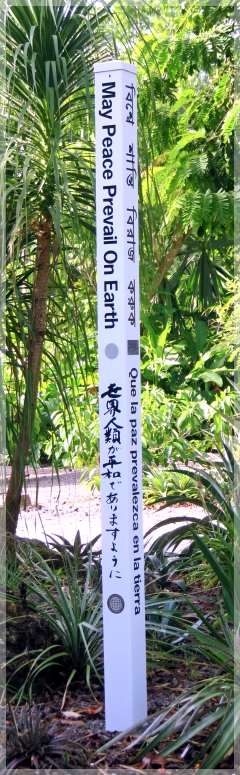 COVID kept us from the Botanic Gardens for well over a year. When we finally returned to one of our favorite places, we came upon a peace pole planted among the palms, bamboo and bromeliads. Although a similar pole is in the city park downtown, I don’t remember seeing one here when last we visited. These poles are just two of the more than 250,000 that have been erected in over 180 nations. Symbolizing the oneness of humanity, the words “May Peace Prevail on Earth” are written in eight different languages. The languages chosen for this pole were English, Arabic, Bengali, Chinese, Hawaiian, Hindi, Japanese, and Spanish—the languages of people who, like us, live at the 26th parallel north. Peace poles stand as a visual reminder to pray for peace on earth and to think, speak and act in the spirit of harmony and peace.
 A popular mystery writer, frequently on the best seller list, now writes most of his books in collaboration with another author. Several years ago, after reading one of his joint efforts, I stopped reading his work entirely. While I never expected a literary masterpiece, the mystery was unrealistic, implausible, and the chapters unconnected. Although it’s said that he sets the plot line and there is an intense back-and-forth between the authors, it didn’t seem that way to me. It was as if the two authors alternated chapters and, at the end of their chapter, each deliberately threw in some farfetched character or event as a way of challenging the other to make sense of it. Having a plot outline certainly didn’t mean continuity or structure in their book.
 While we usually reap what we sow, we also can receive unexpected and undeserved harvests! When we lived in the north, courtesy of God and nature, wildflower seeds took root in the field next to our house and Spiderwort, Sunflowers, Dame’s Rocket, and Wild Bergamot grew there without any effort on my part. Although I hadn’t sowed them, I never protested those beautiful wildflowers; I just thanked God for them. None of us are likely to complain to God about the many undeserved blessings He regularly bestows on us!
 While we often reap what we’ve sown, farmers don’t plant on one day and expect to harvest the next and neither should we. No matter how good the soil, it usually takes about two weeks for a corn shoot to appear and two to three months before it’s ready for harvest. Spiritual farming is even less predictable than growing corn and we shouldn’t expect immediate results after sowing seeds of God’s love and Word. Rarely does an apology yield instant reconciliation, words of correction yield an immediate change, or our first witness produce an instantaneous conversion. It often takes considerable plowing and sowing to soften a hardened heart.
 Devotions of the Heart