
God brought him forth out of Egypt; he hath as it were the strength of an unicorn: he shall eat up the nations his enemies, and shall break their bones, and pierce them through with his arrows. [Numbers 24:8 (KJV)]
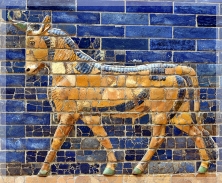 Some believers insist that unicorns actually existed because they are mentioned nine times in the Old Testament. Claiming the Bible is completely without error, they insist that you must believe the same thing—including the unicorns! On the other hand, some people disparage believers and discount all of Scripture because of those same unicorns! Do we blindly believe or do we “throw out the baby with the bathwater” because of one word?
While the Bible is infallible, that’s not always true of translators. The Hebrew word used for this wild animal was re’em and seemed to mean a beast with a horn (but not necessarily only one horn). It’s found in Numbers 23:22, 24:8; Deuteronomy 33:17; Job 39:9,10; Psalm 22:21, 29:6, 92:10; and Isaiah 34:7. When looking at the context, re’em always refers to someone or something with great power. In Numbers, we find God comparing His strength to that of the re’em and, in Psalm 22:21, David refers to his formidable enemies as re’em.
By the third century BC, the language and culture of Greece had spread throughout the world and the Jewish knowledge of Hebrew was declining. The Jewish community in Egypt (along with the Hellenic Egyptian ruler Ptolemy II) initiated the translation of the Torah into Greek. During the next two centuries, the entirety of the Hebrew Scriptures were translated into Greek in what is called the Septuagint. At that time, the Hebrew re’em (wild beast with a horn) was inaccurately translated into the Greek monokeros (one horn). When citing the Hebrew Scriptures, the epistle writers quoted from the Septuagint and, since Gentile Christians knew nothing of Hebrew, the Greek Septuagint became the Bible of the early church.
Fast forward to the fourth century when Latin began replacing Greek as the language of the people. In 382 AD, Pope Damasus I commissioned his secretary, Jerome, to produce a new Scripture translation in Latin. Written in the Latin of the day, St. Jerome’s translation is known as the Vulgate. It is from this translation that we get English words like scripture, salvation, justification, and regeneration. In Jerome’s translation, the Greek monokeros became the Latin unicornis (a one-horned beast).
Fast forward again to the 16th century and the first English translations of Scripture—William Tyndale’s and the Geneva Bibles followed by the King James version in 1611. Although unicornis was rendered as unicorn in these Bibles, it’s unlikely the translators believed it to be the mythological unicorn. Not knowing what it was, they simply transliterated the Latin word into the English “unicorn.” Closely associated with chivalry, by the 1600s the unicorn was a symbol of purity and grace that could be captured only by a virgin. The horse-with-a-horn of myths and fairy tales doesn’t sound much like the untamable, ferocious, and powerful wild re’em of the Old Testament!
Nowadays, only a few Bible translations continue to use unicorn. I found only six (out of 62) and all of those are based on the Wycliff, Geneva, or King James translations. While most other versions translate re’em, monokeros, or unicornis as wild ox, a few use wild bull, rhinoceros, or buffalo. Since no one knows absolutely for sure, Young’s Literal translation returns to the original with reem! The Orthodox Jewish Bible uses wild bull, wild ox, and “re’eim (wild ox).”
So, what was the re’em? While it could refer to rhinoceros, buffalo, or antelope, it probably refers to aurochs, large cattle which once roamed Europe, Africa, and Asia. Ancient Assyrian and other Middle Eastern texts refer to this this wild ox-like animal with a similar word. Because ancient art usually depicted the auroch from a profile view (as does the ancient mosaic pictured), it appeared to have just one horn. Ancestors of domestic cattle, aurochs stood over six-feet tall and weighed over 2,200 pounds. Julius Caesar described them as “a little below the elephant in size,” having the shape and appearance of a horned bull, possessing “extraordinary” strength and speed, and being untamable, even when taken as calves. The auroch became extinct in Poland in 1627.
While we now have an answer to skeptics who mock us for believing in a book attesting to the existence of unicorns (when it doesn’t), we must be cautious in our response. Although Scripture doesn’t speak of a unicorn, that doesn’t mean some creature with just one horn never existed. After all, God created the one-horned narwal and rhinoceros, so who are we to say He never created something like the mythical unicorn? Although we’ve never seen them, we know animals like the wooly mammoth, dodo, saber-toothed tiger, and auroch existed. Having already seen strange creatures like jelly fish, giant anteaters, and the wildebeest, I know better than to deny God’s ability to create any creature He desires. What we can know for sure, however, is that the Bible can be trusted!
There’s no better book with which to defend the Bible than the Bible itself. [D.L. Moody]
 Described as a “preaching genius…like no other preacher you have ever heard,” the late Rev. Fred Craddock was well-known for including stories in his sermons. He told one that took place during the early 60s in a diner in the deep South. Although the white Craddock sat in a booth and was served with courtesy and consideration, he silently watched the diner’s manager treat a Black man at the counter with rudeness, disdain, and open contempt. Although offended by the man’s racist behavior, Craddock remained silent. It was when he walked out of the diner after finishing his meal that the preacher heard a rooster crow. A signal of his betrayal, the crowing told the preacher that, by ignoring one of the “least of these”, he’d ignored Jesus! His silence was as much a betrayal of the Lord as were Peter’s denials!
 When I learned about people like Abraham, David, Moses, and Samson as a girl, they were the Bible’s version of super-heroes like Batman or Superman. The Bible’s heroes were larger than life, obedient, invincible, and seemed to overcome their obstacles effortlessly. Appearing perfect in their faith and actions, they weren’t people to whom I could relate. In reality, they were as flawed as the rest of us but, for the most part, their imperfections and failures were redacted from the stories we learned in Sunday school.
 Having quoted from Isaiah when proclaiming the Messiah’s arrival, we know John knew Isaiah’s prophecies. The Messiah would “bind up the brokenhearted [and] proclaim liberty to captives and freedom to prisoners,” [61:1] but, after spending more than a year confined to a dark cell, John had neither liberty nor freedom. It’s no wonder he doubted.
 While we now know what is meant by an iota and dot, jot and tittle, or yod and kots, we wonder what Jesus means by “the least of these commandments!” If the smallest letter is as important as the largest and the smallest flourish on the smallest letter in Scripture was not to be eliminated, how can there be a “lesser” commandment? The confusion again comes from reading an English translation of a Greek rendering of the original Hebrew. Jesus probably was using a popular Jewish idiom “mitsvot kalot” meaning “light” commandments, rather than “mitsvot ketanot,” meaning less important or small commandments. While this seems a bit like splitting hairs, it reflects Jewish thinking in Jesus’ day when a distinction was made between “light” and “weighty” commandments when comparing one to another.
 What is a jot or a tittle? Found in the King James version, the words “jot” and “tittle” date from the 15th and 16th centuries. “Jot” comes from jota, an alternate spelling of the Greek iota (the smallest letter in the Greek alphabet) and, at the time, meant something very small. “Tittle” was a translation of keraia, a Greek word meaning “a little horn” that referred to an accent mark over a vowel. While those English words were good translations of the New Testament’s Greek, Jesus wasn’t speaking Greek when He gave the Sermon on the Mount. He was speaking Hebrew or Aramaic and the words He used weren’t iota and keraia. He would have used yod, which was the smallest Hebrew letter, and kots, meaning thorn, which was the little curve or flourish at the yod’s top distinguishing it from other letters. The tenth letter of the Hebrew alphabet, yod sounds like a “y” and looks a bit like an apostrophe.
