
For even the Son of Man came not to be served but to serve others and to give his life as a ransom for many. [Matthew 20:28 (NLT)]
 During Lent, I journeyed toward Jesus’ death and resurrection with a Lenten devotional. For each of the season’s forty days, there was a Scripture reading from John, a short devotional, an inspiring quote, interesting facts about Lent’s history, and a unique fast for the day. Each day’s reading also provided journaling space for the reader. For the fortieth day’s journal entry, readers were asked to write a brief letter of thanks to Jesus for all He endured to lead them into eternal life.
More than a week after Good Friday, however, the journal page was blank. Using Christianese words like expiation, redemption, propitiation, and reconciliation, along with born again, forgiveness, salvation, and everlasting life, I easily could have filled that page with a list of what His sacrifice provided. But my mother, who insisted I write a personal note of thanks before enjoying any gift, wouldn’t have approved of such a cursory, let alone tardy, “thank you” note! Jesus certainly deserved better!
Since then, I have pondered all He did for me—not for the world—but for me personally. He provided joy, peace, purpose, and meaning to my life but He did so much more! Jesus loved me! He loved me enough to fast for me—and not just for those forty days in the wilderness. He loved me enough to fast from being God for more than thirty years. Humbling and emptying Himself, the second member of the Trinity traded His Godness for mortal flesh. The One who was there before the world began fasted from the worship of angels, omnipotence, omnipresence, omniscience, sovereignty, and self-existence. He fasted from being God to suffer pain, hunger, thirst, betrayal, discomfort, insults, accusations, humiliation, and the excruciating death of a criminal. That was done for me! Thank you, Jesus!
Because He gave me the gift of His Holy Spirit, Jesus remains with me and continues to lead, guide, guard, comfort, and provide for me. His Spirit helps me understand Scripture, hear His voice, and feel His presence. He guides my prayers—and when I have no words, He prays for me! He gave me a spiritual gift and enables me to bear spiritual fruit. Although He convicts me of my sin, rather than shame me, Jesus forgives me. Thank you, Jesus!
Jesus has been my good shepherd. When I strayed, He found me and brought me home. When I was hurt, he comforted me and dressed my wounds. When danger threatened, He protected me; when I was running on empty, He filled me; and, when I ran myself ragged, He brought me to a place of rest. Because He put people in my life who acted as His hands and voice, I received help, guidance, counseling, encouragement, love, and “sharpening” from His earthly angels. Thank you, Jesus!
As my shepherd, Jesus has been at my side in my darkest moments (as well as my best). He loved me when I was at my worst, when I hated myself, or considered ending my life. When I was angry with Him and turned away, He never abandoned me. He held me when I lost those I loved or was hurt by those who should have protected me. He encouraged me when I was sure I could go no further, lifted me when I fell, and carried me when I couldn’t take another step. He safely brought me through every dark valley into His light. There are times I don’t even like myself, but Jesus loved me enough to die so that I could live! He did that for me! Thank you, Jesus!
Your story is different from mine. Nevertheless, Jesus loves you as much as He loves me! Just as He lived, suffered, died, and rose for me, He lived, suffered, died, and rose for you. What would you write in your letter?
 Every morning, I receive an email from a Christian site to which I subscribe. Having no interest in Temu, make-up, or a “game-changer” pen for seniors, I ignore the ads as nothing more than “click bait.” Today’s ad from a jewelry company, however, caught my eye with its words, “Just in: Angel Numbers.” Having missed all the articles about them in Allure, Reader’s Digest, USA Today, Cosmopolitan, Women’s Day, Instyle, and Vogue, I didn’t know what an “angel number” was, so I Googled it. Apparently, when you see repeated digits (such as 11:11 on your clock, $9.99 on a price tag, 30303 on a license plate, or a date like 2/22/22), the universe is sending you a message! Rather than a coincidence, these repetitive numbers are a “sign from your guardian angel” (or a dead loved one). Supposedly, the “language of angels,” such numbers are meant to point you in a certain direction or confirm the direction in which you’re going! Of course, a host of psychics, spiritual mediums, and numerologists are more than willing to tell you the meaning of your “angel numbers.” And, as I discovered from the ad, once you find your number, you can purchase it in jewelry!
 God gifted Solomon with great wisdom and people from every nation journeyed to Solomon’s court to hear his wisdom. Although 1 Kings 3 tells us that Solomon wisely determined the identity of the real mother in a dispute between two women who claimed to have given birth to the same infant [3:16-28], one wise answer hardly seems newsworthy enough to make him famous beyond Israel’s borders. Even the king’s prolific writings and vast knowledge of botany and zoology don’t fully explain his renown. In a world without mass media, what caused his reputation to travel some 1,400 miles to Sheba (modern Yemen)? Sheba’s queen was so interested in meeting the king that she and her entourage made a journey which, including her stay in Judah and the return trip, took two to three years. What about Solomon caused her to travel so far to assess the king’s wisdom and wealth for herself?
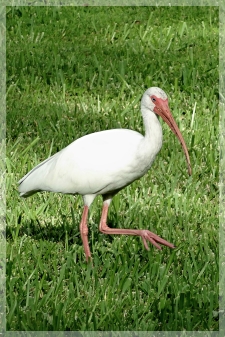 A century of dike-building, agricultural development, and population growth has destroyed much of Florida’s wetlands and threatened the survival of dozens of animals like Florida panthers, Snail Kites, and Wood Storks. The White Ibis, however, is an exception. Having adapted to the new urban landscape, large groups of ibis happily graze the lawns of subdivisions, parks, and golf courses. They’ve found it easier to poke at the soil for a predictable buffet of grubs, earthworms, and insects than to forage in the remaining wetlands for aquatic prey like small fish, frogs, and crayfish. Once wary of humans, these urbanized ibis pay little or no attention to people as they follow one another across our lawns.
 The Israelites had been away from Israel for less than two months when they arrived at Rephidim. With no water to drink, the people complained, questioned whether the Lord was with them, criticized Moses, and then threatened him. Fearing for his life, Moses asked God what to do. Instructing him to strike a rock with his staff, God promised that water would come gushing out and, as promised, it did. The miracle was memorialized by the name given to this location, Massah (meaning testing) and Meribah (meaning quarreling.) Unfortunately, that was not the last time the Israelites tested the Lord and quarreled with Moses.
 Like their parents, my youngest grands like to race and recently did this year’s 5K “Hot Chocolate” run. When Paul referred to running, he wasn’t referring to fun runs like theirs or a marathon like the one their parents ran nor were his boxing and wrestling references to the sports we know today. His allusions were to the Panhellenic games and Olympics which were well known throughout the Roman Empire in his day.
