ANOTHER KIND OF SPARK

We can make a large horse go wherever we want by means of a small bit in its mouth. And a small rudder makes a huge ship turn wherever the pilot chooses to go, even though the winds are strong. In the same way, the tongue is a small thing that makes grand speeches. But a tiny spark can set a great forest on fire. And the tongue is a flame of fire. It is a whole world of wickedness, corrupting the entire body. It can set your whole life on fire, for it is set on fire by hell itself. [James 3:3-6 (NLT)]
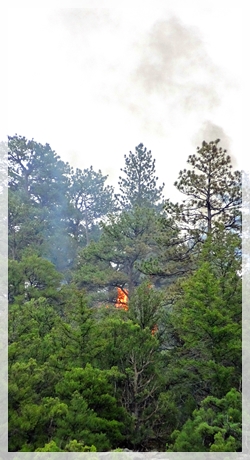
5-16-15DSC09069awebIndeed, the tongue can be a “small thing that makes grand speeches.” Anyone who ever heard Martin Luther King’s “I Have a Dream” speech, John F. Kennedy’s words, “Ask not what your country can do for you…”, or Billy Graham preach knows that tongues can inspire and teach, praise and bless, comfort and pray. Speech, while extremely powerful, can also be incredibly dangerous.

James compares the tongue to a “flame of fire.” Have you even seen television coverage of a forest fire? It’s frightening how one camper’s poorly dowsed fire or a careless hiker’s cigarette can wreak such devastation. Once the fire gets started, it’s nearly impossible to control and its damage can’t be undone. If the wind picks up, the destruction can be enormous. Last year flames came within a few blocks of my son’s house and the barren hillside following the fire was a constant reminder of how close they came to losing their home.

Our words can be as dangerous as a spark in a dry forest. They cannot be taken back once spoken and the damage can be horrendous. Bragging, gossip, exaggeration, flattery, lying, disparagement, and manipulation with our words are all examples of an untamed tongue. Before speaking, we should ask ourselves, “Is it true? Is it kind? Is it necessary?” If in doubt, we should say nothing. Just as a strong wind will fan the fire’s flames, anger can turn a few imprudent words into a raging inferno. Homes and lives can truly be destroyed by the heat of angry words.

Yesterday’s message included Kurt Kaiser’s words “It only takes a spark to get a fire going” in reference to love. It’s important to remember that it only takes a spark from an untamed tongue to get another kind of fire going!

How much more grievous are the consequences of anger than the causes of it. [Marcus Aurelius]

Those who control their tongue will have a long life; opening your mouth can ruin everything. [Proverbs 13:3 (NLT)]

A gentle answer deflects anger, but harsh words make tempers flare. [Proverbs 15:1 (NLT)]

LOCKED DOORS – WHEN HE SAYS “NO”

Who shut the doors to keep the sea in when it broke through and was born, when I made the clouds like a coat for the sea and wrapped it in dark clouds, when I put limits on the sea and put its doors and bars in place, when I said to the sea, “You may come this far, but no farther; this is where your proud waves must stop”? [Job 38:8-11 (NCV)]

7-14-15_5330webWhen the youngest grandchildren visited us in Florida, we were putty in their hands. But, being loving grandparents, we wanted to keep them safe and that meant saying “No!” at times. Among our precautions, the doors to the lanai remained shut and locked to keep the tykes from venturing into the pool without an adult. That’s not to say they didn’t try their level best to thwart our deterrents at every opportunity. They pled with us, made promises they couldn’t keep (“We won’t go near the water”) or resorted to tears. When that didn’t work, they tried to open the doors themselves. We love them too much not to keep them safe and know that certain situations (like toddlers and pools without supervision) require locked doors and firm denials. The little guys, however, simply thought we were being mean keeping them from having their way.

We are God’s children and, like my youngest grands, we often don’t have much common sense when it comes to what we desire. We pray and plead, wheedle and whine for something. When God doesn’t grant our prayers, we often console ourselves by saying that He isn’t denying us; He’s only delaying His affirmative answer. We just need to pray more and try harder to make it happen. Sometimes, however, God’s denials are just that—denials. He may even shut and lock doors to keep us from trying to take matters into our own hands. Just like toddlers, there are times we need doors closed and locks secured for our own protection.

When I look back at some of the things for which I’ve prayed, I can only say “Thank you, God, for blocking my way!” It is only in retrospect, however, that I appreciate God’s denials of my prayers and the ways He deterred me. I clearly had no idea what I was asking for in my prayers, but He did and, in His heavenly wisdom, kept me from making some enormous mistakes simply by obstructing my path. Thank you, God, for loving me enough to say “No!”

After we have made our requests known to Him, our language should be, “Thy will be done.” I would a thousand times rather that Gods’ will should be done than my own. [D. L. Moody]

I say this because I know what I am planning for you,” says the Lord. “I have good plans for you, not plans to hurt you. I will give you hope and a good future. Then you will call my name. You will come to me and pray to me, and I will listen to you. [Jeremiahs 2:11-12 (NCV)]

WEEDS

He [Jesus] answered, “The one who plants the good seeds is the Son of Man. The field is the world. The good seeds are those who belong to the kingdom. The weeds are those who belong to the evil one. The enemy who planted them is the devil.” [Matthew 13: 37-39 (NLT)]

7-1-15thistle (Canadian)-LGenWI572-cropwebI love thistles—when I’m taking their pictures in the woods. I discovered I don’t much care for them when they’re in my garden. But, there they were, along with dandelions, knotweed, clover, sorrel, mint, chives, prickly lettuce and other unidentified weeds in what used to be my rose garden. Months of neglect had taken its toll on our plant beds and only a few pink rose petals were even visible in the tangled mess. At one time, this had been a well-established and properly tended garden, but our more than nine month absence for two years in a row allowed the weeds to prevail.

My husband and I were faced with a dilemma similar to the one God faced with Sodom: in ours, far too many weeds and in His, far too many sinners. Because Abraham pled with God, the righteous Lot and his family were saved from destruction but the rest of the sinful city was destroyed. In the case of our garden, however, the two remaining stunted rose bushes had no one to plead for them and were pulled up along with the weeds. Unlike God, we swept away the innocent with the guilty! After thoroughly removing every plant, we started fresh, only this time with zebra grass that, hopefully, will better survive our neglectful gardening.

As we worked, I thought of Jesus’ parables about the farmers who sowed their seeds. One farmer planted seeds on different kinds of ground. The seeds sown on the quality soil produced a good harvest and represented those who heard and understood God’s word—people of faith. In another parable, Jesus told of a farmer who had planted good seeds in quality soil only to learn that his field had weeds. The weeds, planted by the enemy, were scheduled for future destruction. Looking at my garden, I knew it wasn’t Satan, but rather neglect, that had caused my weeds. It suffered from lack of attention; there had been no cultivating, watering, pruning, fertilizer, or weed pulling.

We can have a firmly established faith but, like our garden, faith can’t be ignored or neglected; it must be nurtured. Without cultivating our faith with church and fellowship, watering it with His word, pruning it with prayer, fertilizing it with service, and vigorous weed pulling with confession and repentance, our faith can’t thrive. The enemy will be able to take over and destroy the garden of our lives. Without consistent care, our faith won’t flourish; it will be weak or die like my roses.

As for me, now that I’m done with the house garden, I plan on doing some serious work in the garden of my faith. I don’t want to give the enemy a foothold and end up being swept away with the wicked or burnt with the weeds. How about you? Do you have any gardening that needs to be done?

The Lord remained with Abraham. Abraham approached him and said, “Will you sweep away both the righteous and the wicked? [Genesis 18:22b-23 (NLT)]

When the ground soaks up the falling rain and bears a good crop for the farmer, it has God’s blessing. But if a field bears thorns and thistles, it is useless. The farmer will soon condemn that field and burn it. [Hebrews 6:7-8 (NLT)]

THE ELEPHANT IN THE ROOM

Don’t fret or worry. Instead of worrying, pray. Let petitions and praises shape your worries into prayers, letting God know your concerns. Before you know it, a sense of God’s wholeness, everything coming together for good, will come and settle you down. It’s wonderful what happens when Christ displaces worry at the center of your life. [Philippians 4:6-7 (MSG)]

5-28-15 elephantNCweb
Our land rover stopped as the bull elephant approached. He paraded around in all of his elephant magnificence and, perhaps thinking we were a cow elephant, he even fully displayed his manhood. Although our cameras were clicking away, apparently that was not the response he desired. After circling us several times, he turned his back to us, raised his tail, and did what elephants do in the grass of the Serengeti! While we held our noses and looked in dismay at the enormous pile in the road, he lumbered away.

Elephants in the Serengeti don’t like to be ignored and neither do elephants in the living rooms of our lives. There’s an elephant sitting in the room whenever an obvious but unpleasant truth is being disregarded or going unaddressed. There have been several elephants in my life that I thought could be ignored. “If I pay no attention to it,” I thought, “maybe, it will just go away.” Problems, however, like elephants, don’t take being ignored lightly. If we disregard them in the living room, they’ll just stomp around the bedroom at night and keep us awake; they may even follow us to work or visit other family members. Ignored elephants will leave a big pile of stink behind them and unheeded problems do the same thing. Paying no attention to a problem doesn’t make it disappear; it just gets bigger, messier and harder to clean up.

We shouldn’t ignore the elephants in our lives; we need to give them to God in prayer and look to His word for guidance. In answer to our prayers, however, God will probably hand us a shovel and tell us to get to work scooping up the mess. It’s often an unpleasant and difficult task, but it can be done. With God’s guidance, I’ve managed to clean up the assorted stinky piles the elephants in my life created. The task, however, would have been far easier if I had just properly acknowledged the problems when they first appeared and given them the attention they originally demanded.

Impossible situations can become possible miracles. [Robert H. Schuller]

“If you’ll hold on to me for dear life,” says God, “I’ll get you out of any trouble. I’ll give you the best of care if you’ll only get to know and trust me. Call me and I’ll answer, be at your side in bad times; I’ll rescue you, then throw you a party. I’ll give you a long life, give you a long drink of salvation!” [Psalm 91:14-16 (MSG)]


GRANDPAS -Father’s Day 2015

If God doesn’t build the house, the builders only build shacks. If God doesn’t guard the city, the night watchman might as well nap. It’s useless to rise early and go to bed late, and work your worried fingers to the bone. Don’t you know he enjoys giving rest to those he loves? [Psalm 127:1-2 (MSG)]

6-22-150402cropOld friends were in town and several couples had gotten together for dinner. The men (now all retired and grandpas) got to talking. Instead of talking about work, which is what they used to do, or sports, which they still do, they started talking about their various grandchildren. I loved hearing them go on about teething, toys, Disney movies and the various cute sayings and fantastic achievements of their beloved grands. In short, they sounded just like my women friends and I did some forty plus years ago when we spoke about our children. These men clearly loved the grandpa gig and they chatted about it with the same enthusiasm they used to save for their golf games and the play-offs.

This group of men is from a generation of fathers that weren’t very “hands-on” in the way of baby and child care when their children were young. Parental roles were more defined then: our husbands were the breadwinners and we women were the homemakers, in charge of the house and children. Don’t get me wrong! None of them were neglectful; they are men of faith and all were attentive and loving fathers. They were, however, extremely busy in furthering their careers and attaining financial security for their families. Good fathers all, they just weren’t as involved in the diapers, doctor’s appointments, feeding, classroom parties, lessons and homework as many of today’s dads are. Their own children had done all of the same things their grandchildren were doing, but this was the first time these olds guys were taking part in it. I’m glad they all have grandchildren so they can now experience some of the joy they missed the first time around. Grandchildren are, indeed, God’s reward for growing older (and for not killing one’s teenagers, but that’s another meditation!)

Everything turned out well for these men’s families; it didn’t for many. These men have been blessed with a second chance; not all will be. We need to make sure none of us get so busy building our houses that we neglect building a home for those in it. Unless God is part of the building and guarding of our home and family, we will have nothing. It’s fine to be ambitious, but not to the extent that our spirit, body or family is neglected. Financial security is meaningless if the home life suffers. What good are accomplishments, honors, wealth or fame if we lose our souls, physical health, or families? If we don’t trust our lives to God, we will be anxious and have no rest. If we trust him, he will surely provide and give us the rest and peace we so desire.

Children are, indeed, a gift from God. And grandchildren are the frosting on His cake!

Imagine life is a game in which you are juggling five balls. The balls are called work, family, health, friends, and integrity. And you’re keeping them all in the air. But one day you finally come to understand that work is a rubber ball. If you drop it, it will bounce back. The other four balls – family, health, friends, integrity – are made of glass. If you drop one of these, it will be irrevocably scuffed, nicked, perhaps even shattered. And once you truly understand the lesson of the five balls, you will have the beginnings of balance in your life. [From “Suzanne’s Diary for Nicholas” by James Patterson]

Don’t you see that children are God’s best gift? the fruit of the womb his generous legacy? Like a warrior’s fistful of arrows are the children of a vigorous youth. Oh, how blessed are you parents, with your quivers full of children! Your enemies don’t stand a chance against you; you’ll sweep them right off your doorstep. [Psalm 127:3-5 (MSG)]

BEEN HERE BUT DIDN’T DO THAT!

The servant grew up before God—a scrawny seedling, a scrubby plant in a parched field. There was nothing attractive about him, nothing to cause us to take a second look. He was looked down on and passed over, a man who suffered, who knew pain firsthand. One look at him and people turned away. We looked down on him, thought he was scum. But the fact is, it was our pains he carried – our disfigurements, all the things wrong with us. [Isaiah 53:2-4a (MSG)]

Writing yesterday’s message reminded me of another common teen complaint: “But you just don’t understand!” My teenagers were positive that I’d never experienced any of the challenges, temptations and angst they were having. I’m sure my grandchildren are equally sure their parents have no idea what their life is like. We may not have had all of the gadgets and technology of today’s teens; we didn’t have Facebook, smart phones, texting, and the Internet. We did, however, struggle with many of the same issues: mean people, SATs, crushes, insecurity, rejection, being grounded, alcohol and parties when the parents were gone.

Sometimes we’re not much different than teenagers when we talk to God. “You just don’t understand!” we protest. But, He really does. Jesus actually experienced life and all of its adversities and struggles during his thirty-three years as a man. Granted, He experienced them in a dramatically different setting and time. The First Century didn’t have the bells and whistles of today, but the temptations and challenges were much the same: sexual immorality, pride, pain, abuse, anger, doubt, desire, envy, deceit, sorrow, injustice. Not everyone liked Him, not everyone listened to Him, and not everyone believed or respected Him. He truly knows what it means to be human; He certainly knows what it is to suffer.

When we talk with God, He truly does understand. He’s been here and he was sorely tempted by Satan; the only difference is that He never sinned.

Now that we know what we have – Jesus, this great High Priest with ready access to God – let’s not let it slip through our fingers. We don’t have a priest who is out of touch with our reality. He’s been through weakness and testing, experienced it all – all but the sin. So let’s walk right up to him and get what he is ready to give. Take the mercy, accept the help. [Hebrews 4:14-16 (MSG)]