
And do not fear those who kill the body but cannot kill the soul. Rather fear him who can destroy both soul and body in hell. Are not two sparrows sold for a penny? And not one of them will fall to the ground apart from your Father. But even the hairs of your head are all numbered. Fear not, therefore; you are of more value than many sparrows. [Matthew 10:28-31 (ESV)]
 As the economy tanks and COVID-19 spreads, we hear economists and politicians speak of making a cost-benefit analysis to determine the cost of a prolonged shutdown of business and industry with millions out of work versus the cost of hundreds of thousands (or millions) of people dying. How do we put a price tag on life, especially if the life is ours or that of someone we know and love?
By reducing the human body into its basic elements, DataGenetics concluded that the grand total of materials in a typical human body is a meager $160. I suppose that means the larger the body, the more valuable it is. FinanceDegreeCenter found that all our body’s organs (hair, blood, bone marrow, heart, liver, kidneys, etc.) could be worth up to $45 million when sold on the black market. That value, however, would depend on our nationality, health, blood type, age, and the purchaser’s urgency of need. According to the New York Times, the Environmental Protection Agency values a life at $9.5 million, which is their benchmark for determining whether to clean up a toxic waste site.
Does our value change with age? Is a baby’s life more worthy of saving than that of a seventy-year-old? During the George W. Bush administration, the lives of people over 70 were valued at 67% that of younger people when calculating the cost-benefit of regulating soot emissions from power plants. Although AARP’s backlash put an end to that model, could appraising all ages equally devalue the lives of young people? Along with considering the deceased’s age, juries in wrongful death law suits consider things like income, quality of life, and earning potential. Their valuations can range from several hundred thousand dollars to several million.
How can any society assess the trade-off between economic well-being and anyone’s life? What is the value of one person? What is an acceptable number of fatalities? Yet, when we look at the dire economic consequences of a total shut-down, we find economists warning that making people poorer (with the resulting loss of food, shelter, essential services, mental health, medical care, opportunities, and sanitation) also has severe health consequences for the entire nation.
I’m neither economist nor politician and I can’t imagine doing a cost-benefit analysis between lives lost and a tanked economy. I’m thankful that the tough choices they are facing are not mine to make. Let us continue to lift in prayer our nation’s leaders and policy makers so that they will be guided by God’s wisdom in making the difficult decisions necessary in the days ahead. Although we hope that medical research and decisive government action will quickly put an end to this crisis, our ultimate hope lies in God.
As for any person’s value—all I know is that, from conception to death, the life of each and every person is cherished by God. He doesn’t value us by size, health, race, nationality, age, works, sex, income, potential, or even religion. Having formed us and breathed His life into us, God values each one of us as if we were His only child. We are so precious to Him that Jesus suffered and died for us—not for our economy but for our salvation! Every life is worthy of the salvation offered by Jesus—even that of a repentant thief who had but a few hours left to live as he hung on a cross beside Jesus.
Because of God’s enormous love for us, let us face today, tomorrow, and all of the days to follow with faith, hope, and love!
What is your only hope in life and death?
That I am not my own, but belong with body and soul, both in life and in death, to my faithful Saviour Jesus Christ. He has fully paid for all my sins with his precious blood, and has set me free from all the power of the devil. He also preserves me in such a way that without the will of my heavenly Father not a hair can fall from my head; indeed, all things must work together for my salvation. Therefore, by his Holy Spirit he also assures me of eternal life and makes me heartily willing and ready from now on to live for him. [Heidelberg Catechism]
 While I learned about international finance and Brexit at a women-only seminar, I also learned something more important by my reaction to two of the attendees. Their plumped up lips, wrinkle free faces, and curvaceous shapes indicated the work of a plastic surgeon and their perfect coifs and make-up caused me to wonder if they’d been professionally done that morning. Dressed from head-to toe in designer wear, it was obvious they shop at stores like Louis Vuitton, Ferragamo, and Fendi rather than Kohl’s, T.J Maxx, or Old Navy. One woman’s long cardigan sported Gucci’s trademark red and green stripes and her purse, belt and shoes all displayed the designer’s gold double G logo. The other woman, with her very blond hair, heavy make-up, lavender rabbit fur vest, matching silk blouse, swanky jewelry, and glittery Lucite heels, looked like she belonged in an episode of The Real Housewives of New Jersey.
  By the end of the phone call, tears were rolling down my cheeks; yet another loved one is seriously ill. Given my age and that of my friends, I shouldn’t be surprised; we are nearing our expiration dates so receiving news of someone’s illness or death is becoming my new normal.
 While summer is hurricane season here in Florida, early spring is “sinkhole season.” For most property owners, a sinkhole is little more than a headache but, for some, it means the loss of their homes and possibly their lives. Seven weeks ago, two families north of here lost their homes and belongings as the earth collapsed beneath them, leaving a chasm at least 40-feet wide and 60-feet long. Back in 2013, a man went to sleep and literally disappeared as he, his bed and then his entire bedroom vanished into the earth; his body was never recovered.
 A man down the street has surrounded his home with security cameras pointed in every direction. I’m told that he’s an unpleasant old coot but I wouldn’t know; in all the years we’ve lived here, I’ve never seen him. He has, however, managed to irk one neighbor enough that she salutes his cameras with her middle finger every time she passes by his house.
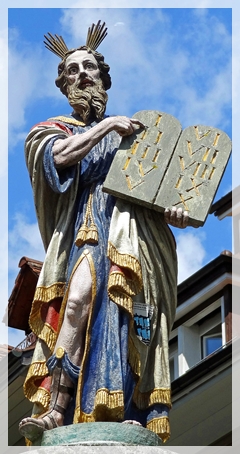 In Scripture, the number forty often appeared in the context of preparation, judgment, or testing. The rain poured down upon Noah for forty days and nights. After spending forty years in Egypt and another forty as a shepherd, Moses twice spent forty days with the Lord on Mt. Sinai. The Israelite scouts spent forty days exploring the land of Canaan and, because the people lost heart and rebelled at their report, they spent an extra forty years wandering the wilderness (one year for each day the men explored). Jonah warned Nineveh their destruction would take place in forty days, Ezekiel lay on his right side for forty days because of Judah’s sins and, before being slain by David, Goliath taunted Saul’s army for forty days.
 Devotions of the Heart