IN ENEMY TERRITORY

Be alert and of sober mind. Your enemy the devil prowls around like a roaring lion looking for someone to devour. Resist him, standing firm in the faith, because you know that the family of believers throughout the world is undergoing the same kind of sufferings. [1 Peter 5:8-9 (NIV)]

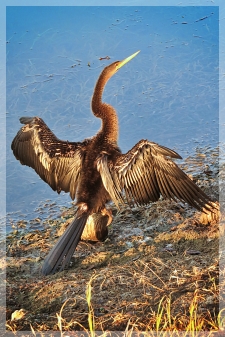
anhingaAnhingas are among my favorites of our lake’s birds. Unlike most birds, their bones are heavy and dense and, rather than waders like the herons and egrets or paddlers like the ducks, they are deep-diving swimmers. Lacking the oil glands that waterproof the feathers of other water birds, anhingas (and their cormorant cousins) become water-logged in the water. While making it difficult to remain afloat, that allows them to dive up to sixty feet deep, swim underwater for several hundred feet, and stay underwater for more than a minute. Eventually, however, the birds become so heavy they will sink unless they return to land to dry their feathers.

Every morning I find anhingas resting along the lake’s shoreline and spreading their wings to dry. The wettest ones get barely out of the water but, as they dry, they waddle further back until dry enough to get up onto a rock, bench, or low hanging branch. As their feathers continue to dry, they move higher up in the trees until they are dry and light enough to take flight.

Unlike the lake’s ducks who nest and sleep in the vegetation along the shoreline, anhingas remain on land only out of necessity. Vulnerable to predators, a soaking wet anhinga is like a “sitting duck.” With its stubby legs and large webbed feet, it can’t run; water-logged, the water isn’t a good option and yet it’s too wet to fly up to safety. While hissing, grunting, and trying to look intimidating by ruffling its feathers, raising its tail, lengthening and waving its long neck, and pointing its spear-like beak may deter some birds of prey, that behavior probably won’t dissuade hungry alligators or crocodiles.

Just as being vulnerable to a predator’s attack is part and parcel of being an anhinga, being vulnerable to our enemy’s attack is an inevitable part of being human in our fallen world. Rather than gators and crocs, that enemy is Satan and he can sneak up on us even more adeptly than the wiliest reptile in the Everglades. Rather than the weight of soaking wet feathers, it is the weight of things like pain, illness, betrayal, weariness, conflict, loneliness, loss, disappointment (and even hurricanes) that make us especially vulnerable to attack. The enemy will use every weapon in his armory including lies, half-truths, fear, despair, hopelessness, and (his favorite) doubt to assault our belief in the goodness of God. Fortunately, in His wisdom, God armed us for battle with more than the saber-sharp beak and intimidating appearance of the anhinga. We wage war with the weapons of our faith: God’s Word and the power of the Holy Spirit.

An anhinga, aware of its vulnerability when wet, only enters the water to hunt or bathe. With neck extended and eyes wide open, it remains watchful when drying along the shoreline and never dawdles there once dry. Like the anhinga, we must be alert to our vulnerability in our fallen world. Unlike the anhinga, however, we often act as if we’re not sitting smack dab in the middle of the enemy’s territory! A. W. Tozer warns us about thinking of the world as a “playground instead of a battleground.” May we never forget that we live in the enemy’s territory and he is as dangerous as a prowling lion or a hungry alligator!

Anyone who serves the Lord is going to be the target of Satan’s attacks. [Zac Poonen]

Finally, be strong in the Lord and in his mighty power. Put on the full armor of God, so that you can take your stand against the devil’s schemes. For our struggle is not against flesh and blood, but against the rulers, against the authorities, against the powers of this dark world and against the spiritual forces of evil in the heavenly realms. [Ephesians 6:10-12 (NIV)]

Copyright ©2022 jsjdevotions. All rights reserved.

HEARING

For twenty-three years…the word of the Lord has come to me, and I have spoken persistently to you, but you have not listened. You have neither listened nor inclined your ears to hear. [Jeremiah 25:3a,4a (ESV)]

green heron

As the language of the Scriptures, Jesus spoke and read Hebrew and, as the language of the Roman Empire, He probably spoke some Greek, as well. His everyday spoken language, however, would have been Aramaic. A Semitic language widespread throughout the Middle East by the 7th century BC, Aramaic was adopted by the Jews during their Babylonian exile. By Jesus’ time, Hebrew (considered the “holy tongue”) was reserved for holy matters such as prayer but Aramaic was used for everyday speech. Jesus may have spoken Hebrew in the Temple but, as the common language of people throughout the Middle East, He spoke Aramaic, the rest of the time.

Even though Jesus spoke Aramaic, the words of the New Testament (probably composed between 50 and 100 AD) were written in Greek, the language of scholarship at the time. Since Jewish scholars had already translated much of what we call the Old Testament from Hebrew and Aramaic into Greek, it made perfect sense for the New Testament’s authors to write in Greek, as well. As a result, when we read the Bible, we are reading English words translated from Greek but originally written or spoken in Hebrew and Aramaic. As happens with even the best translation, sometimes the nuance of a word is lost in translation.

For example, consider the Greek word akouwhich simply means “to hear, to be endowed with the ability to hear, or to hear something” and usually is translated into English as “hear” or “listen.” This meaning is sufficient when Jesus heard the Centurion express his faith, Herod heard the Magi say the Messiah had come, Jesus heard that John was imprisoned, John heard about the deeds of Jesus, and Peter heard the rooster crow. Akouό, however, is not sufficient when both the prophets and Jesus spoke of having ears that hear. The words they used had the root word shema/shama and the words “hear” or “listen” don’t catch its full meaning.

In Greek and English, hearing or listening are mental activities but the Hebrew/Aramaic word shema/shama meant more than that. It was as much a physical activity as an intellectual one. Along with hearing, it meant to take heed, submit, obey, and do what is asked. We may hear the television but we expect our children to shema/shama us when we tell them to do their homework!

As an observant Jew, Jesus would have said what is known as the Shema every morning and evening. It begins with the word shema: “Hear, O Israel! The LORD is our God, the LORD alone. You shall love the LORD your God with all your heart and with all your soul and with all your might…”  The Shema continues on to tell the Israelites the rewards of obedience and the consequences of disobedience. Shema/shama is the word prophets used when warning Israel and Jesus used when explaining His parables and the consequences of not “hearing” His words. While hearing is passive, shema/shama most definitely is not. The people of Israel failed to shema God’s words and warnings. Will we make the same mistake?

Just as the weeds are gathered and burned with fire, so will it be at the end of the age. The Son of Man will send his angels, and they will gather out of his kingdom all causes of sin and all law-breakers, and throw them into the fiery furnace. In that place there will be weeping and gnashing of teeth. Then the righteous will shine like the sun in the kingdom of their Father. He who has ears, let him hear. [Matthew 13:40-43 (ESV)]

Copyright ©2022 jsjdevotions. All rights reserved.

NO EXPERIENCE WASTED

And we know that God causes everything to work together for the good of those who love God and are called according to his purpose for them. [Romans 8:28 (NLT)]

God has a plan for each and every one of us and no experience is ever wasted. All that happened in the past has prepared us for what happens today and what will happen tomorrow. For example, consider Moses; the first two-thirds of his life were merely preparation for what he accomplished during the last third. For forty years, he acquired a unique skill set while living as a member of Pharaoh’s household. Being the adopted son of an Egyptian princess, he received an education befitting a prince and came to understand the protocol and ways of the royal court. Moreover, since he also was cared for by his birth mother, he knew Hebrew and understood the plight of his people. With his Egyptian/Hebrew background, Moses could communicate with both Israelites and their Egyptian oppressors. Quite likely, he was the only person with access to both Israel’s elders and Pharaoh’s court and that royal education certainly served him well when he penned most of the first five books of the Bible.

Moses’ second forty years were spent as a shepherd in Midian. A stranger in a strange land, the pampered prince had four decades to learn how to live as a nomad and shepherd. He also had forty years to learn about controlling his temper (the reason he landed in Midian in the first place). The skills he developed while herding dumb animals in the wilderness prepared him for forty years of guiding over two million “stiff-necked” people and their livestock through the desert.

At eighty, Moses might have been thinking about taking it easy—maybe selling the sheep and relaxing in his hammock under a palm tree. God, however, wasn’t going to let those eighty years of experience go to waste. It was during the last third of his life that Moses fulfilled his God-given purpose by shepherding the Israelites to the Promised Land.

Our life experiences do more than develop character and spiritual maturity; they provide us with distinctive insights, strengths, and capabilities. Every one of our past successes, failures, sorrows, joys, gains, and losses prepared us to do God’s work today and every one of today’s experiences will become tomorrow’s assets. We know how the story of Moses finished but how will our stories end? Like Moses, will we use our assets to further God’s Kingdom or will we squander them while relaxing in the hammock under a palm tree or sitting on the porch in a rocking chair?

No experience is wasted. Everything in life is happening to grow you up, to fill you up, to help you to become more of who you were created to be. [Oprah Winfrey]

So, my dear brothers and sisters, be strong and immovable. Always work enthusiastically for the Lord, for you know that nothing you do for the Lord is ever useless. [1 Corinthians 15:58 (NLT)]

Copyright ©2022 jsjdevotions. All rights reserved.

WHICH CAME FIRST?

Then God said, “Let there be light,” and there was light. … Then the Lord God formed the man from the dust of the ground. He breathed the breath of life into the man’s nostrils, and the man became a living person. [Genesis 1:3. 2:7 (NLT)]

hen and eggs

Years ago, The Jerusalem Post published a joke about human arrogance. After considering all of humanity’s scientific progress, a group of scientists decided that God no longer was necessary. The chief scientist explained to God that man’s ability to clone people, manipulate atoms, build molecules, fly through space, create body parts with 3-D printers, and perform other miraculous feats meant God was unneeded and could be replaced by man. After patiently listening to the scientist, God suggested a human-making contest with only one rule: “We have to do it just like I did in the Bible.” Saying that was easy, the arrogant scientist bent over to pick up a handful of dust. “Put that down!” said God, while adding, “To do it my way, you have to make your own dust!”

Our vacation home in Idaho came complete with chickens and hen house. Every morning, the littlest grands would trek out to the hen house, check for eggs, and return with the makings of an omelet. I was relieved they never asked the age-old unanswerable question of “Which came first, the chicken or the egg?” We need a chicken (actually two) to have a fertilized egg but we need a fertilized egg to make a chicken. This seemingly futile question has been discussed for thousands of years. The Greek philosopher Aristotle considered it but evaded the answer by saying that both egg and chicken went infinitely backwards and always existed. The oldest fossilized eggs are 190 million years old and the oldest fossilized birds are only 150 million years old so paleontologists might say the egg came first. A strict reading of Genesis, however, would lead us to conclude that the chicken came first because animals appeared on the 5th day of creation. It’s a silly question but people ask it because they want to understand how something can come from nothing.

When making the children’s omelets, we still needed the raw ingredients. Along with the eggs that came from chickens (that came from eggs), we needed butter and cheese from cows, salt from the sea, pepper from the drupe of a pepper plant (Piper nigrum}, and green peppers and onions that came from seeds sown by a farmer, as well as a frying pan, whisk, spatula, and gas stove. Although my seamstress friend creates stunning clothing, she needs the silk from the silkworm (that came from an egg) or the cotton from the cotton bush (that came from a seed) to do so. My wood-working friend creates beautiful furniture but he can’t do it without the wood that comes from an oak tree that comes from an acorn that originally came from the oak! This begs the question, “Which came first, the oak or the acorn?” As the arrogant scientist learned, mankind can’t create something from nothing!

God, however, created everything from nothing. He had no eggs for the chickens, acorns for the oaks, seeds for the apple trees, or pollen for the flowers. He had no hydrogen or oxygen for water and no sodium or chloride to add to the water for the sea! Simply put, God spoke all creation into existence. That’s a rather unsatisfactory answer for those who want a technical explanation but the Bible is a book of theology that tells us the who and not a book of science that tells us how. We’re not about to get any more details as to how chaos turned to order, a void came to be filled, and nothing became something. Whether it was the chicken or its egg that came first will always be a conundrum.

The Lord merely spoke, and the heavens were created. He breathed the word, and all the stars were born. He assigned the sea its boundaries and locked the oceans in vast reservoirs. Let the whole world fear the Lord, and let everyone stand in awe of him. For when he spoke, the world began! It appeared at his command. [Psalm 33:6-9 (NLT)]

Copyright ©2022 jsjdevotions. All rights reserved.

GOD THE SON

The virgin will conceive a child! She will give birth to a son and will call him Immanuel (which means ‘God is with us’). [Isaiah 7:14 (NLT)]

So the Word became human and made his home among us. He was full of unfailing love and faithfulness. And we have seen his glory, the glory of the Father’s one and only Son. [John 1:14 (NLT)]

It was the whole Trinity, which at the beginning of creation said, “Let us make man.” It was the whole Trinity again, which at the beginning of the Gospel seemed to say, “Let us save man.” [J.C. Ryle]

African iris
When reciting either the Apostle’s or Nicene Creeds, we express our belief in God, the Father Almighty, who created heaven and earth, and in His Son, Jesus Christ. When thinking of God as the Father and Jesus as His son, however, it’s easy to think of Jesus as sort of a God, Jr. As the son, He’s a smaller, younger, novice, or apprentice version of God the Father—sort of like the son who’s learning the business so He can take over when His father retires. Nothing could be further from the truth.

When we read the first chapter of Genesis, God refers to “us” and “our image,” so the plural nature of God didn’t just happen two thousand years ago in Bethlehem. The Apostle John tells us that Jesus (the Word) existed with God in the very beginning. Our triune God (the Father, Son, and Holy Spirit) exists beyond time—He always has been and always will be. Having no beginning, He will have no end. Although it was thousands of years between creation and Jesus’ birth, God the Son always existed. In the same way, the Holy Spirit wasn’t born on Pentecost; like the Father and the Son, He always has been!

That night in Bethlehem, Jesus didn’t come as an assistant God or as a lesser version of God the Father. Look at His names: Wonderful Counselor, Mighty God, Everlasting Father, Prince of Peace and Immanuel. Those are powerful names given to a baby boy but that baby boy was God Himself. He didn’t come as a god who looked like a man nor did He come as a man who looked like God. Both fully God and fully man, He was co-equal and co-eternal with God the Father and God the Holy Spirit—they were one in nature, power, action, and will. Rather than God, Jr., Jesus was wholly God—only He was in clothed in flesh and chose to live as a man.

Let us never forget that it was God who came to be born as a man that night in Bethlehem. It was God who was baptized by John and called “the Lamb of God.” It was God who preached the Sermon on the Mount, threw the money changers out of the temple, and called Himself “the bread of life” and the “good shepherd.” It was God who spoke with the woman at the well, healed the lepers, gave sight to the blind, and raised Lazarus from the dead. It was God who was tempted by Satan in the wilderness and it was God who lived a sinless life as a man in a sin-filled world. It was God who was betrayed by Judas, denied by Peter, sweat blood in Gethsemane, and condemned to die between two thieves. Mocked, whipped, and nailed to a cross, that was God who suffered and died a criminal’s death. And it was God who rose from the dead and ascended into heaven. It was God, in the form of a man called Jesus, who did it all just for us!

Our triune God is one in essence and yet three distinct persons. Understanding how each personage of the Trinity can be fully God while there is only one God is beyond my pay grade. Then again, I can’t understand things like quantum physics, the theory of relativity, string theory, or black holes. I can’t even fathom how I can be body, soul, and spirit in one person, so I shouldn’t be surprised at my limited understanding of the Trinity. As John Wesley aptly said, “Bring me a worm that can comprehend a man, and then I will show you a man that can comprehend the Triune God.”

I believe in one God, the Father Almighty, Maker of heaven and earth, and of all things visible and invisible. And in one Lord Jesus Christ, the only-begotten Son of God, begotten of the Father before all worlds; God of God, Light of Light, very God of very God; begotten, not made, being of one substance with the Father, by whom all things were made. [Nicene Creed]

Jesus said to them, “For sure, I tell you, before Abraham was born, I was and am and always will be!” [John 8:58 (NLV)]

Copyright ©2022 jsjdevotions. All rights reserved.

YOU WOULDN’T UNDERSTAND

“My thoughts are nothing like your thoughts,” says the Lord. “And my ways are far beyond anything you could imagine. For just as the heavens are higher than the earth, so my ways are higher than your ways and my thoughts higher than your thoughts.” [Isaiah 55:8-9 (NLT)]
spiderwort

During our summer travels, we were seated with a young couple during breakfast at a rural B&B. Upon discovering they were PhD candidates at the University of Chicago, we asked for an explanation of their research. Our eyes glazed over as the man used words like photons, leptons, mesons, baryons, and hadronic interactions. By the time his wife explained her materials research and mentioned macromolecular interactions, microstructures, interface dynamics, nanoparticles and stress variations, I think we would have preferred a flippant, “We’d tell you but then we’d have to kill you!” response to the ones we got. As patient as they were and as dumbed-down as they made their explanations, we barely knew more about their studies at the end of our conversation than we did at the beginning.

Perhaps a better answer to our questions would have been, “You wouldn’t understand even if we told you!” Nevertheless, if they’d said that, even though they were right, we would have been offended by their answer and insisted we could figure it out. Their world, however, is so far removed from ours and their vocabulary so specific that it would have taken them hours (more likely days) of explanation before we could have a vague understanding of what they did and why they did it. Nevertheless, we managed to find common ground in our fondness for Chicago, the charm of the B&B, and the delicious breakfast we were enjoying.

Even though the Bible clearly explains that God’s thoughts and ways are not ours, Scripture’s answer is neither satisfying nor comforting in the face of tragedy. Naturally, we want an explanation but God is strangely silent. Perhaps that’s just His way of saying, “Trust me, child, you really wouldn’t understand even if I explained it all to you!” While it’s not found in the Bible, the old maxim, “God works in mysterious ways,” is true. If the world of physics and materials science is beyond my limited understanding, I know I’m incapable of ever understanding what makes God run the universe the way He does. I’m still having trouble understanding a love so great that He gave His son as propitiation for our sins! I can’t fully grasp an all-powerful God who has always existed and always will—an all-knowing God, unconstrained by time or space, who can be everywhere at once—a God who can see yesterday, today and all the variations of tomorrow at one time. If I can’t fully comprehend God’s traits, what makes me think I could ever comprehend His reasoning?

We mortals want a detailed explanation of our lives from God but, even if He offered us one, we’d never understand it. Moreover, I’m not so sure I really want to know—the weight of such divine knowledge would be overwhelming. As we did with those grad students, however, we can find common ground—in God’s case, that would be His love for us and our love for Him. For now, that will have to suffice.

Oh, how great are God’s riches and wisdom and knowledge! How impossible it is for us to understand his decisions and his ways! [Romans 11:33 (NLT)]

The teaching of your word gives light, so even the simple can understand. [Psalm119:130 (NLT)]

God moves in a mysterious way His wonders to perform;
He plants His footsteps in the sea And rides upon the storm.
Deep in unfathomable mines Of never failing skill
He treasures up His bright designs And works His sov’reign will.
Ye fearful saints, fresh courage take; The clouds ye so much dread
Are big with mercy and shall break In blessings on your head.
Judge not the Lord by feeble sense, But trust Him for His grace;
Behind a frowning providence He hides a smiling face.
His purposes will ripen fast, Unfolding every hour;
The bud may have a bitter taste, But sweet will be the flow’r.
Blind unbelief is sure to err And scan His work in vain;
God is His own interpreter, And He will make it plain.
[William Cowper]

Copyright ©2022 jsjdevotions. All rights reserved.