TRUTH OR FICTION?

All scripture is breathed by God, and it is useful for teaching, for rebuke, for improvement, for training in righteousness, so that people who belong to God may be complete, fitted out and ready for every good work. [2 Timothy 3:16-17 (NTE)]

Bible
I didn’t mean to spoil anyone’s holiday last month when writing about some common Christmas misconceptions in “The Real Story.” Like many others, I display historically inaccurate nativity scenes, sing “We Three Kings,” attend live nativities and Christmas pageants, and never will tire of the little ones, in their crooked tinsel halos, singing “Happy Birthday, Jesus!” Even when not historically accurate, Christmas practices like these have become a beautiful part of our traditional celebration of the Lord’s birth. That devotion’s purpose was to point out that, since  God’s story needs no embellishment, we need to know the difference between legend, tradition, and truth if our witness is to be effective.

It’s crucial to know what Scripture says because it’s not just Christmas traditions that can blur the line between truth and fiction. For example, even though Dan Brown’s bestseller The Da Vinci Code  is entirely fiction, there are many people who believe it to be reality-based. While adding sex, intrigue, and conspiracy to the story of God’s redemption of mankind made for a best seller and popular movie, it’s a poor substitute for the truth found in God’s word! We can’t rewrite Jesus to make Him more human nor can we rewrite His message to make it fit our purposes. As Christians, we must be wary of hoaxes and untruths in any sort of media, whether they purport to be fiction or not.

Several years ago, a woman in our study group asked to lead the day’s prayer from a popular devotional. Because the book’s author originally claimed the book’s words came directly from Jesus, this woman believed she was directly quoting the Lord in the prayer and gave its words the same authority as Scripture. The problem wasn’t in the prayer’s insipid words, it was in the author’s claim of divine revelation—that they were Jesus’ words. None of us can speak for God and that prayer’s words were the author’s, not the Lord’s. If our witness is to be effective, we must know the difference between Spirit-led ideas and God’s word. No matter how inspiring, we must never put our words (or those of anyone else) in Jesus’ mouth. If we want to know what He has to say, the Bible (rather than a devotional) is where we should look!

In another small group, we were discussing the crucifixion when Joseph of Arimathea was mentioned. Scripture only tells us that he was a wealthy member of the Sanhedrin who obtained Jesus’ body from Pilate and, with Nicodemus, prepared it for burial before laying the Lord in his own tomb. One group member, however, related how Joseph later brought the gospel to Britain along with the Holy Grail and, when he stuck his staff into the ground, it miraculously turned into a thorn tree overnight. While Joseph was mentioned by early church historians and in apocryphal and non-canonical accounts, no additional details were ever found credible. He wasn’t even associated with the Holy Grail until his name appeared in a 12th century verse romance and the first mention of his evangelizing Britain wasn’t made until the mid-13th century! As for the Holy Grail—Scripture makes absolutely no mention of a Holy Grail because there was none; like this story of Joseph of Arimathea, it is nothing more than a mythical legend. Nevertheless, many Christians continue to confuse legend with gospel truth.

Because it is authoritative, true, and complete, Scripture alone is the basis for our faith, doctrine, and witness. Proverbs 30:5-6 and Deuteronomy 4:2 and 12:32 all speak to Scripture’s sufficiency with their warnings to neither add to nor take away from God’s word. Moreover, in spite of skeptics’ claims, every book that God intended to be in the Bible is there. Rather than being lost or hidden, any “missing” books were rejected because they were fallible religious/historical books rather than the inspired inerrant Word of God.

As Jesus’ witnesses, we are expected to “tell the truth, the whole truth, and nothing but the truth!” Of course, to do that we must know the truth and we can only do that by doing what the Bereans did—test what we hear and read by searching for the truth in Scripture!

And the people of Berea were more open-minded than those in Thessalonica, and they listened eagerly to Paul’s message. They searched the Scriptures day after day to see if Paul and Silas were teaching the truth. [Acts 17:11 (NLT)]

Copyright ©2023 jsjdevotions. All rights reserved.

THE REAL STORY

And she brought forth her firstborn son, and wrapped him in swaddling clothes, and laid him in a manger; because there was no room for them in the inn. [Luke 2:7 (KJV)]

Magi
Between countless Christmas pageants, Christmas card illustrations, nativity sets, and the words of our favorite carols, the Christmas story we know actually may not be the one told by Luke. Although most translations say Mary laid Jesus in a manger because there was “no room for them in the inn,” it probably wasn’t an inn and no mention is made of an innkeeper (or his wife). The word usually translated as “inn” in this verse was kataluma and it appears one more time in Luke 22:11 and Mark 14:14 when Jesus sent Peter and John to Jerusalem to determine the location of the kataluma where they would celebrate their Passover meal. Here kataluma  is translated as guest room or guestchamber and Luke described it as a large upstairs room in a person’s house. Rather than kataluma , the word Luke used for inn when telling the Parable of the Good Samaritan was pandocheion which clearly meant inn or public house.

Rather than staying in the 1st century equivalent of a Motel 6, the couple would have stayed with relatives, as was the custom of the time. But, since everyone else in the family also was in Bethlehem for the census, the house would have been overflowing with people. Even though Mary was pregnant, the older family members had priority on rooms. Rather than no room at the inn, there was no room for them in the normal living quarters.

We wrongly assume Jesus was born in a barn or a stable because of the manger (an animal’s feeding trough) but animals usually weren’t housed in an exterior building. To keep them safe from theft and the elements, they were kept on the ground floor of the house, often under the living quarters. Because of the manger’s mention, it probably was here that Mary gave birth. Had I been Mary and about to give birth, I would have preferred the relative quiet and privacy afforded in the animals’ quarters to the commotion of a house filled with people! While it makes for great drama to think of a cruel innkeeper refusing them a room, it’s rather nice to picture the savior of mankind being welcomed into the wonderful chaos of an extended family oohing and aahing over Him!

Even though animals are included in every pageant and nativity, Scripture doesn’t mention Mary riding a donkey into Bethlehem, the shepherds bringing any sheep, or even camels. Because of the manger, we assume the presence of a cow but that’s mere speculation.

As for the angels—the only mention of angels in Luke’s account is when they announce Messiah’s birth to the shepherds. While it’s logical to think angels watched over the Holy Family that night, Scripture doesn’t say so and there’s no reason to think they were visible. Moreover, as much as I love singing the long “Gloria in excelsis Deo,” in the carol, Scripture only says the angels praised God and spoke their message.

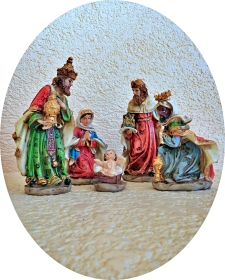
In Matthew’s gospel we read of the wise men (magi) from the east who visited Jesus. While “magi” came to mean astrologers, sorcerers, or magicians, these men probably were Magians, a priestly caste from Media, Persia, Assyria, or Babylonia. Learned in the prophecies of Hebrew Scripture, they were worshipful seekers of the truth. Their number (three) and names come from song rather than Scripture and their kingship and camels may come from their mention in Isaiah 60. Careful reading, however, tells us Isaiah’s prophecy refers to Christ’s return rather than His birth. Nevertheless, an unknown number of Magi brought this young king gifts of gold, frankincense, and myrrh. Whether such costly offerings were theirs or on behalf of a foreign king is unknown.

Even the Magi’s appearance in our pageants and nativities is incorrect. Because the Holy Family fled to Egypt immediately after their departure, the Magi must have arrived after Mary’s purification and Jesus’ presentation in the Temple 40 days after His birth. When the Magi arrive, Matthew refers to Jesus as a child rather than an infant and, based on the age of the boys Herod ordered slaughtered, their visit probably occurred when Jesus was a toddler.

Christmas is a time of great pageantry and kings kneeling in front of an infant in a manger, surrounded by animals, shepherds, and angels, makes for great theater. The facts surrounding Jesus’ birth, however, are more marvelous that any we could imagine! The message that the Son of God came in human form to sacrifice Himself for our sins and provide eternal life to all who believe in Him needs no embellishment.

It is here, in the thing that happened at the first Christmas, that the most profound unfathomable depths of the Christian revelation lie. God became man; Nothing in fiction is so fantastic as this truth of the incarnation.  [J.I. Packer]

And the angel said unto them, Fear not: for, behold, I bring you good tidings of great joy, which shall be to all people. For unto you is born this day in the city of David a Saviour, which is Christ the Lord. And this shall be a sign unto you; Ye shall find the babe wrapped in swaddling clothes, lying in a manger. And suddenly there was with the angel a multitude of the heavenly host praising God, and saying, Glory to God in the highest, and on earth peace, good will toward men. [Luke 2:10-14 (KJV)]

Copyright ©2022 jsjdevotions. All rights reserved.
EUODIA AND SYNTYCHE

I have a special appeal which goes jointly to Euodia and Syntyche: please, please, come to a common mind in the Lord. [Philippians 4:2 (NTE)]

sandhill cranes
These words from Philippians are the only mention of Euodia and Syntyche in the New Testament. Personally, if someone is going to read about me 2,000 years from now, I would prefer something about how easy it was to get along with me rather than about any arguments I had. Because Paul urges the women to settle their disagreement, it seems that their dispute was personal rather than doctrinal. Had the issue been one of doctrine, Paul would have stepped in and corrected the error as he did in many of his letters to the early churches.

Bible scholars have a sense of humor and it’s been suggested that better names for these women would be “Odious” and “Soon Touchy.” Perhaps Euodia really was disagreeable and unpleasant and Syntyche was thin-skinned and quick-tempered. Then again, maybe they were just like the rest of us at our less than best—stubborn, indignant, tactless, resentful, short-tempered, uncompromising, or easily offended. We don’t know what their problem was nor do we know who was “right” and who was “wrong.” In this case, by holding a grudge, they both were in error!

Because people in conflict usually expect others to take sides, conflict affects more than those directly involved. The women’s behavior was threatening the existence of the church at Philippi and their dispute was hindering God’s work. To save the church, Paul didn’t tell them they had to become best friends or even agree with each other, just to be of the same mind as the Lord. For the sake of the church, he wanted them to find a way to live in harmony.

The letter to the Philippians was written to “all of God’s holy people in Philippi who belong to Christ Jesus, including the church leaders and deacons.” [1:1] In the early church, Paul’s apostolic letters were meant to be read aloud to the entire congregation. Less than 15% of men were literate and that number was less for women. The congregation sat in a circle or semi-circle around the reader so that everyone saw the speaker. This arrangement meant they also saw one another and their reaction to the words spoken. Can you imagine Euodia and Syntyche (and those who may have taken sides in their conflict) as they heard the apostle’s words? There probably was a fair amount of squirming in the seats that day!

Like churches, families can suffer because of quarrels. My friend Wendy’s two sisters have a long-standing feud and refuse to speak with one another. Whenever she returned to her hometown, each sister expected Wendy to spend time with her but got irate and offended if she spent time with the other sibling. Even though Wendy refused to be caught up in their animosity, she was in a no-win situation. Eventually, it became easier to step away from the drama altogether and not return home at all. The sisters’ vendetta impacted more than just Wendy; ten cousins were affected as were the women’s parents when they were alive.

Heavenly Father, knowing that we can’t agree with everybody all of the time, show us how to get along with them. Give us loving, forgiving, and understanding hearts. Toughen our hides so that we don’t take offense so easily. Show us how to have harmony in all of our relationships. Help us to acknowledge other people’s points of view and guide us to respectfully agree to disagree with one another when necessary.

Until the day that you become perfect, don’t expect others to be. [From “Hugs – Daily Inspirations for Grandmas” (Howard Books)]

So, my dear brothers and sisters, get this straight. Every person should be quick to hear, slow to speak, slow to anger. Human anger, you see, doesn’t produce God’s justice! So put away everything that is sordid, all that overflowing malice, and humbly receive the word which has been planted within you and which has the power to rescue your lives. [James 1:19-21 (NTE)]

Copyright ©2022 jsjdevotions. All rights reserved.

SELFIES

Finally, all of you, be like-minded, be sympathetic, love one another, be compassionate and humble. [1 Peter 3:8 (NIV)]

Rejoice with those who rejoice; mourn with those who mourn. [Romans 12:15 (NIV)]


I watched as the couple extended their selfie stick and posed. Focusing only on themselves, they were oblivious to others on the beach and the beautiful sunset behind them. In love and on vacation, for the moment the world revolved around them and nothing else mattered.

It’s not just when we’re in love that we think the world revolves around us. When encountering difficulties, we frequently get out an emotional selfie stick. Focusing on ourselves and our particular situation, we often end up throwing ourselves a pity party while whining things like, “Poor me…my life is so difficult…I hurt…it’s unfair…no one understands my situation…I’m miserable…nobody cares!” Fixated on what we’re feeling, we can’t see God let alone anyone else!

On the other hand, if we put aside the selfie stick and turn the camera around, we can move beyond our limited self-awareness and interest. By zooming out or using the panoramic setting, we get an entirely different perspective. When our view widens, we begin to see people with problems of their own, and, in many cases, those problems are far worse than ours. With better perspective, we cease being the center of the universe and our difficulties cease being the center of our lives.

According to NASA astronauts, seeing the earth from space causes a profound change in their awareness. When astronaut Ron Garan viewed his home planet from space, he was in awe of its overwhelming beauty. By viewing the earth without borders, he also was struck both by the oneness of the world and by the inequity existing on it. He felt a deep sense of sadness as he thought of the billions of people on earth who suffer from things like hunger, lack of clean water, social injustice, conflicts, and poverty.

We don’t need to be astronauts to step back far enough to realize how many people suffer and suffer far more than do we on even our worst days. The pain and problems in our lives are just a small part of the interconnected and continually evolving drama of life in this world. We are but one of more than 7.8 billion people on earth and only one of the nearly 335 million people in our nation. Those numbers are humbling—and a gentle reminder that life does not revolve around us!

Oddly, when we recognize the pain of others, our pain is lessened, not because they might hurt more than we do but because we become united with them in our anguish. Rather than wallowing in self-pity, widening our perspective allows empathy and compassion to emerge. No longer alone in our suffering, we become connected with others in this flawed and troubled world of ours. No longer isolated in our distress, we move from focusing on the “me” to caring about the “we.”

Father, open our eyes to you and to the world around us. Broaden our view so that we see the purpose in pain, the lesson in loss, and the meaning in misery. Give us compassionate hearts and peace filled souls. If we are to cry, let our tears be for others and, if we are to mourn, let our mourning be for all who grieve. Please strengthen and comfort us so that we can strengthen and comfort others.

Between stimulus and response there is a space. In that space is our power to choose our response. In our response lies our growth and our freedom. [Viktor Frankl]

Praise be to the God and Father of our Lord Jesus Christ, the Father of compassion and the God of all comfort, who comforts us in all our troubles, so that we can comfort those in any trouble with the comfort we ourselves receive from God. For just as we share abundantly in the sufferings of Christ, so also our comfort abounds through Christ. [2 Corinthians 1:3-5 (NIV)]

Copyright ©2022 jsjdevotions. All rights reserved.

A FEARLESS INVENTORY

If we claim we have no sin, we are only fooling ourselves and not living in the truth. But if we confess our sins to him, he is faithful and just to forgive us our sins and to cleanse us from all wickedness. [1 John 1:8-9 (NLT)]

Made a searching and fearless moral inventory of ourselves. [Step 4 of the 12 steps of Alcoholics Anonymous]

great blue heron

Step four in most twelve-step recovery programs requires “a searching and fearless inventory of ourselves.” However, it’s not just addicts or alcoholics who should take an honest inventory of themselves—we all should. Blindness to our faults can keep us from far more than recovery; it keeps us from a relationship with Jesus. Sin keeps us from being the people God wants us to be because it weighs us down with guilt and shame.

While most of us probably have no problem saying, “Forgive us our trespasses,” and admitting we’ve trespassed, the problem occurs when we’re asked to catalog those trespasses! We’d much rather gloss over our faults than face the unpleasant task of honest self-examination. Real confession, however, requires more than just admitting we’re sinners; it requires taking a good hard look at ourselves to determine how we sinned. Since self-examination can be unpleasant, we tend to generalize or even avoid confession altogether in our prayers; but, we can’t grow spiritually if we’re discounting or ignoring our sins.

It’s easy to spot what’s wrong in the world or in the lives of others but much harder with ourselves. If we’re innocent of the obvious sins—murder, bribery, fraud, assault, worshiping graven images, stealing, and blasphemy—we feel pretty good about our behavior. But even the best Christian, when making a searching and fearless inventory, is likely to find some hypocrisy, bitterness, jealousy, pride, selfishness, greed, prejudice, worry, and/or materialism. Upon further examination, we’ll probably find a list of failures, as well—failure to forgive, show patience, love God with our whole being, love our neighbor as ourselves, have a grateful heart, pray for our enemies, read God’s word, further His kingdom, bear the Fruit of the Spirit, do what we know is right, or give the glory to God.

We don’t need to confess our sins to receive forgiveness. Our sins—past, present, and future—were cancelled when Jesus was nailed to the cross. He paid the debt with His life and anyone who believes in Him receives that forgiveness. The assurance of our forgiveness, however, doesn’t give us carte blanche to keep on sinning.

As Jesus’ followers, we are expected to make war on our sins—to “put to death the sinful, earthly things lurking within” us. How can we go to war if we don’t know what it is we’re battling? Our omniscient God doesn’t need our confession to know our sins—He knows them all. Confession is for us! Simply saying, “forgive us our trespasses” is little more than lip service; admitting lack of forgiveness regarding the ex, surfing for porn, deceit on your resume, or gossiping about your neighbor is taking up arms and engaging in combat against that sin!

Confession makes us open up the junk drawer of our lives, scrutinize it carefully, and toss out the trash that we’ve accumulated. That searching and fearless inventory makes no excuses—it focuses on the truth and accepts full responsibility for the actions. Recognizing that our sins are offensive to God, we repent and forsake our sins, admit our need of God’s saving grace, and commit to walking in Jesus’ footsteps.

Children of God should not make a general confession by acknowledging their innumerable sins in a vague manner, because such confession does not provide conscience opportunity to do its perfect work. They ought to allow the Holy Spirit through their conscience to point out their sins one by one. Christians must accept its reproach and be willing, according to the mind of the Spirit, to eliminate everything which is contrary to God. [Watchman Nee]

So put to death the sinful, earthly things lurking within you. Have nothing to do with sexual immorality, impurity, lust, and evil desires. Don’t be greedy, for a greedy person is an idolater, worshiping the things of this world. [Colossians 3:5 (NLT)]

Copyright ©2022 jsjdevotions. All rights reserved

IN ENEMY TERRITORY

Be alert and of sober mind. Your enemy the devil prowls around like a roaring lion looking for someone to devour. Resist him, standing firm in the faith, because you know that the family of believers throughout the world is undergoing the same kind of sufferings. [1 Peter 5:8-9 (NIV)]

anhingaAnhingas are among my favorites of our lake’s birds. Unlike most birds, their bones are heavy and dense and, rather than waders like the herons and egrets or paddlers like the ducks, they are deep-diving swimmers. Lacking the oil glands that waterproof the feathers of other water birds, anhingas (and their cormorant cousins) become water-logged in the water. While making it difficult to remain afloat, that allows them to dive up to sixty feet deep, swim underwater for several hundred feet, and stay underwater for more than a minute. Eventually, however, the birds become so heavy they will sink unless they return to land to dry their feathers.

Every morning I find anhingas resting along the lake’s shoreline and spreading their wings to dry. The wettest ones get barely out of the water but, as they dry, they waddle further back until dry enough to get up onto a rock, bench, or low hanging branch. As their feathers continue to dry, they move higher up in the trees until they are dry and light enough to take flight.

Unlike the lake’s ducks who nest and sleep in the vegetation along the shoreline, anhingas remain on land only out of necessity. Vulnerable to predators, a soaking wet anhinga is like a “sitting duck.” With its stubby legs and large webbed feet, it can’t run; water-logged, the water isn’t a good option and yet it’s too wet to fly up to safety. While hissing, grunting, and trying to look intimidating by ruffling its feathers, raising its tail, lengthening and waving its long neck, and pointing its spear-like beak may deter some birds of prey, that behavior probably won’t dissuade hungry alligators or crocodiles.

Just as being vulnerable to a predator’s attack is part and parcel of being an anhinga, being vulnerable to our enemy’s attack is an inevitable part of being human in our fallen world. Rather than gators and crocs, that enemy is Satan and he can sneak up on us even more adeptly than the wiliest reptile in the Everglades. Rather than the weight of soaking wet feathers, it is the weight of things like pain, illness, betrayal, weariness, conflict, loneliness, loss, disappointment (and even hurricanes) that make us especially vulnerable to attack. The enemy will use every weapon in his armory including lies, half-truths, fear, despair, hopelessness, and (his favorite) doubt to assault our belief in the goodness of God. Fortunately, in His wisdom, God armed us for battle with more than the saber-sharp beak and intimidating appearance of the anhinga. We wage war with the weapons of our faith: God’s Word and the power of the Holy Spirit.

An anhinga, aware of its vulnerability when wet, only enters the water to hunt or bathe. With neck extended and eyes wide open, it remains watchful when drying along the shoreline and never dawdles there once dry. Like the anhinga, we must be alert to our vulnerability in our fallen world. Unlike the anhinga, however, we often act as if we’re not sitting smack dab in the middle of the enemy’s territory! A. W. Tozer warns us about thinking of the world as a “playground instead of a battleground.” May we never forget that we live in the enemy’s territory and he is as dangerous as a prowling lion or a hungry alligator!

Anyone who serves the Lord is going to be the target of Satan’s attacks. [Zac Poonen]

Finally, be strong in the Lord and in his mighty power. Put on the full armor of God, so that you can take your stand against the devil’s schemes. For our struggle is not against flesh and blood, but against the rulers, against the authorities, against the powers of this dark world and against the spiritual forces of evil in the heavenly realms. [Ephesians 6:10-12 (NIV)]

Copyright ©2022 jsjdevotions. All rights reserved.