
PAY IT FORWARD

white-lined sphinx mothYou must not steal. [Exodus 20:15 (NLT)]

The wicked borrow and never repay, but the godly are generous givers. [Psalm 37:21 (NLT)]

Pay it Forward is more than the title of a novel or a film and today happens to be “Pay It Forward Day:” a worldwide celebration of kindness that takes place every year on April 28th. The pay it forward movement began with Catherine Ryan Hyde’s novel in which a young boy starts with the idea that, by doing a good deed for three people and then asking them to “pay it forward” to three more people, a human chain letter of kindness would be created that could go on forever. Paying it forward, however, is a long-standing philosophy. More than one hundred years ago, novelist Lily Hardy Hammond wrote, ”You don’t pay love back; you pay it forward,” and, in 1841, Ralph Waldo Emerson wrote that, “The benefit we receive must be rendered again, line for line, deed for deed, cent for cent, to somebody.” We can trace the idea back further to Benjamin Fanklin but the source of the concept is found in Scripture.

We’re all familiar with the prohibition against stealing in the eighth commandment. Most of us think of stealing as a criminal offense. Since we’re not likely to rob a bank, mug an old lady, break and enter, or even defraud people of their life savings, we probably feel pretty self-righteous when pondering this commandment. Reading Psalm 37, however, brought me to a wider interpretation of theft: “The wicked borrow and never repay…”

After a little thought, I think we’ll agree that if we borrow money, a lawnmower or even a book and don’t return it, we’ve stolen the item. But, what about other things that we might have taken from our family, friends and neighbors? What about the time someone spent teaching us to knit, change a tire, or use a computer? What about the guidance someone gave during a difficult time in our lives? What about the mentoring we received from teachers or fellow workers or the assistance offered by a neighbor when we were laid up and couldn’t fend for ourselves? What about the person who took a risk, trusted our ability, or gave us a valuable opportunity? Granted, the people who offered these things never expected payment in return. Moreover, in most cases, they don’t need those lessons, guidance, mentoring, assistance or opportunities returned. Regardless, don’t we still have a debt to settle? If we’ve received the gift of a good deed, don’t we have the obligation of repaying that debt to someone else in need?

Paying it forward means far more than just buying coffee for the person behind you at Starbucks. Perhaps it’s time to give that eighth commandment some serious thought. Is there a debt we haven’t yet repaid? And yet, even if no one ever did anything kind to us, we are still called to pay it forward. By God’s grace, we are saved and there is no way we can ever repay our debt to Him. Nevertheless, we can pay it forward by extending His grace and kindness to all we meet. Rather than just doing kindness, let us live it!

I do not pretend to give such a deed; I only lend it to you. When you … meet with another honest Man in similar Distress, you must pay me by lending this Sum to him; enjoining him to discharge the Debt by a like operation, when he shall be able, and shall meet with another opportunity. I hope it may thus go thro’ many hands, before it meets with a Knave that will stop its Progress. This is a trick of mine for doing a deal of good with a little money. [Benjamin Franklin, written on April 25, 1784]
Do to others whatever you would like them to do to you. This is the essence of all that is taught in the law and the prophets. [Matthew 7:12 (NLT)]

Copyright ©2020 jsjdevotions. All rights reserved.

THE REAL QUESTION

So, my dear family, this is my appeal to you by the mercies of God: offer your bodies as a living sacrifice, holy and pleasing to God. Worship like this brings your mind into line with God’s. What’s more, don’t let yourselves be squeezed into the shape dictated by the present age. Instead, be transformed by the renewing of your minds, so that you can work out what God’s will is, what is good, acceptable and complete. [Romans 12:1-2 (NTE)]

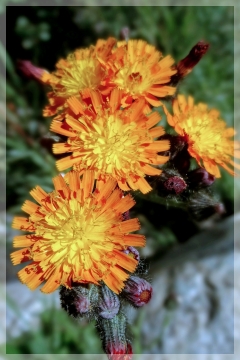
agoseris (orange) - mountain dandelionLike Job, we want to know “Why?” Wanting to understand the inexplicable, there are some who claim this pandemic is a sign of the end times; indeed, it is a terrifying time. When Jesus spoke of the end times, however, He warned His disciples to be wary about the signs and not to be misled. When we start looking for signs, we begin reading meanings into things that aren’t necessarily there. While we know that chaotic and difficult times will pave the way for Jesus’ return, we also know that chaos, difficulty, and even pandemics have been characteristics of life since the exile from Eden. I don’t know if this is a sign of the end times but I am cautious of doomsday prophets who claim to know what God is doing. Let us remember Jesus’ own words: ”No one knows the day or hour when these things will happen not even the angels in heaven or the Son himself. Only the Father knows.” [Matthew 24:36] If neither Jesus nor angels knew, I doubt a mere mortal does! Whether or not the Australian wildfires, African locusts, and COVID-19 are precursors of things to come doesn’t change what’s happening or our reaction to them.
“Do you suppose,” said a friend, “that God got so sick and tired of our bickering, conflicts, and complaint that He’s sent us all to our rooms as punishment?” Indeed, there are some who say this pandemic is God’s judgment upon his sinful children. He’s used plagues before and it wasn’t just the Egyptians who suffered them at His hands. After the Israelites worshiped the golden calf, God sent a plague upon them; when they complained of no meat, He struck them with another plague; and, when they complained about Moses and Aaron, a plague that killed 14,700 quickly followed. When David sinned against God by taking a census, 70,000 innocent people died in a plague. Since God used plagues to discipline His children in the past, we might wonder if COVID-19 is His punishment for our sins. We simply don’t know and I would be cautious of anyone who claims to know the answer; Job’s friends got in trouble for that very thing! God made it clear to Job that the “why” is really not ours to know.

Perhaps, rather than sending us to our rooms as punishment, our loving Father has given us a “time out” for an attitude adjustment. Could this be God’s version of a “market correction” when, following a drop of 10%, the value of over-priced stocks are adjusted to more accurate levels? Instead of stocks, however, could this be a time to correct our priorities: a time to reevaluate their value and adjust them to more godly levels? When viewed in the light of this pandemic, many of the things we once thought important have become meaningless and some things we took for granted have become precious. Just as a stock market correction is a reminder for investors to reassess their holdings, this pandemic may be a time for us to reassess our priorities and values. What is worth keeping and what should we let go?

Jesus told us that wherever our treasure is, there will be our heart. Perhaps we’ve been sent to our rooms to examine our hearts: to see ourselves in a spiritual mirror to determine how much like Christ we look, how attached we’ve become to the things of the world, and determine who and what comes first in our lives.

None of us can divine God’s purpose; He didn’t tell Jesus or Job so I don’t think we can expect to know. Rather than asking “why?” theologian and author Timothy Keller says the question we should be asking is this: “Is God to whom I look to and trust in when bad things happen?”

You must keep all earthy treasures out of your heart, and let Christ be your treasure, and let Him have your heart. [Charles Spurgeon]

“Don’t let your hearts be troubled,” Jesus continued. “Trust God – and trust me, too! … I’m leaving you peace. I’m giving you my own peace. I don’t give gifts in the way the world does. Don’t let your hearts be troubled; don’t be fearful. … I’ve said these things to you so that you can have peace in me. You’ll have trouble in the world. But cheer up! I have defeated the world! [John 14:1,27,16:33 (NTE)]

Copyright ©2020 jsjdevotions. All rights reserved.

THE OPEN DOOR

There is no longer Jew or Gentile, slave or free, male and female. For you are all one in Christ Jesus. [Galatians 3:28 (NLT)]

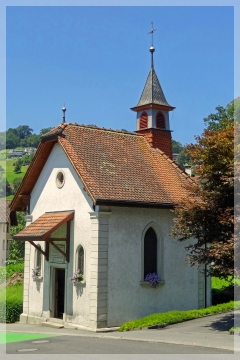
weggis - switzerland - mudslide chapel

When this pandemic first began, many thought of it as a Chinese virus. We now realize it’s not a Chinese, Italian, or even a New York thing; it’s affecting everyone everywhere, if not directly then indirectly. Lockdowns, quarantines, social distancing, face masks, make-shift hospitals and morgues, silent streets, shortages, closed churches, along with shuttered stores, schools and businesses and the financial fallout from those closures: these have altered the lives people across the globe. COVID-19 is no respecter of borders; as of yesterday, the number of confirmed cases was more than two million in at least 177 different countries.

Acknowledging that there is nothing typical about church during this pandemic, we didn’t air a typical church service on Palm Sunday. Instead, we chose to host a global celebration of our global Savior and offered messages and music from Britain, Ireland, Scotland, India, South Africa, South Korea, China, and Cuba, along with words and music from across the U.S. As I watched an Englishwoman recite a poem about prayer, witnessed a couple raise their voices in praise from a rooftop in a strangely silent Havana, joined a family as they sang from their living room in India, and shed a tear while a South Korean violinist played Ave Maria in an empty room, I realized how much this pandemic has brought us together across the world.

As beautiful and inspiring as were Palm Sunday’s musical offerings, I was touched most by the words of a man in China who thanked our church for its free App. His words reminded me that Jesus can be as contagious as COVID and that faith, hope and love can cross borders as easy as a virus. Coronavirus reminds us that, rather than an isolated community, we are part of a global community. We are not one church or one denomination; we are not Protestant, Roman Catholic, or Orthodox. We are one Church—the global Christian Church—and we follow one Savior—Jesus Christ!

While unable to attend church, we can continue being the Church and our congregation is larger than we think! My church has fewer than 70 people but in their first 24-hours, our Palm Sunday service was seen by over 5,700 people and our Easter one by over 7,800 (with over 80% of those views out of the U.S.!) Just as borders can’t stop COVID-19, they can’t stop Jesus. Let us thank God that today’s technology allows us to reach much further than we ever thought possible.

Alexander Graham Bell said, “When one door closes, another opens.” The rest of his quotation is, ”But we often look so long and so regretfully upon the closed door that we do not see the one which has opened for us.” Lament over the closed doors to our churches must not blind us to the digital door that has opened. Imagine the possibilities if, instead of being a single church or denomination, we acted as one family and all of Christ’s followers reached out virtually to join hands with the rest of the world. We serve a global Savior; indeed, in Christ there is no east or west!

In Christ there is no east or west, In him no south or north,
But one great fam’ly bound by love Throughout the whole wide earth.
In him shall true hearts ev’rywhere Their high communion find;
His service is the golden cord Close binding humankind.
In Christ now meet both east and west, In him meet south and north,
All Christly souls are one in him Throughout the whole wide earth.
[John Oxenham (1908)]

Make every effort to keep yourselves united in the Spirit, binding yourselves together with peace. For there is one body and one Spirit, just as you have been called to one glorious hope for the future. There is one Lord, one faith, one baptism, one God and Father of all, who is over all, in all, and living through all. [Ephesians 4:3-6 (NLT)]

Copyright ©2020 jsjdevotions. All rights reserved.

CATALOG OF JOY

Make a joyful noise to the Lord, all the earth! Serve the Lord with gladness! Come into his presence with singing! Know that the Lord, he is God! It is he who made us, and we are his; we are his people, and the sheep of his pasture. [Psalm 100:1-2 (ESV)]

The surest mark of a Christian is not faith, or even love, but joy.[ Samuel M. Shoemaker]

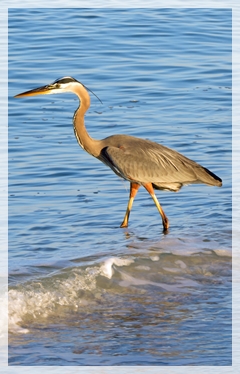
great blue heronWhen we retired, we joked that our pill boxes were the only way we knew the day of the week. Now that we’re sheltering in place, that is more true than funny. For young and old alike, the days are blending one into the other with the only difference between yesterday and today being the news (which just seems to gets worse).
While COVID-19 is an enemy lurking at our door, chances are another enemy has already entered our lives: common garden variety depression—what I call the glums and gloomies. As the days wear on, it’s harder to see the bright side of life. Built for community, we now live in a world where kisses are weapons and we show our love by staying away from one another! Instead of hoarding toilet paper and bleach wipes, we wish we’d stockpiled hugs. We’d happily trade a bottle of hand sanitizer just to cuddle with a grand for a minute or shake a friend’s hand.

This prolonged isolation reminds me of a winter spent at our mountain home back in 1997. Having broken my knee the first day on the slopes, my mobility was severely limited. In spite of having hung up my skis for the season, I maintained good spirits until my husband and son departed for two weeks on business. Although they left me well stocked with food and a stack of library books, it was just me, my crutches, and the four walls for the duration and the glums and gloomies descended in full force. In one of those beautiful God-incidences, I happened upon an Oprah show about keeping a gratitude journal. Since my days were all the same, writing down five things for which I was grateful every day was a challenge at first. But, once I started, it got easier as I found joy in little everyday things: seeing a cardinal on the back deck, getting a phone call, reading a good book, or sipping cocoa by the fire on a snowy night! That gratitude journal was my life-line to sanity (and continues to be one today) because it moved my focus from me and my misery to God and His goodness.

When the glums and gloomies visited one of my friends fourteen years ago, she made a list of the things that gave her joy and ended up with about fifty things—none of which cost money. As with my gratitude journal, her entries weren’t deep spiritual thoughts: just simple things like hearing her little grand’s giggle, balancing her checkbook on the first try, or seeing her golf ball miss the water hazard. Although she’s made a few revisions and additions to the list through the years, she still pulls out her catalog of joy whenever she feels depression knocking at her door! I imagine she’s been looking at it a lot nowadays.

It’s easy to be grateful when life is good but, when life takes a downhill slide into discouragement or despair, gratitude doesn’t come naturally—certainly not easily. Nevertheless, it’s worth the effort. Even though the world has gone topsy turvy, we can be thankful because our sovereign God, a God who loves and cherishes us, is firmly in control. We can be thankful that, even though we are apart from one another, we are not alone; we are united in Christ with other believers. We can be thankful because we have the hope given to us by Jesus. We may not feel grateful for all that has occurred but we can be grateful by choosing to look beyond our circumstances. We don’t have to be thankful for this pandemic but we can practice being thankful in the midst of it.

Between the horror of this pandemic and the sameness of our days, we must be intentional about gratitude and joy and open our eyes to God’s many blessings. An attitude of gratitude, even in our trials, is what distinguishes us as Christians. What would you write in a gratitude journal today? What would be in your catalog of joy?

The Christian who walks with the Lord and keeps constant communion with Him will see many reason for rejoicing and thanksgiving all day long.[Warren Wiersbe]

Enter his gates with thanksgiving, and his courts with praise! Give thanks to him; bless his name! For the Lord is good; his steadfast love endures forever, and his faithfulness to all generations.  [Psalm 100:4-5 (NLT)]

 Copyright ©2020 jsjdevotions. All rights reserved.

JESUS SAVES

This, you see, is how much God loved the world: enough to give his only, special son, so that everyone who believes in him should not be lost but should share in the life of God’s new age. [John 3:16 (NTE)]

Another one of my Abundance assignments gave an interesting twist to paying it forward. We were to give an extra $3.16 to the drive-thru cashier who was supposed to credit it to the next customer and tell them the 3.16 was from John. We rarely utilize drive-thrus and now, with social distancing, aren’t going out, so this was one assignment I set aside. Nevertheless, I thought about the ways we do or don’t evangelize.

Christians tend to get upset when the presence of a religious symbol on public property is threatened. Yet, other than an occasional Christmas decoration, we rarely display anything religious on our own private property. We claim our children should be allowed to pray at school yet how many of us use our freedom to openly say grace before meals in a public restaurant or pray with others in public spaces? We’ll wear tee-shirts with logos advertising our favorite designers, restaurants, and teams; how many do we have with Bible verses on them?

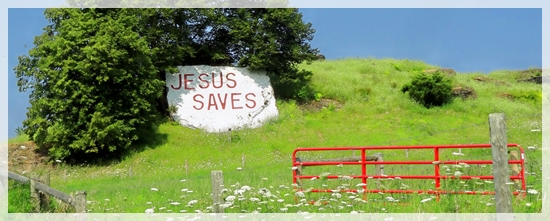
For nearly forty years, we drove by the “Jesus Saves” rock. Prior to 1955, however, that big rock displayed a Potosi Beer advertisement. A prayer group from the local Presbyterian church obtained permission to repaint the rock and the “Jesus Saves” rock now is known throughout a tri-state area. To my knowledge, in all of these years, the rock has never been defaced. Granted, it is in rural Illinois, but it’s hard to believe that no youngsters have tried adding something to the sign. While that speaks to the virtue of small town values, it probably helps that the farmer who owns the land keeps a watchful eye on the famous rock (and a bull has been known to roam in the pasture below). A local family installed a light so that it can even been seen in the dark of night and various community organizations continue to keep the sign freshly painted. The “Jesus Saves” sign is both a community effort and a community witness.

While I disagree with their theology, I admire Jehovah’s Witnesses for their persistent evangelizing. Most of us hesitate to discuss Jesus with our neighbor, but Witnesses are willing to speak with strangers, often going door-to-door. They and their display are an almost daily fixture at our area parks and beaches. Few of us are that dedicated to spreading the Word of God, although I did read of one man who named his Wi-Fi router “Jesus Saves” so that anyone searching for a signal would see the message! Since his router probably is password protected and Jesus welcomes all, his would seem to be a slightly mixed message. Nevertheless, he’s witnessing in a small way.

Failure to share the message of John 3:16 isn’t like not telling someone about the latest NetFlix offering, our favorite YouTube video, or even the news that Walmart finally has toilet paper and hand sanitizer! Let us remember that people’s eternal destiny rests in our witness. As Charles Stanley said, “The joy you’ll have when you meet that person in heaven will far exceed any discomfort you felt in sharing the gospel.”

“All who call upon the name of the Lord,” you see, “will be saved.” So how are they to call on someone when they haven’t believed in him? And how are they to believe if they don’t hear? And how will they hear without someone announcing it to them? [Romans 10:13-14 (NTE)]

Copyright ©2020 jsjdevotions. All rights reserved.

PRAY FOR PEACE

I urge you, first of all, to pray for all people. Ask God to help them; intercede on their behalf, and give thanks for them. Pray this way for kings and all who are in authority so that we can live peaceful and quiet lives marked by godliness and dignity. [1 Timothy 2:1-2 (NLT)]

Saying your prayers is like brushing your teeth.
It’s a habit you form—a commitment you keep.
You should brush your teeth, both morning and night;
The same with your prayers, if you’re saying them right.
To not let your spirit or teeth decay
Be sure to pray and brush every day! [Anonymous]

water lilyAlthough I’ve prayed while folding laundry and washing dishes, it seemed almost sacrilegious to combine prayer with an electric toothbrush and Crest! Nevertheless, after asking, “What would happen if we all pray twice a day for peace?” my next “Abundance” assignment was to pray for peace while brushing my teeth!

The lack of a declared war certainly doesn’t define peace. According to the Global Peace Index, last year the United States ranked 128th out of 163 nations rated for their peacefulness (with Iceland maintaining first place as the most peaceful and Afghanistan replacing Syria as the least). The U.S. Peace Index ranked my state of Florida at 47th out of 50 (with Maine, Vermont, and New Hampshire as the three most peaceful states.) Considering the political tensions both here and abroad, tribal conflicts and civil wars, terrorist attacks, conflicts and division within the church, divorce and custody battles, road rage, and the violence on our streets, in our homes and even at our schools, praying for peace seems like a good idea.

Since being peacemakers and praying for peace is God directed, I wonder why we’re not more diligent about praying for an end to the strife in our world. Living in a world that is fractured along political, ideological, socio-economic, ethnic, and even religious lines, we probably should pray for peace more than two times a day. We wouldn’t have to do it while brushing our teeth but, since we may be more conscientious about our dental hygiene than prayer, at least we’d remember to do it!

While we can cast blame for the lack of peace on things like politics, injustice, prejudice, corruption, economics, or this pandemic, the fault also lies within each one of us. While brushing and praying, I remembered the words to a song I often sang in Sunday school: “Let there be peace on earth and let it begin with me.” Peace must begin with us. As we pray while brushing, rinsing and spitting, perhaps we should consider what comes out of our mouths. Do we allow words of anger, frustration, criticism, and blame to spill out rather than ones of love, compassion, encouragement, or forgiveness? Our prayers for peace are empty and meaningless unless that peace begins with us!

What could happen if all of Christ’s followers really did pray for peace twice a day?

Let there be peace on earth, And let it begin with me.
Let there be peace on earth, The peace that was meant to be.
With God as our Father, Brothers all are we.
Let me walk with my brother In perfect harmony.
With ev’ry step I take, Let this be my solemn vow:
To take each moment and live Each moment in peace eternally.
Let there be peace on earth, And let it begin with me.
[Jill Jackson-Miller and Sy Miller]

Do all that you can to live in peace with everyone. [Romans 12:18 (NLT)]

Copyright ©2020 jsjdevotions. All rights reserved.