
I had everything a man could desire! … Anything I wanted, I would take. I denied myself no pleasure. I even found great pleasure in hard work, a reward for all my labors. But as I looked at everything I had worked so hard to accomplish, it was all so meaningless—like chasing the wind. There was nothing really worthwhile anywhere. [Ecclesiastes 2:8b-10-11 (NLT)]
 When considering Solomon’s excess and riches, I recalled comedian George Carlin’s “Stuff” routine. First performed for Comic Relief in 1986, Carlin made fun of our obsession with having stuff. Along with being the King of Israel, Solomon was the King of Stuff. Denying himself nothing, along with his elaborate throne of gold and ivory, he displayed 500 ornamental gold shields on the walls of his palace. Rather than silver, all the king’s goblets and eating utensils were made of pure gold. He had 40,000 stalls of horses for his chariots, and 12,000 horseman.
Because Solomon controlled the chief trading routes north from the Arabian Peninsula, he collected the equivalent of over $1.2 billion a year in tribute from Arabian kings, merchants, and traders as well as Israel’s governors. It wasn’t just the queen of Sheba who gifted him with precious jewels, spices, and tons of gold. Everyone who visited the king brought him gifts of stuff: silver, gold, spices, weapons, clothing, mules, and horses. Every three years, Solomon collected even more stuff when his fleet of ships returned with additional horses, mules, gold, silver, robes, ivory, apes, and monkeys. The king collected women as readily as he did gold. With 1,000 women in his household, just imagine the amount of stuff the harem held! Nevertheless, despite all his “stuff,” Solomon’s words in Ecclesiastes are not the words of a happy or contented man.
Carlin described our houses as places to keep our stuff while we go out and buy even more of it, but having lots of stuff becomes a burden. We must take care of it, insure it, worry about it, and find a place to put it. Some people have so much stuff, they hire professional organizers to arrange it while others have so much stuff they rent storage units for some of it! With over 50,000 such facilities here, self-storage is one of the fastest growing American industries. It’s easy to imagine what Carlin would make of the over two billion square-feet of space that now are dedicated to storing all our stuff!
You’ll never see a U-Haul following a hearse and Solomon knew that he couldn’t take his riches with him. Nevertheless, he continued to amass stuff and so do we. None of it, however, seemed to satisfy the king any more than our stuff can satisfy us. Denying himself nothing, Solomon claimed to have had everything a man could desire. Nevertheless, contentment eluded him and the king came to hate life and find everything meaningless.
Despite his wisdom, Solomon didn’t understand that wealth and material possessions can’t bring us joy, meaning, fulfillment, or purpose. Exquisite gems, hammered gold shields, golden goblets, and a colossal harem were a poor substitute for a relationship with God. Contentment can’t be found in stuff, no matter how beautiful; it’s found in our confidence in the sufficiency of God. As for those 500 gold shields and the rest of the palace’s treasures of which Solomon was so proud—they were carried off as plunder by Shishak of Egypt just five years after Solomon’s son Rehoboam became king!
You say, “If I had a little more, I should be very satisfied.” You make a mistake. If you are not content with what you have, you would not be satisfied if it were doubled. [Charles Haddon Spurgeon]
 God gifted Solomon with great wisdom and people from every nation journeyed to Solomon’s court to hear his wisdom. Although 1 Kings 3 tells us that Solomon wisely determined the identity of the real mother in a dispute between two women who claimed to have given birth to the same infant [3:16-28], one wise answer hardly seems newsworthy enough to make him famous beyond Israel’s borders. Even the king’s prolific writings and vast knowledge of botany and zoology don’t fully explain his renown. In a world without mass media, what caused his reputation to travel some 1,400 miles to Sheba (modern Yemen)? Sheba’s queen was so interested in meeting the king that she and her entourage made a journey which, including her stay in Judah and the return trip, took two to three years. What about Solomon caused her to travel so far to assess the king’s wisdom and wealth for herself?
 The patient Cormorant had been diving and resurfacing empty-beaked for several minutes before finally emerging victorious with a large fish crosswise in its beak. The fish thrashed in the cormorant’s beak while the bird tried to re-position its meal so it could be swallowed head first. A Brown Pelican suddenly crashed into the water and, after a great deal of wing flapping and water splashing, it was clear the Cormorant was no match for the larger bird. While the Pelican threw back its head and swallowed the unlucky fish, the unfortunate cormorant swam away still hungry.
 The Israelites had been away from Israel for less than two months when they arrived at Rephidim. With no water to drink, the people complained, questioned whether the Lord was with them, criticized Moses, and then threatened him. Fearing for his life, Moses asked God what to do. Instructing him to strike a rock with his staff, God promised that water would come gushing out and, as promised, it did. The miracle was memorialized by the name given to this location, Massah (meaning testing) and Meribah (meaning quarreling.) Unfortunately, that was not the last time the Israelites tested the Lord and quarreled with Moses.
 At first, it seems that the “Parable of the Unforgiving Servant” should be called the “Parable of the Forgiven Servant.” After all, the king forgave his servant’s debt of 10,000 talents—the equivalent of billions of dollars. While the first part of the parable illustrates the value and extravagance of God’s forgiveness, it takes a dark turn in the second part when illustrating the reciprocal nature of His forgiveness—something the servant learned the hard way!
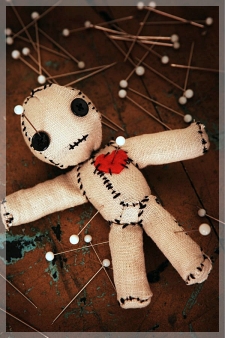 Without a globe, I allowed a random number to decide the nation for which I’d pray this week. Number 19 was Benin and I’m embarrassed to admit knowing nothing about this narrow strip of land in West Africa between Nigeria and Togo. These three nations once were part of the kingdom of Dahomey and it was in Dahomey that the ancient practice of voudon/vodun/vodou (commonly called voodoo) began. Now a republic, Benin is a severely underdeveloped nation, rife with corruption, where the life expectancy for men is just 60! A little over 40% of the population are Christian, nearly 30% Muslim, about 17% practice voodoo, and another 10% follow other indigenous/animistic religions. As a side note, ARDA (The Association for Religion Data Archives) stated that many of those identifying as Christian also practice voodoo.
 Devotions of the Heart