
But he [Jesus] answered, “It is written, “‘Man shall not live by bread alone, but by every word that comes from the mouth of God.’”… Jesus said to him, “Again it is written, ‘You shall not put the Lord your God to the test.’” … Then Jesus said to him, “Be gone, Satan! For it is written, “‘You shall worship the Lord your God and him only shall you serve.’” [Matthew 4:4,7,10 (ESV)]
 God’s armor includes the belt of truth, the breastplate of righteousness, the shoes of the gospel of peace, the shield of faith, and the helmet of salvation. No soldier, however, would go into battle without a weapon. While a soldier might go into battle without armor as did David when he met Goliath, he’d never go without a weapon. The young shepherd’s weapon was a handful of stones but the Christian’s weapon is the “sword of the Spirit, which is the word of God.”
The sword Paul describes wasn’t like the nearly six-foot heavy broad sword (rhomphaia) David used to decapitate Goliath or the sword of judgement of Revelation. The sword of the Spirit is a machaira, a small sword, knife, or dagger used in in hand-to-hand combat. While the Christian’s one offensive weapon is small, it is mighty because it can defeat Satan! When Jesus was in the wilderness, He used this powerful sword. The Lord answered each of Satan’s temptations with the words, “It is written…” He needed nothing more than the Word to send Satan packing.
Satan frequently uses his own machaira when tempting people—only his version of the Word is perverted. He’s more than willing to put his words in God’s mouth! When tempting Eve in the garden, the evil one emphasized God’s prohibition rather than His gifts when he asked if God really said she couldn’t eat any of the fruit in the garden. Although Eve corrected him that only one tree was prohibited, she was unsure of God’s words and added that it couldn’t even be touched! When Satan assured Eve that she wouldn’t die if she ate the fruit, the woman was bamboozled; not knowing and trusting God’s word is what brought death into the world!
Long before GPS and cell phones, toward the end of World War II, the allied forces conducted a military campaign to mop up the remaining Nazi resistance in Berlin. When a crucial mission was assigned to one unit, it was essential that each soldier memorize a detailed map of the enemy’s positions in the city. Because each soldier managed to commit the map to memory, the mission was a success. Several years later, the Army conducted an experiment to see if that original feat could be repeated. The participating soldiers were offered an extra week’s furlough as incentive if they could carry out a comparable mission without a glitch. Despite the promise of furlough, this second unit failed to match the success of the first. Could their failure have been because their lives never were in jeopardy? Perhaps one’s survival in battle serves as a greater motivation than a week’s vacation in peacetime.
While I’ve found this story in a variety of sources, I can’t verify its truth. Nevertheless, it makes a great sermon illustration and I found it in a commentary on Ephesians 6:17. As Christians, we are engaged in spiritual warfare. Rather than holding a map of Berlin and Nazi strongholds in our memory, we need the Bible in our hearts. Paul warned us that Satan “disguises himself as an angel of light.” [2 Cor. 11:14] The only way to spot his falsehoods and perversion of the gospel is to know the truth! The sword of the Spirit—the word of God—is the only offensive weapon in our arsenal. The more we read it, the more we memorize it, and the more thoroughly we know and understand it, the better prepared we are to march into battle. We must study God’s Word as if our lives depended on it—because they do.
The Bible is an armory of heavenly weapons, a laboratory of infallible medicines, a mine of exhaustless wealth. It is a guidebook for every road, a chart for every sea, a medicine for every malady, and a balm for every wound. [Thomas Guthrie]
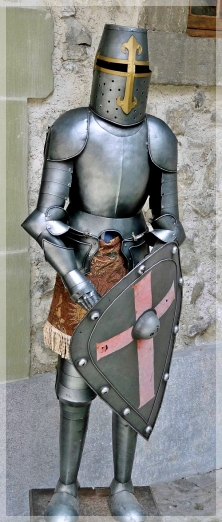 As a young child, I loved singing “Onward, Christian Soldiers” in Sunday school. My enthusiasm for the hymn waned as I grew older and learned about the evil and horrors of the Crusades and the World, Korean, and Vietnam wars. With its mention of war, soldiers, mighty armies, battles, and foes, the hymn seemed to glorify war. Even though the martial imagery comes from Biblical texts, the hymn’s combination of soldiers marching into battle and Jesus (the Prince of Peace) has caused controversy and some denominations have eliminated it from their hymnals.
 Having previously warned people that not everyone who claimed to follow Him would enter the Kingdom, Jesus told the Parable of the Sheep and Goats in which He likened the last judgment to a king separating the sheep from the goats at the end of the day. Placing the sheep to His right and the goats to His left, the King invites the sheep into the Kingdom. The reasoning behind His selection is disarmingly simple: “For I was hungry, and you fed me. I was thirsty, and you gave me a drink. I was a stranger, and you invited me into your home. I was naked, and you gave me clothing. I was sick, and you cared for me. I was in prison, and you visited me.” [Matthew 25:35-36] Having failed to do those things, the goats are sent into eternal punishment.
 The email from my dentist asked, “Would you recommend us?” When I answered in the affirmative, I was hyperlinked to a site that added my five-star rating to that of other patients. The following day, I received a longer survey regarding my recent visit. Once done, it again asked if I would recommend his services and requested use of my name in an on-line testimonial. It’s clear that my dentist wants more than feedback; he wants the public approval of his patients. Although I like him, I like my privacy more, so I declined!
 Every morning, I receive an email from a Christian site to which I subscribe. Having no interest in Temu, make-up, or a “game-changer” pen for seniors, I ignore the ads as nothing more than “click bait.” Today’s ad from a jewelry company, however, caught my eye with its words, “Just in: Angel Numbers.” Having missed all the articles about them in Allure, Reader’s Digest, USA Today, Cosmopolitan, Women’s Day, Instyle, and Vogue, I didn’t know what an “angel number” was, so I Googled it. Apparently, when you see repeated digits (such as 11:11 on your clock, $9.99 on a price tag, 30303 on a license plate, or a date like 2/22/22), the universe is sending you a message! Rather than a coincidence, these repetitive numbers are a “sign from your guardian angel” (or a dead loved one). Supposedly, the “language of angels,” such numbers are meant to point you in a certain direction or confirm the direction in which you’re going! Of course, a host of psychics, spiritual mediums, and numerologists are more than willing to tell you the meaning of your “angel numbers.” And, as I discovered from the ad, once you find your number, you can purchase it in jewelry!
 After pointing out Jesus as the “Lamb of God,” some of John the Baptizer’s disciples left John to follow Jesus. Later, John’s remaining disciples reported that Jesus was baptizing (it actually was His disciples) and wanted to know whose purification ritual of baptism was valid. With many turning from John to Jesus, the Baptizer’s disciples were confused, concerned, and probably a little envious. Apparently, they forgot that John’s original mission was that of forerunner—the one who would prepare the way for the Messiah and point the way to the Lamb of God. Knowing that he wasn’t the bridegroom but only His friend, the Baptizer humbly affirmed his position by telling his disciples that Jesus must become more prominent while he became less and less important. J.C. Ryle likened the Baptizer’s role to that of a star growing paler and paler as the sun rises until the star completely disappears in the light of the sun. John clearly understood that he was to fade in the light of the Son.
 Devotions of the Heart