
But Jesus called them together and said, “You know that the rulers in this world lord it over their people, and officials flaunt their authority over those under them. But among you it will be different. Whoever wants to be a leader among you must be your servant, and whoever wants to be first among you must become your slave. [Matthew 20:25-27 (NLT)]
 Recently, the news has been filled with stories about powerful men who have misused their influence to prey on others. Unfortunately, abuse of power is nothing new. Consider our Biblical hero King David. While strolling on his roof late one afternoon, he looked down on the city below and spotted a beautiful woman taking her ritual bath. Even though he knew she was married, David sent for her. With at least six wives already, he wasn’t lacking for female companionship. Nevertheless, he wanted the beautiful Bathsheba. The Bible tells us the two had sex, she got pregnant, and David killed her husband to conceal their adultery. The Bible, however, tells us nothing of Bathsheba. We know she didn’t ask David to invade her privacy and, obedient to her king, she went to his palace. How could she refuse and to whom could she complain? Whether David managed to seduce her with his charm or forced himself on her doesn’t matter. He was her king and she had no choice. He wrongly took advantage of his power when he sent his men to get her, had sex with her, and manipulated events so that her husband was killed in battle.
This is not a male-bashing devotion; it is a reminder to us all that power and authority of any kind is a privilege. We are told to be good stewards of our wealth and use it wisely. When we are blessed with positions of authority or power, we should use that wisely, as well. If we’re not millionaires, CEOs, politicians, producers, or celebrities, we might think we have little or no power, but we do. We have the power to make someone else’s day good or bad and we have the power to affect their future. We can badger or intimidate co-workers, baby sitters, interns, clerks, sales people, bus drivers, assistants, neighbors, care givers, maintenance people, spouses and even children. It’s not just sexual abuse; there are many other ways to abuse, demean, mistreat, manipulate, or exploit people. Bullies aren’t found just on the playground; I’ve seen them berate wait staff, receptionists, and students. Threats aren’t made just by bosses; I’ve seen them made by irate customers. Politicians aren’t the only ones with clout; many of us have the ability to put in a good (or bad) word that can change someone’s future. We can make or break someone’s reputation with a few keystrokes. Having the upper hand never gives us the right to hit with it and having the power to do something doesn’t necessarily mean we should.
Abuse of power has consequences; conceived in adultery, David and Bathsheba’s child died and we’ve recently seen numerous successful careers crash. We may not make the tabloids when we shortchange the sitter, take out our anger on the secretary, or threaten someone out of spite. Nevertheless, there will be consequences for us as well—if not in this world, then in the next. In the parable of the talents, Jesus tells us that we’ll be held accountable for the way we use our gifts. We tend to think of those gifts as money, time and skills. They also include knowledge, relationships, privilege, power and authority and we should use all of them with love and compassion. Moreover, when we use our influence or authority to mistreat those less powerful, let us remember that we are mistreating the most powerful one of all!
 For several years, a well-known and highly regarded actor/comedian’s name was synonymous with fatherhood and family values. After becoming the subject of sexual abuse allegations, spanning more than fifty years, by more than fifty women, his name went from respected to scorned. Several universities rescinded the honorary degrees awarded him, removed him from their boards and fund-raising campaigns, and eradicated his name from buildings and scholarships. His statue was removed from a Disney theme park, reruns of his shows were cancelled, there was a petition to revoke his Presidential Medal of Freedom, and he was dumped by his agent. No one wanted their good names tarnished by any association with such disgraceful behavior.
 In Leviticus, we find Aaron’s sons, Nadab and Abihu, offering incense to worship God. Although their goal was good, priests were required to fulfill their duties without variation and the brothers disregarded the method specified by God. Worshiping God was the right intent but using prohibited fire was the wrong way to do it and they were consumed by God’s fire. Bringing the Ark of the Covenant back to Jerusalem was a good goal but using a cart to transport it was the wrong method and Uzzah was struck dead when he reached out to steady it.
 We, therefore, can confidently say: ‘The Lord is my helper; I will not fear. What can man do to me?’ [Hebrews 13:6 (PHILLIPS)]
 Our fight is not against people on earth. We are fighting against the rulers and authorities and the powers of this world’s darkness. We are fighting against the spiritual powers of evil in the heavenly places. [Ephesians 6:12 (ERV)]
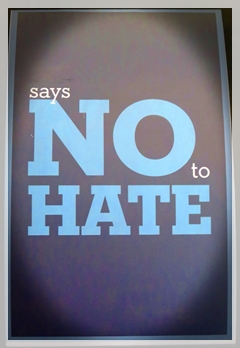 I walked into the university workout facility and was greeted by a large sign telling me the school says no to hate. I was surprised that a Christian University felt the need to say what should be obvious. Has hate become so much a part of our everyday lives that we have to be reminded not to do it? There wasn’t a sign telling us not to pee in the pool, have fist fights, or swear. Evidently, certain acceptable behavior was assumed but not hating wasn’t! Apparently, the sign is necessary because people feel freer to express their prejudice, intolerance, and bias than do any of those other things.
 Devotions of the Heart