
The person who has two shirts must share with the person who has none. And the person with food must share with the one in need. [Luke 3:10-11 (VOICE)]

Early this year, a charity event in our Florida town raised over $11 million in one auction. The top bid was $750,000 for the world’s first 2016 Rolls-Royce Dawn ultra-luxury convertible. $720,000 each netted three bidders exclusive access to Napa Valley’s BottleRock music festival along with personalized guitars and several vintage bottles of wine. $400,000 won some lucky person (and nine friends) a cooking class and dinner hosted by celebrity chef Mario Batali and legendary actress Glen Close. For a bid of $320,000, one couple will soar off on a private journey to Vietnam, Cambodia, Laos, Japan and the Philippines. Every year, we watch the private jets fly into town for this event, read accounts of the fabulous dinners that are part of the activities, and gasp at the enormous amount of money spent in the name of charity. It’s obvious the attendees at this impressive event have more than enough to share.
Not everyone who shares, however, has more than enough. I recently heard a teacher explain why her classes do service projects as part of their curriculum. Most of her students are poor inner city kids who have spent the better part of their lives on the receiving end of public aid and charity. She has them volunteer so they learn how good it feels to be on the giving end! They may not have money but, young and able-bodied, they share their time, talents and youthful vigor. Giving empowers them in a way that receiving can’t.
The latest newsletter from a charity we help support included a heartfelt letter of appreciation from a women they helped. Granted our little check played a minor part of what was done for her, but her letter reminded me that it truly is more blessed to give than to receive. Feeling fortunate to be a small part of changing a life for the better, I wrote in my gratitude journal, “Thank you, God, for giving us more than enough so we can share with others.” The Holy Spirit quickly convicted me: “Whether in abundance or need, you always have enough to share!”
A boy shared his fish and bread with 5,000, a widow shared the last of her food with Elijah and, for all we know, the Good Samaritan shared his last few shekels when paying the innkeeper. They didn’t have extra—in fact, they didn’t even have enough, but they all shared what they did have. Sharing that improves the human condition is love in action. We are obligated to share and not just in times of abundance or even bare sufficiency. From the ultra-rich to the under-privileged, whether we have a feast or but a few crumbs, a Christian always has more than enough to share.
Thank you, God, for always providing us with enough of something to share with those in need.
To be poor does not mean you lack the means to extend charity to another. You may lack money or food, but you have the gift of friendship to overwhelm the loneliness that grips the lives of so many. [Stanley Hauerwas]
 I watched the snowy egret at the beach and couldn’t quite decide if he was an exceptionally smart bird, just plain lazy, or a little of both. Egrets are excellent fishermen and will wade in the shallows stirring up the water with their feet to flush out delicacies like fish, frogs, and crayfish. Other times, they exhibit great patience as they stand nearly immobile for several minutes just waiting for their prey to come near enough for them to strike and catch dinner.
 “Biology!? Math!? English! AAHH!” groans Nancy in a recent one of Guy Gilchrist’s comics. “I shouldn’t have to memorize anything I can Google!!” she protests with a frown. Oh, I feel your pain, Nancy; indeed, I do! Were it not for my Bible’s concordance and Google, I’d be hard put to include Bible verses in my devotions. I can manage to remember the gist of many verses but don’t ask me for chapter or verse and you’d better not quote me because my words won’t be exact. If quizzed on Scripture, I definitely would need an open book test and, like Nancy, would much prefer having access to Google.
 As I grabbed my jacket, I noticed the familiar Under Armour logo on the front. Looking down, I saw that my t-shirt advertised a local boot camp class and my shorts displayed Fila’s logo. Eyeing my husband, I saw that his shorts displayed the same logo as mine and his shirt advertised the physical therapy clinic that has treated him over the years. While my cap sported the famed Nike swish, the name of a local pub was embroidered on his. A red swish peeked out from the top of his shoes while my socks were decorated with New Balance’s logo and pink ribbons for breast cancer awareness. The large “N” on each side of our sneakers identified them as another New Balance purchase. We were virtual walking billboards and we’d paid a hefty price for the privilege of advertising other people’s goods and services!
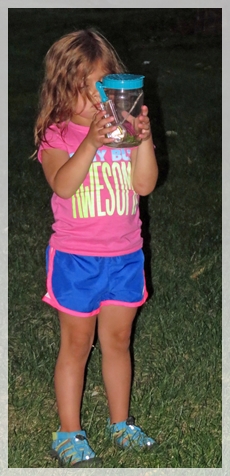 Warm summer nights at the lake mean campfires, s’mores and fireflies. As the darkness descends, bug jars appear and the children start chasing these fascinating insects. How odd that the same child who will shirk away from any insect during the day will give chase to and capture these flashing winged beetles at night. By the end of the evening, the children have collected a jarful of tiny flying stars (that will be released as soon as the little ones are tucked into bed).
 “I Can’t Get No Satisfaction” sang the Rolling Stones in 1965. Back in 520 BC, the Jews of Jerusalem were probably singing their own version of that song. Sixteen years earlier, upon their return to Jerusalem from exile in Babylon, they had started to rebuild the temple just as God had instructed them to do. Within two years, however, construction had stopped. Granted, they had hostile neighbors who, fearing a prosperous Jewish state, harassed them. In actuality, though, they were more to blame for their delay than were their political opponents. Questioning God’s timing, they’d grown discouraged, lost focus and become more concerned about building their own homes than finishing God’s house. God sent a message to the people through the prophet Haggai pointing out that the harder the people worked for themselves, the less they had to show for it. By ignoring God and fulfilling their needs first, the Jews were destined to remain unsatisfied. Moreover, God was angry that He had been ignored. So angry, in fact, that He sent a drought to destroy their crops and livestock.

