
But God said to him, “You fool! You will die this very night. Then who will get everything you worked for?” Yes, a person is a fool to store up earthly wealth but not have a rich relationship with God. [Luke 12: 20-21 (NLT)]
 When touring a nearby resort town, a beautiful old mansion was pointed out. It was once owned by a man who made so much money on his invention of the sanitary milk bottle cap that he retired at the age of 26. For 93 years, the Chicago White Sox played at a ball field named for the team’s founder. In 2003, the field was renamed US Cellular Park and then, in 2016, it became the Guaranteed Rate Field. When I went to Northwestern University, the football venue was named for a former Evanston mayor. In 1997, the stadium was renamed to honor the family of a generous donor to the school’s athletic facilities. A friend’s daughter is attending a school named for a German immigrant who opened a Chicago butcher shop in 1883. Who were these men?
If you’ve not been on a Lake Geneva boat tour, you’ve never heard O.N. Tevander. Although one can still find pictures of his bottle capping machine, he doesn’t even rate a mention in Wikipedia. Do today’s baseball fans know that Charles Comiskey was a key person in the formation of the American League and founder of the Chicago White Sox? Do the Northwestern Wildcats know anything of William Dyche, class of 1882, and that his name was to remain on any NU stadium for perpetuity? In another twenty years, will they have any idea that Patrick Ryan founded Aon Corporation and once served on the university’s Board of Trustees? By then, it’s possible that another large check will have been written and the stadium will have yet another name. When you hear the name Oscar Mayer, do you think of an immigrant butcher from Bavaria or of a large corporation (now owned by Kraft), hot dogs and the wiener song?
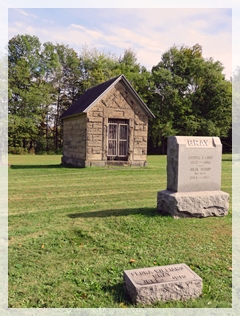
Even if we amass great wealth, make generous donations, or achieve some modicum of fame, chances are that most of us will be forgotten in a few generations. Our last name might remain on a corporate letterhead or, if wealthy enough, we could have a building or stadium named after us (at least for a while). Our headstone may rest in a cemetery, we might be listed in a genealogy chart, or an old letter or picture of us may reside in a box of memorabilia stored in someone’s attic. Nevertheless, we will be long gone and, for the most part, forgotten. For William Dyche, perpetuity lasted only 71 years! How long will it last for us? Even if a great grandchild has our china, a piece of our jewelry or carries our name, our essence will have vanished. We will be little more than a short family story or a faceless name.
Jesus told a parable about the rich man whose land was so productive that he ran out of room to store his crops. Rather than share his excess, he just built bigger barns so he could relax and enjoy his wealth for years to come. Unfortunately for him, he died that very night. A simple parable, it points out the temporal nature of life.
Financial planners often ask their clients, “What will be your legacy?” The rich man in the parable left a legacy of filled barns for someone else to enjoy. Sadly, he forgot the most important thing—his soul. Sometimes we’re so busy thinking about our legacy here on earth that, like the man in the parable, we also forget about our souls. Whether or not we are remembered in this world isn’t really important. The real question is whether or not God will welcome us into His kingdom in the next.
 Yesterday I mentioned getting an email with the subject, “How firm is your foundation?” Although it was an advertisement for a new study Bible connecting Biblical teachings to Christian beliefs, that very question has been the topic of discussion in our northern church for the last few weeks. The parish is doing a church-wide study of Martin Luther’s Small Catechism. Back in the 1500s, Martin Luther was appalled at the lack of knowledge of both pastors and their congregations. Not especially tactful, he accused some pastors of being “lazy bellies and presumptuous saints!” His words for their congregations, “simple cattle and mindless pigs!” were no more diplomatic. People who called themselves Christians had no idea what that meant. They didn’t know the Ten Commandments, the Apostle’s Creed or even the Lord’s Prayer, let alone anything else in the Bible. Last week, our Pastor asked us what Luther might say if he visited today’s churches. We agreed that his words for our pastors would be more complimentary but that his words for their congregations might be the same or worse!
 All they did was sin even more, rebel in the desert against the High God. They tried to get their own way with God, clamored for favors, for special attention. They whined like spoiled children, “Why can’t God give us a decent meal in this desert? Sure, he struck the rock and the water flowed, creeks cascaded from the rock. But how about some fresh-baked bread? How about a nice cut of meat?” [Psalm 78:17-20 (MSG)]
 Penn Jillette is the larger and vocal half of the extraordinary magician duo of Penn and Teller. Famed as an entertainer, Penn is also an outspoken atheist. Several years ago, an audience member politely approached the entertainer after his show and gave him a pocket-sized copy of the New Testament and Psalms. Although the gesture did not cause the magician to change his point of view, it did impress him enough to cause him to make a video about the encounter.With great respect for the man who had given him the Bible, Penn asked, “How much do you have to hate somebody to not proselytize? How much do you have to hate someone to believe everlasting life is possible and not tell them that?” Penn can’t understand why so few Christians, people who claim to have the answer to eternal life, are so unwilling to share it.
 Although an acolyte usually lights the altar candles at our northern church, our pastor did it yesterday. He came out of the sacristy with an unlit brass candle lighter in his hand, reached up to the sanctuary lamp, removed its red glass globe and took it out of the holder. Using the sanctuary candle, he lit the candle lighter before using it to light the altar candles. After returning the sanctuary lamp to its rightful place on the wall, he explained that, although there had been several books of matches in the sacristy, they all were empty. No one seems to smoke anymore and, being new to our parish, he had no idea where matches might be stored. A resourceful man, he solved the problem perfectly.
 Devotions of the Heart