THE VIRTUE FARM

But I did find this: God created people to be virtuous, but they have each turned to follow their own downward path. [Ecclesiastes 7:29 (NLT)]

When living in rural Illinois, I loved walking along the country roads, passing by fields of soy beans and corn, and seeing the horses, cows, goats, and sheep grazing in the fields. Virtue was a common name in the community and I often passed by the Virtue Farm. Thinking Virtue a noble name, I wondered if the Virtue family lived up to its promise of good character and moral excellence.

After Pope Gregory listed what came to be known as the seven deadly sins in 590 AD, he also listed seven virtues considered fundamental to Christian ethics: prudence (care and moderation with money), temperance (moderation in needed things and abstinence from unneeded ones), fortitude (never giving up), justice (being fair and equitable with others), faith, hope, and love. While it’s easy to recognize those last three virtues as coming from the Apostle Paul, the Pope’s list isn’t explicitly Biblical and the first four come from the Greek philosophers. When Peter listed the attributes of a Christian’s character, he included faith, moral excellence, knowledge, self-control, patient endurance, godliness, brotherly affection, and love for everyone. [2 Peter 1:5-7] Paul listed the fruit of the spirit in Galatians as love, joy, peace, patience, kindness, goodness, faithfulness, gentleness and self-control [5:22-23]. Looking at all of these lists, we can get a good idea of what qualities determine virtue. Unfortunately, we seem to have lowered the bar a bit since the time of Aristotle, Peter, Paul, and Pope Gregory. Nowadays, someone usually is considered of good character if they’re honest (most of the time), work hard, and don’t cheat on their spouse. While that’s a start, it hardly defines moral excellence.

With virtue in short supply these days, it would be nice if the Virtue Farm actually planted and harvested virtue as they do beans and corn. Of course, once it got to market, would there be any buyers? From what I see in the media, people aren’t much interested in things like chastity, modesty, self-respect, or fairness and good sportsmanship. Words like temperance, industry, and thrift are rarely used and the qualities of humility, courtesy, and self-control aren’t held in high regard.

We’re not born with virtue; it’s not like the blue eyes or musical talent we might have at birth. Moreover, virtue doesn’t grow on trees and can’t be purchased at the local farmers’ market or grocery. Virtue is something we choose; while the Holy Spirit provides us with His fruit, it is up to us to develop those virtues into good habits. While the Virtue Farm continues planting soy beans and corn, we must cultivate the seeds of virtue in our own lives. The Apostle Peter assures us that it can be done: “By his divine power, God has given us everything we need for living a godly life.” [2 Peter 1:3]

Father, we are faced with moral choices every day. Teach us with your word, guide us by your example, and strengthen us with your Holy Spirit so that we always choose the virtuous path.

Throw off your old sinful nature and your former way of life, which is corrupted by lust and deception. Instead, let the Spirit renew your thoughts and attitudes. Put on your new nature, created to be like God—truly righteous and holy. [Ephesians 4:22-24 (NLT)] 

Copyright ©2020 jsjdevotions. All rights reserved.

KARMA

Don’t be misled—you cannot mock the justice of God. You will always harvest what you plant. Those who live only to satisfy their own sinful nature will harvest decay and death from that sinful nature. But those who live to please the Spirit will harvest everlasting life from the Spirit. So let’s not get tired of doing what is good. At just the right time we will reap a harvest of blessing if we don’t give up. [Galatians 6:7-9 (NLT)]

maccawCutting in and out of traffic, the sports car sped around us and raced through a red light. A few minutes later, we saw it pulled off to the side of the road with a policeman at the driver’s side window. While the driver deserved the ticket, what happened was not karma. Nevertheless, when seeing someone suffer the consequences of their bad behavior, people often say, “It was karma—what goes around comes around!” Granted, what goes around often comes back around but the word “karma” is not a word that should be in our Christian vocabulary.

Although Christianity says we will harvest what we’ve planted, karma is not a Christian concept. Karma tells us that every good or bad action will result in a comparable good or bad consequence. Because the full reward or penalty doesn’t happen in this lifetime, it’s necessary to return to life again to reap the consequences of previous actions. The behavior during this and previous lives determines one’s destiny (and form) in future lives. Not only do people get what they deserve in karma, but they also get whatever their past life deserves! This life’s cancer, poverty, or paralysis is the result of a previous life’s transgressions or offenses (and we don’t even remember what they were)!

Karma requires reincarnation and there is no such thing as reincarnation in the gospel message. We die once and we’re judged once; our eternal reward or punishment is determined in a single lifetime. We’ll be reborn, but that rebirth is in this life, not in some future life. Yes, there will be an afterlife—but it will be as us (not something or someone else) and it only will be in one of two places: heaven or hell.

As Christians, we sow in this world and reap both in this world and the next. Because there are consequences to our actions, we often reap what we sow in this lifetime, but not completely. We live in a fallen world where the wicked can prosper, the righteous can suffer, and not every reckless driver gets a ticket. Nevertheless, a final day of judgment is promised in Revelation. It is God, however, not karma, who ensures that righteousness is rewarded and sin punished. While there will be rewards for good works and judgment for failures, there will be no condemnation to hell for the Christian. Rather than a pronouncement of doom, our judgment will be more like an assessment of value. What did we do with the gifts with which we’d been blessed? While I don’t understand how this judgment will work or what rewards we might receive or forfeit, I do know that it won’t be in some future life as an insect, dog, pauper or prince.

Thankfully, because of God’s mercy, Christians don’t receive what they ought to get; as sinners, what we deserve is death! Thankfully, because of God’s grace, we also get what we don’t deserve: salvation, forgiveness of sins, abundant life, the Holy Spirit, and an eternity in heaven!

We have one and only one opportunity to get it right and live according to God’s plan. Let’s not waste it!

Each person is destined to die once and after that comes judgment… [Hebrews 9:27 (NLT)]

For we must all stand before Christ to be judged. We will each receive whatever we deserve for the good or evil we have done in this earthly body. [2 Corinthians 5:10 (NLT)]

Copyright ©2020 jsjdevotions. All rights reserved.

RENEW – NEW YEAR’S DAY

But this is the new covenant I will make with the people of Israel after those days,” says the Lord. “I will put my instructions deep within them, and I will write them on their hearts. I will be their God, and they will be my people. … And I will forgive their wickedness, and I will never again remember their sins. [Jeremiah 31:33,34b (NLT)]

Come, let us use the grace divine, and all with one accord,
in a perpetual covenant join ourselves to Christ the Lord;
Give up ourselves, thru Jesus’ power, his name to glorify;
and promise, in this sacred hour, for God to live and die. [Charles Wesley]

queen butterflyJohn Wesley had an excellent alternative to making a New Year’s resolution that’s unlikely to be kept. Believing that Christians should reaffirm their covenant with God, in 1755, he introduced a covenant service to the Methodist Societies. By 1775, this service was usually held on New Year’s Eve (and called a Watch Night Service) or New Year’s Day. This was a service of renewal in which believers would gather for self-examination and reflection and then renew their covenant with God by dedicating themselves wholly to Him. The practice of a covenant renewal service held on the Sunday nearest January 1st continues in some Methodist churches today and is a practice that has crossed denominational lines.
A covenant is a promise between two (or more) parties to perform certain actions. The covenant of the New Testament between God and man is that He will restore fellowship with and forgive the sins of those whose hearts are turned to Him; it is a covenant of salvation by grace through faith. Our part of this promise is our faith in Jesus and a giving up of self so that He can fill us with His Spirit; it is the taking of His yoke and a commitment to follow Him. Unlike a resolution to eat healthier or exercise more, it is God’s power, not our good intentions, that keeps this covenant in place.

I don’t know if you’re making any resolutions today, but let us all join together in renewing the covenant of grace—to be God’s people, trusting in His word, empowered by Him to be His hands and feet, seeking to bring His light into this dark world. Our prayer can be as simple as, “O Lord, I dedicate my life to you and will serve you in every way I can!”

Lord, I am no longer my own, but Yours. Put me to what You will. Rank me with whom You will. Let me be employed by You or laid aside for You, exalted for You or brought low by You. Let me have all things. Let me have nothing. I freely & heartily yield all things to Your pleasure and disposal. And now, O glorious and blessed God, Father, Son, and Holy Spirit, You are mine and I am Yours. So be it. Amen. [John Wesley]

Now may the God of peace—who brought up from the dead our Lord Jesus, the great Shepherd of the sheep, and ratified an eternal covenant with his blood—may he equip you with all you need for doing his will. May he produce in you, through the power of Jesus Christ, every good thing that is pleasing to him. All glory to him forever and ever! Amen. [Hebrews 13:20-21 (NLT)]

Copyright ©2020 jsjdevotions. All rights reserved.

THE CRÈCHE AND THE CROSS

For this is how God loved the world: He gave his one and only Son, so that everyone who believes in him will not perish but have eternal life. God sent his Son into the world not to judge the world, but to save the world through him. [John 3 16-17 (NLT)]

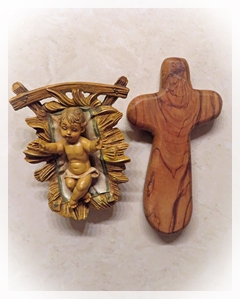
creche and crossPew Research reports that while 90% of Americans celebrate Christmas, more than half of them celebrate it only as a cultural holiday! While they’ll decorate their house with lights and wreaths, trim a tree, send cards, and exchange gifts, Christmas is just an excuse for good food, parties, family gatherings, and presents. While they’re not indifferent to Santa, gifts, merriment, or decorations, like the people of 1st century Palestine, they are indifferent to the Christ child. The shepherds saw the star and sought the babe in the manger and a caravan from the East brought Him gifts, but we don’t read of any townspeople visiting Joseph and Mary. What of the priests and scribes who told Herod where the Messiah would be born? They knew the prophecies but didn’t join the Magi in their quest to find the One who would fulfill those prophecies. Lowly shepherds and men from a faraway land recognized Jesus as the Messiah but most of God’s chosen people ignored the greatest event in all of history.

Some people react to Christmas with antipathy; like Herod, they hate its message. Rather than join the magi and seek the newborn King of the Jews, the enraged Herod slaughtered all of the male babies around Bethlehem in an attempt to kill the king! The “bah humbuggers” are like the atheist who erected a 10-foot 300-pound pentagram just 20-feet from a nativity scene in a Boca Raton park in 2016. Non-believers don’t want a King who might knock them off their pedestals any more than Herod wanted one who could knock him off his throne. They’re uncomfortable with the concepts of sin, salvation, love, sacrifice, obedience and forgiveness that surround Christmas. Then again, maybe they dislike this day simply because Christmas reminds them of the emptiness of their lives.

Some people respond to Christmas as did the angels, shepherds, magi, Simeon, and Anna: with worship. Tonight and tomorrow, people around the world will raise their voices in praise and thanksgiving, light candles, sing carols, kneel in prayer, lift their hands in worship, and share bread and wine at communion. Some will come and adore Him tonight but won’t return to church until next Christmas. But others will ponder the events of this night, as did Mary. They will allow the Christ child to enter into their hearts and lives and affect their every thought, word, and action for the rest of their lives. After extinguishing the Christmas Eve candles, they will continue to let their lights shine all year long. They are the ones who know that God came as a baby and lay in a manger so that He could suffer, die on the cross as a common criminal, and pay the penalty for mankind’s sins. They know that the crèche is meaningless without the cross!

Let us behold, the Lamb of God who takes away the sin of the world!

But Mary kept all these things in her heart and thought about them often. The shepherds went back to their flocks, glorifying and praising God for all they had heard and seen. It was just as the angel had told them. [Luke 2:19b-20 (NLT)]

Copyright ©2019 jsjdevotions. All rights reserved.

WORDS

A word out of your mouth may seem of no account, but it can accomplish nearly anything—or destroy it! It only takes a spark, remember, to set off a forest fire. A careless or wrongly placed word out of your mouth can do that. By our speech we can ruin the world, turn harmony to chaos, throw mud on a reputation, send the whole world up in smoke and go up in smoke with it, smoke right from the pit of hell. [James 3:4-6 (MSG)]

rabbitJames warns of the dangers of an untamed tongue and the damage that can be done with ill-considered words. Although he was speaking of speech, the same goes for the written word. Whether we’re holding a pen, our fingers are speeding across a keyboard, or our thumbs are tapping out a text, our words are powerful. Whether we use them to build or destroy is our choice.

C.S. Lewis, one of the great Christian minds of the 20th century, authored more than thirty books. A man who never used a typewriter, he also was a prolific letter writer. Writing not just to friends and colleagues, he answered every letter sent to him. Most of us probably have trouble responding to someone with a quick email, yet this busy man never hesitated to handwrite a response, even to strangers or children who wrote after reading one of his books or hearing him on radio. More than 3,200 of Lewis’ handwritten letters remain and have been published in various collections. They range from the somewhat mundane (thanking someone for a ham) to the exceptional (reassuring a woman who is afraid of dying).

Often writing more than 100 letters a month, his letters show not just a deep thinker with a brilliant mind but also a compassionate man generous enough to take the time to instruct, explain, empathize, encourage, and reveal himself and his vulnerabilities. Nevertheless, Lewis once complained, “If I didn’t have so many letters to answer, I’d have time to write another book.” His words from another letter, however, explain why he did it: “Ever since I became a Christian, I have thought that perhaps the best, perhaps the only service I could do for my unbelieving neighbours was to explain and defend the belief.” He wrote those letters out of obedience to God and concern for the people who’d written to him.

While many proverbs give dire warnings about imprudent words, the other half of those proverbs often are about judicious ones. That C.S. Lewis’ letters continue to be read today illustrates the power of the written word. Rather than start a wildfire with cruel words, Lewis sowed seeds of Christ with his kind ones; may we do the same. Let us never forget the beautiful things our words, both spoken and written, can do when used wisely and with love!

Words kill, words give life; they’re either poison or fruit—you choose. [Proverbs 18:21 (MSG)]

The words of the wicked kill; the speech of the upright saves. [Proverbs 12:6 (MSG)]

Copyright ©2019 jsjdevotions. All rights reserved.

OUR GATEKEEPER

Be careful what you think, because your thoughts run your life. [Proverbs 4:23 NCV]

Corkscrew SwampActing as gatekeepers for the temple in Jerusalem, the Levites opened and closed its doors and guarded it during the night. Among their many duties, they prohibited entry to anyone considered “unclean,” protected the temple from theft or desecration, watched the offering and tithe money, and maintained proper decorum within the temple. They also were the ones who imposed the death penalty on any who dared enter the temple illegally.

Although many churches have implemented security measures, we no longer have Levites at our church doors. Most of us, however, could use a similar gatekeeper to protect our minds (and mouths) from anything that could defile us. Like crashers at a party, negative thoughts can sneak into our heads. Once in, they tend to prop open the door so more negativity can follow. Anger often brings his pals animosity and resentment. Once fear steals in, worry slips in right behind him; doubt, regret and suspicion are sure to follow. Before we know it, bitterness and hatred have joined the party, along with envy, lust, and their old friend guilt. When our minds are filled with undesirable and unwelcome callers, there’s little room left for any positive thinking. Once those bad thoughts have gotten into our heads, they want to continue their damage by spilling out through our mouths.

The mind’s gatekeeper must be diligent, on duty 24/7, and refuse entry to any thoughts and feelings considered “unclean” or inappropriate. He’d maintain order in house and keep our thinking in line. On the lookout for hazards, he’d steer us away from situations that could bring trouble or temptation. Rather than kill temple trespassers who stepped beyond the warning stone, the gatekeeper would squash any negative words before they could escape!

Unfortunately, the books of Kings and Chronicles tell us that the Temple’s gatekeepers fell down on the job. They allowed the dwelling place of God to be defiled by idolatry and fall into disrepair. When King Hezekiah ordered the Temple’s purification, it took more than two weeks simply to clean it!

At the moment of Jesus’s death, the Temple was no longer the place of God’s presence. Because of Christ, God dwells within each one of us. Having provided each of us with a far better Gatekeeper in the Holy Spirit, Levites are no longer needed at our doors. We, however, must cede control to the Spirit so that He can do His job!

You should know that your body is a temple for the Holy Spirit who is in you. You have received the Holy Spirit from God. So you do not belong to yourselves. [1 Corinthians 6:19 (NCV)]

Those who live following their sinful selves think only about things that their sinful selves want. But those who live following the Spirit are thinking about the things the Spirit wants them to do. If people’s thinking is controlled by the sinful self, there is death. But if their thinking is controlled by the Spirit, there is life and peace.  …The true children of God are those who let God’s Spirit lead them. [Romans 8:5-6,14 (NLT)]

Copyright ©2019 jsjdevotions. All rights reserved.