A NEW HEART

pigsAnd I will give you a new heart, and I will put a new spirit in you. I will take out your stony, stubborn heart and give you a tender, responsive heart. And I will put my Spirit in you so that you will follow my decrees and be careful to obey my regulations. [Ezekiel 36:26-27 (NLT)]

Last Friday, doctors in Maryland made history when they transplanted a genetically modified pig’s heart into a human in a last-ditch effort to save the life of David Bennett, Sr. A medical first, Bennett was too ill to qualify for a routine heart transplant or an artificial ventricular assist device. The 57-year-old’s prognosis is uncertain and it will be months before doctors know whether the transplant can be deemed a “success.” As with any organ transplant, the main risk is that of organ rejection and Bennett will need potent immunosuppressing drugs for the remainder of his life.

I remember how astonished the world was back in 1967 when Dr. Christiaan Barnard performed the first human-to-human heart transplant. The news that a surgeon had cut open someone’s chest, lifted out a diseased heart, and successfully replaced it with a healthy one from a dead donor was astounding. Although that first heart transplant recipient lived only eighteen days, today’s recipients have an 85% chance of living one year and a 69% chance of surviving five. The survival rate continues to decrease through the years with only 50% of heart transplant recipients living ten years and just 15% making 20 years. In spite of the risks, last year over 50,000 transplant candidates worldwide vied for the 5,000 hearts that were available. Sadly, there just aren’t enough hearts to go around.

54 years ago, the medical journals were wrong when they credited Dr. Bernard with the first heart transplant; God has been replacing hearts for ages! He takes our damaged hearts of stone, hearts unwilling to respond to Him, and replaces them with a new heart and spirit. After accepting His new heart, we have no need for immunosuppressive drugs because the new heart won’t be rejected. Unlike transplant candidates, we don’t have to meet specific criteria or put our names on a waiting list. Everyone qualifies and all we have to do is repent! The best news is that there’s no heart shortage and we don’t have to wait for someone to die; Jesus did that for us 2,000 years ago!

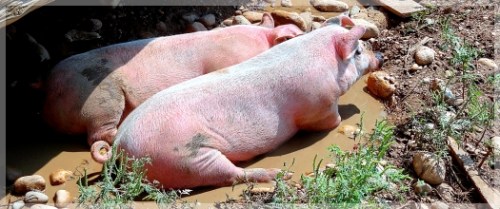
Even with a pig’s heart, Mr. Bennett won’t to want to live in a sty, cool off with a mud bath, snuffle in the soil, or start eating a mix of corn, soybeans, sorghum, and wheat. While his new heart will give him a new lease on life (at least for a short time), it will not change him. He will be the same man with the same favorite activities, world view, media preferences, attitudes, likes and dislikes, morals and principles he had before surgery. On the other hand, the new heart God gives us will make a huge change in us. We will have a new mind, new preferences, new spiritual gifts, new beliefs and morals, a new love for who and what we may have hated, and a new aversion to things we once might have loved. Rather than getting immunosuppressant drugs, we will receive an infusion of love, joy, peace, patience, kindness, goodness, faithfulness, gentleness, and self-control! Getting a new heart in God’s hospital also yields a far better survival rate—no death, only eternal life!

O Holy Spirit, descend plentifully into my heart. Enlighten the dark corners of this neglected dwelling and scatter there thy cheerful beams. [Augustine]

Repent, and turn from your sins. Don’t let them destroy you! Put all your rebellion behind you, and find yourselves a new heart and a new spirit. For why should you die, O people of Israel? I don’t want you to die, says the Sovereign Lord. Turn back and live! [Ezekiel 18:30b-32 (NLT)]

I will give them hearts that recognize me as the Lord. They will be my people, and I will be their God, for they will return to me wholeheartedly. [Jeremiah 24:7 (NLT)]

Copyright ©2022 jsjdevotions. All rights reserved

TAKE ME TO THE WATER

God saved you by his grace when you believed. And you can’t take credit for this; it is a gift from God. Salvation is not a reward for the good things we have done, so none of us can boast about it. [ Ephesians 2:8-9 (NLT)]

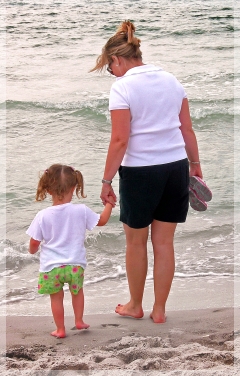
Baptism - affusion In immersion baptism, a person is completely submerged in the water and, every time I witness a full immersion baptism done in the Gulf of Mexico, I think of what it must have been like when John baptized Jesus and the Holy Spirit descended on our Lord. Since the Greek word used to describe this event was baptizo, meaning to dip, sink, or submerge, we can safely assume His was a full immersion baptism.

The water of baptism illustrates dying and being buried with Christ and the coming out of the water illustrates Christ’s resurrection. Baptizo is the word Jesus used when telling the disciples to baptize new believers and, in the early church, full immersion was the norm. There is, however, evidence that affusion, the pouring of water over a person, was used for invalids. Although aspersion, or the sprinkling of water for baptism, is the norm in many mainstream churches today, it did not come into practice until around the 13th century. While today’s Christian church agrees on the importance of baptism, it is divided as to the method and conduct of this sacrament.

In determining the amount of water necessary to make a baptism “official,” it would be easy to become as nitpicky as were the Pharisees of Jesus’ day as they quibbled over specifics of the law. For an immersion advocate, would the baptism be invalid if a person’s hand or some of their hair didn’t get wet and how long must they be under water? For the pourers and sprinklers, how much water is too much and how little water is not enough? If there were no water available, would spittle or tears do? I don’t know the answer but I suspect God is more concerned with matters of the heart than ritual. Since I think our commitment to Jesus is far more important than the method of baptism or the amount of water used, I’m staying clear of that controversy!

Along with the dispute among Christian churches over the method of baptism, there is disagreement on whether baptism is absolutely necessary for salvation. On Pentecost, Peter told the crowd they’d receive the Holy Spirit once they repented, turned to God and were baptized, which seems to support the side claiming baptism is required for salvation. On the other hand, while preaching to the household of Cornelius, Peter asked if anyone objected to the family’s baptism since they’d already received the Holy Spirit. This passage seems to support the side that, rather than a condition for salvation, baptism is evidence of salvation. While Scripture makes it clear that belief is a requirement for salvation, it never clearly says that baptism is, so I’ll leave the meaning of the original Greek text to theologians and scholars.

In the meantime, I’ll look to Scripture’s words that clearly tell us we are saved by grace through faith and not through works, effort or the law. A believer can be saved without being baptized because baptism isn’t how we receive forgiveness of our sins—we are saved by grace through faith in Jesus. Nevertheless, a believer will be baptized because Jesus commanded it!

Granted, I have a distinctly Protestant view of baptism and you are free to disagree. What we can agree on is that, regardless of the method used, it’s never too late to be baptized! Of all the baptisms I’ve witnessed, my favorite is when one of our church family made her declaration of faith at the age of 95.  Too frail for full immersion in the Gulf, while flanked by the pastor and her son, she was baptized (by affusion) in the name of the Father, the Son and the Holy Spirit! Praise be to God!

Indeed, baptism is a vow, a sacred vow of the believer to follow Christ. Just as a wedding celebrates the fusion of two hearts, baptism celebrates the union of sinner with Savior. [Max Lucado]

Jesus came and told his disciples, “I have been given all authority in heaven and on earth. Therefore, go and make disciples of all the nations, baptizing them in the name of the Father and the Son and the Holy Spirit. Teach these new disciples to obey all the commands I have given you. And be sure of this: I am with you always, even to the end of the age.” [Matthew 28 (18-20 (NLT)]

Copyright ©2022 jsjdevotions. All rights reserved.

METAMORPHOSIS

monarch metamorphosisJesus said to him, “For sure, I tell you, unless a man is born again, he cannot see the holy nation of God.” Nicodemus said to Him, “How can a man be born when he is old? How can he get into his mother’s body and be born the second time?” [John 3:3-4 (NLV)]

The being “born again” concept in Christianity isn’t an easy one to understand, yet we see it demonstrated whenever we look at a butterfly. Take the monarch, for example; it starts out as a tiny egg that hatches about four days after being laid. That’s its first birth. The caterpillar actually eats its way out of the shell before munching on the leaf where the egg was laid. Over the next ten to fourteen days, it eats and grows, shedding its skin every time it gets too tight. The full-grown caterpillar then spins silk and attaches its hind end to a leaf, hangs upside down and sheds its skin for the fifth and final time. When the new skin forms, it hardens and takes the form of a chrysalis. The monarch’s chrysalis is a beautiful jade green with little specks of gold and looks like a case that could be used to hold a jewel. Over the next ten to fourteen days, the caterpillar undergoes a metamorphosis. During this stage, the DNA that makes wings is switched on and something almost miraculous happens. When the transformation is complete, the chrysalis bursts open and out emerges a full-grown butterfly. It is born again! The new butterfly hangs onto the chrysalis for a bit, drying its wings and getting stronger, before taking flight and becoming the thing of beauty God meant it to be.

The monarch caterpillar looks and acts nothing like the monarch butterfly and it’s hard to believe they are actually the same creature but they are! The DNA sequence of the caterpillar is identical to that of the butterfly it becomes. The caterpillar, however, no longer exists—it has to die to become a butterfly, much as a person’s old self must “die” when he becomes a follower of Jesus. When we’re “born again,” like the butterfly, we have the same DNA of the person we once were and yet we’re an entirely different creature.

Unlike the butterfly, however, the change is internal not external. Moreover, caterpillars have no choice about whether or not they will become butterflies—they just keep eating and growing and shedding and nature takes its course. On the other hand, people do have a choice about whether they will experience their metamorphosis. They can choose to remain wrapped up in the dark chrysalis of unbelief, a hidden jewel than will never reach its potential, or choose to be reborn in Christ. While there is a scientific explanation for the near-miraculous transformation of a caterpillar into a butterfly, science can’t explain the miraculous transformation that occurs when we are reborn, the Holy Spirit comes to live in our hearts, and we become the things of beauty God created us to be.

We know that our old life, our old sinful self, was nailed to the cross with Christ. And so the power of sin that held us was destroyed. Sin is no longer our boss. When a man is dead, he is free from the power of sin. And if we have died with Christ, we believe we will live with Him also. [Romans 6:6-8 (NLV)]

You have now become a new person and are always learning more about Christ. You are being made more like Christ. He is the One Who made you. [Colossians 3:10 (NLV)]

I have been put up on the cross to die with Christ. I no longer live. Christ lives in me. The life I now live in this body, I live by putting my trust in the Son of God. He was the One Who loved me and gave Himself for me. [Galatians 2:20 (NLV)]

Copyright ©2021 jsjdevotions. All rights reserved.

BUBBLING OVER

Words bubble up from waters deep within a person; a stream gushes from the fountain of wisdom. [Proverbs 18:4 (VOICE)]

Reichenback Falls - Switzerland“A children’s story which is enjoyed only by children is a bad children’s story,” said C.S. Lewis. I agree and admit to enjoying the seven books comprising Lewis’ The Chronicles of Narnia both as a child and an adult. Even though the Narnia books take place in a make-believe world filled with talking animals, mythical creatures, and magic, there are Christian overtones to the entire series. For example, the first book calls up images from Genesis when Aslan, the Great Lion, sings Narnia into existence and evil is introduced to the land. In the second, Aslan willingly dies so that the sins of one boy are forgiven but comes alive again. In another book, Eustace, who had “greedy, dragonish thoughts” becomes a dragon. When Aslan strips away the boy’s scales and throws him into the water, the repentant boy is transformed and images of rebirth and baptism come to mind. Resembling the last book of the Bible, the final story in the series tells of a beast, a false prophet, Narnia’s fall, and a Narnian paradise (where sadness and weariness do not exist).
In spite of the Christian symbolism throughout the series, Lewis never set out to use his fairy tale as a way of writing a “Christian” book for children. “Everything began with images, a faun carrying an umbrella, a queen on a sledge, a magnificent lion. At first there wasn’t even anything Christian about them,” said Lewis. In fact, that image of the faun had been in his mind since he was 16, long before he became a believer. When Lewis began writing The Voyage of the Dawn Treader, he thought it would be the last in the series. He didn’t anticipate writing four more Narnia books and evoking the end times with the last one. How then did his books become “Christian”? The author explained: “That element pushed itself in of its own accord. It was part of the bubbling.”

Without deliberately meaning to do so, Lewis’ deep faith in Christ couldn’t help but bubble over into his work. As the tale solidified, Lewis found himself answering the imaginary question of “What might Christ become like if there really were a world like Narnia, and He chose to be incarnate and die and rise again in that world as He actually has done in ours?” The question, however, came after he’d begun writing the answer.

Lewis’ phrase, “part of the bubbling,” got me thinking. Gifted with a brilliant mind, C.S. Lewis has been called “one of the intellectual giants of the 20th century.” Nevertheless, I don’t think those stories sprang just from his genius; they came from the presence of the Holy Spirit! His genius may have put the words on paper but the spring from which they bubbled over was filled with Biblical truth, Christian doctrine, and love of God. Once Lewis became a believer, he couldn’t help but put Christian ideals and a Biblical worldview into everything he said or wrote.

None of us are likely to be called intellectual giants but, as followers of Jesus, I wonder if what bubbles out of us in our day-to-day existence reflects our faith the way it should. Instead of imagining what Christ would be like in Narnia, perhaps we should consider what He would be like in our world today and then make Him visible in our words and actions. What bubbles from our fountain?

There is but one good; that is God. Everything else is good when it looks to Him and bad when it turns from Him. [C.S. Lewis]

Do not slack in your faithfulness and hard work. Let your spirit be on fire, bubbling up and boiling over, as you serve the Lord. [Romans 12:11 (VOICE)]

Copyright ©2021 jsjdevotions. All rights reserved.

LAS POSADAS – LUMINARIA (3)

Again Jesus spoke to them, saying, “I am the light of the world. Whoever follows me will not walk in darkness, but will have the light of life.” [John 8:12 (ESV)]

I have come into the world as light, so that whoever believes in me may not remain in darkness. [John 12:46 (ESV)]

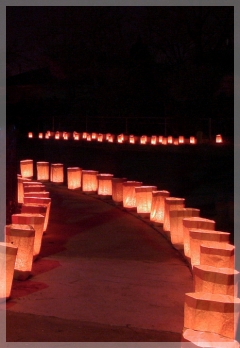
luminariaHundreds of years ago, when Las Posadas was first celebrated, people gathered piñon pine branches into square piles to burn small vigil fires called luminaria to light the way for the Peregrinos as they searched for lodging. On Christmas Eve, bonfires were lit along the roads and in the church yard to guide people to midnight mass. Just as Las Posadas moved into the southwestern states as the Spanish and Mexicans came northward, so did the luminaria. When inexpensive flat-bottom paper bags appeared on the Santa Fe Trail in the 1870s, people started folding down the bag tops, anchoring the bag with a few handfuls of sand, and setting a small candle inside. Better than using precious fire wood, these luminaria (also called farolitos) became the popular tradition that continues in the southwest today.

While I probably won’t be part of any Las Posadas celebrations when I’m in New Mexico next week, I will see plenty of luminaria, even though many of those who set them out know nothing of Las Posadas. Although some of those lanterns will be made of hard plastic and powered by electricity rather than candles, the warm glow of their flickering lights illuminate the walkways, sidewalks, driveways and flat roof tops throughout the state each December.

For those who celebrate Las Posadas, the luminaria serve to light Joseph and Mary’s way as they seek lodging. For others, luminaria guide the way to Christmas Eve worship, are a way of welcoming the Christ child into their homes, or remind them of the star of Bethlehem. Sadly, for many more, their luminaria are lit simply to guide Santa’s gift-laden sleigh to their houses.

Wherever we are this Christmas season, we’re sure to encounter holiday light displays. Whether they’re luminaria, projection spotlights, mini-string or large colored bulb lights, let their brightness remind us that Jesus is the Light of the World. When Christ’s light came into the world, it did more than illuminate our sins. It brought us salvation by guiding mankind out of the darkness of sin and death and into the light of Christ! Jesus called us to lead others into His light but we mustn’t stop at merely pointing the way to Christ. Jesus calls us to be the light—to be His luminaria and provide light for others.

The light of Christ shines brightest in dark and troubled times—and these are dark and troubled times. On a dark night, one individual paper bag holding a flickering candle in it isn’t very impressive and it certainly doesn’t shed much light. Collectively, however, hundreds of luminaria are an impressive sight. Darkness can never overpower God’s light but His light can overpower the world’s darkness. Let us be the world’s luminaria, not just at Christmas, but all year long!

Darkness cannot drive out darkness; only light can do that. Hate cannot drive out hate; only love can do that. [Martin Luther King, Jr.]

You are the light of the world. A city set on a hill cannot be hidden. Nor do people light a lamp and put it under a basket, but on a stand, and it gives light to all in the house. In the same way, let your light shine before others, so that they may see your good works and give glory to your Father who is in heaven. [Matthew 5:14-16 (ESV)]

This is the message we have heard from him and proclaim to you, that God is light, and in him is no darkness at all. If we say we have fellowship with him while we walk in darkness, we lie and do not practice the truth. [John 1:5-6 (ESV)]

Copyright ©2021 jsjdevotions. All rights reserved.

THE LAST SUPPER (Part 3 – Bathing and Washing)

Peter said to him, “You shall never wash my feet.” Jesus answered him, “If I do not wash you, you have no share with me.” Simon Peter said to him, “Lord, not my feet only but also my hands and my head!” Jesus said to him, “The one who has bathed does not need to wash, except for his feet, but is completely clean. And you are clean, but not every one of you.” [John 13:8-10 (ESV)]

Apparently speechless when Jesus washed their feet, John records no one objecting to His doing so until Jesus came to Peter. After protesting that Jesus never would never wash his feet, the Lord warned the disciple that unless he allowed Jesus to wash him, Peter wouldn’t belong to Him. Eager to show his devotion to Jesus, Peter then enthusiastically offered the rest of his body for cleansing. Jesus explained that, because Peter already bathed, only his feet needed washing, while adding that not all of those present were clean. Since we know the rest of the story, we know He was referring to Judas. The reference to Judas not being clean, however, tells us that this exchange is about more than washing the filth of Judah’s roads off the disciple’s feet. Since Jesus wasn’t giving a hygiene lesson, what did He mean?

When Jesus said he must wash Peter’s feet, the Greek word used was niptó, a word used for washing or wetting only a part of the body, as we would with our hands before dinner or as Jesus did with the men’s feet. But, when Jesus said the men already were clean because they had bathed, the Greek word used was louó which meant bathing the entire body as we would in a long hot shower. Using both words in John 13:10, Jesus said that the one who bathed (louó) was completely clean and didn’t need to wash (niptó) except for his feet. What do bathing and washing have to do with mankind’s relationship with Jesus?

The total bath—the louó—occurs when we come to Jesus. It is when our sins are forgiven “as far as the east is from the west” [Psalm 103:12] and our scarlet sins are made “as white as snow.” [Isaiah 1:18] Once-and-done, the bath of salvation does not need to be done over and over again. With the exception of the unclean Judas, all of the disciples had bathed by trusting and believing in Jesus. When Jesus died on the cross, He paid the price for our sins (past, present, and future) once and for all time.

Having once been bathed and made new in Christ, we don’t need another bath. That our eternal salvation is secure in Christ, however, doesn’t negate the need to repent of our daily sins and ask for His forgiveness. No matter how clean they were every morning, the disciples’ feet got soiled while walking through Judah’s dirt so they needed to be washed daily. As clean as we are because of bathing in the righteous of Christ and try as hard as we might, we’re bound to step in some mud puddles and become soiled by the world’s sins as we walk through life in our fallen world. If we want to walk in daily fellowship with our Lord, we must confess and repent of the sins that soil us and allow Jesus to wash (nipto) away the filth of our fallen world every day. Salvation (the bathing) is a one-time act but sanctification (the washing) is a lifelong process; it is what allows His forgiveness to change our lives.

If we say we have no sin, we deceive ourselves, and the truth is not in us. If we confess our sins, he is faithful and just to forgive us our sins and to cleanse us from all unrighteousness. [1 John 1:8-9 (ESV)]

Copyright ©2021 jsjdevotions. All rights reserved.