
Then Jesus left the Jordan, full of the Holy Spirit, and was led by the Spirit in the wilderness for forty days to be tempted by the devil. He ate nothing during those days, and when they were over, he was hungry. [Luke 4:1-2 (CSB)]
 Lent begins on Wednesday. Beginning with the solemn reminder that we are but dust and to dust we shall return and concluding with Christ’s victory over death on Easter Sunday, the season’s forty days represent the time the Lord spent alone in the wilderness, fasting in preparation for his ministry, and undergoing Satan’s temptations. A period of self-discipline and repentance, Lent often is observed by such things as contemplation, confession, prayer, fasting, moderation, service, and giving
Lent is a season of self-denial but not for the sake of self-denial; it’s about emptying ourselves as we take up our crosses to follow Jesus! Sometimes, we’re so full of ourselves, there’s not enough room for God. Lent is about having less of us so there is more of Him! We can choose to fast—which is abstaining from food—or choose to abstain from some pastime or habit that may be impeding our relationship with God. The purpose of fasting or abstaining is to develop a hunger for God that is greater than our craving for the temptations and pleasures of life.
Like the beginning of a new year, Lent affords us an opportunity to do some serious soul searching. Have we cooled in our devotion to the Lord and our enthusiasm for His work? Are we using our time, talents, and spiritual gifts as God wants them used? Is there anything hindering our relationship with the Lord? Do we need to realign our hearts and have a spiritual reset? If so, Lent is an opportune time to prayerfully turn away from the small pleasures, indulgences, and bad habits or influences that have distracted or derailed us spiritually. The self-denial of Lent is abstaining from anything (other than God) that ordinarily fills a need we have—whether food, drink, shopping, or some other indulgence or guilty pleasure. Giving us gratification and comfort, it is taking up space in our hearts that rightfully belongs to God!
Andrew Murray describes fasting this way: “Fasting helps express, deepens, confirms the resolution that we are ready to sacrifice anything, even ourselves, to attain what we seek for the kingdom of God.” Simply put, fasting and abstinence are ways to show God that He is more important to us than any pleasures of this world. Whether we give up certain foods or meals, computer games, Net Flix, social media, or our free time to work in the homeless shelter, Lent is a time to reorganize our priorities and put God where He rightfully belongs—in the center of our lives!
Nothing in Scripture demands Lent’s observance; if and how we observe Lent is a personal choice. Nevertheless, my prayer for you is that these next six weeks will be ones of spiritual renewal and growth.
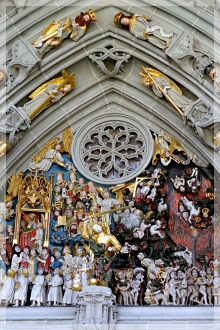 Before stepping inside of the Bern Münster Cathedral, you’ll probably stop and stare at the archway above the main entrance. There you’ll see 294 carved sandstone figures in a graphic illustration of God’s final judgment when the wicked are separated from the righteous. To your right are the naked damned souls in the midst of flames while, on your left, the righteous stand clothed in white and marked with the seal of God on their foreheads. Lady Justice with her scales and the Archangel Michael with his sword stand in the center. The entire scene is surrounded by larger statues of various saints and martyrs as well as the five wise virgins and the five foolish ones who weren’t ready for the bridegroom’s return!
 I came across an article questioning whether we have to believe certain things to be a Christian or is it enough just to trust God. The author believed that Christians don’t have to “assent intellectually” to the facts of traditional Christian teaching or agree with the Christian creeds. “Faith” to the author is simply placing one’s confidence in “Spirit” (not the Holy Spirit) and following Jesus’ teaching is more important than believing certain things about Him. Having nothing to do with dogma or creeds, Christianity was seen as a wisdom tradition and way of life rather than a belief. Claiming they were “man-made” and date from the 4th century and Emperor Constantine, the author believed Christianity’s creeds should be disregarded.
 Because the literacy rate in the 1st century was around 10 to 15%, only a few people could read the Hebrew Scriptures or Apostolic letters. By necessity, the new faith came about through public reading and preaching. In his letter to Timothy, the Apostle Paul warned of a time when sound doctrine would no longer be tolerated. Rather than reproof, rebuke, exhortation, and instruction, people would want to have their itching ears knéthó (meaning tickled or scratched). Rather than knowledge and doctrine, they’d be more interested in myths, sensationalism, and viewpoints suiting their desires. I fear that time has come!
 The early Christians often marked anniversaries of the martyrdom of Christ’s followers. By the fourth century, however, there’d been so many martyrs that there weren’t enough days to honor them all and the idea of one feast day honoring all the martyrs began. In 609, Pope Boniface IV established an All Saints’ Day in May. After Christianity came to Ireland, however, the Roman church attached the Feast of All Saints to the pagan holiday of Samhain (a celebration of the end of the harvest and precursor to Halloween). In 847, Pope Gregory IV formally rebranded this pagan Celtic festival as All Saints Day. Saturday, November 1, is All Saints’ Day and, regardless of your denomination, it remains a day to commemorate all of the saints, not as determined by any Pope, but as defined in the Bible.
 “Chocolate comes from cacao beans. Beans are vegetables. Salads are made of vegetables. Therefore, chocolate is a salad!” said the sign in the bakery. “I like their logic!” I thought. If you’ve ever tried to lose weight you probably know the loopholes used by dieters. Broken cookies have no calories because they fell out when the cookies broke, anything eaten with a diet soda is calorie-free, and food eaten off someone else’s plate doesn’t count because the original calories belong to them! Technically, anything licked off a spoon while preparing food isn’t eating; it’s cooking! Furthermore, if you’re eating with someone else, you’ve kept to your diet if the other person consumes more than you! As a once struggling dieter, I know all the excuses to justify over indulging. The worst lies are the ones we tell ourselves and, unfortunately, most of them aren’t as silly as these.
 Devotions of the Heart