BLESS YOU

May the Lord bless you and protect you. May the Lord smile on you and be gracious to you. May the Lord show you his favor and give you his peace. [Numbers 6:24-26 (NLT)]

crabappleThe Lord instructed Moses that this prayer was to be used by Aaron and his descendants (Israel’s priests) as a blessing for the people of Israel. Since then, this familiar benediction, often said at the end of a worship service, has been used by synagogues and Christian churches throughout the world.

There’s another blessing that’s been around for centuries: saying “God bless you!” after a sneeze. The source of this tradition is murkier than the source of that beautiful benediction. It may have been because of an ancient superstition that the soul left the body during a sneeze; the blessing was a way to keep evil spirits from invading the sneezer while his soul was out wandering. Another notion was that a sneeze expelled evil spirits and the blessing kept those spirits from invading a new person. Some people thought that one’s heart stopped beating during a sneeze so the blessing welcomed the sneezer back from the dead.

Some scholars credit Pope Gregory I with starting this pleasant tradition. During an outbreak of the bubonic plague in the late 6th century, the Pope commanded unceasing prayer to stop the epidemic. Since sneezing and coughing were plague symptoms, he asked that a sneezer be immediately blessed so he wouldn’t develop the disease. How ever it came to be, “God bless” following a sneeze is considered common courtesy. What does is actually mean when we ask God to bless someone?

A blessing is a divine gift (whether spiritual, physical, or material) that either directly or indirectly affects the life, health, or well-being of an individual or community. As with any true gift, a blessing is offered unconditionally. When we ask God’s blessings on someone, we are asking for God’s divine favor to rest upon him or her. It’s a prayer that God will care for someone and keep that person from harm. It’s a request for God’s kindness and mercy to someone. A blessing asks God to shower someone with His approval and to bring him or her harmony and peace.

We’re not Levitical priests, bubonic plague is not a concern, and we know our spirits don’t run off nor do our hearts stop beating when we sneeze, so we don’t need to ask God’s blessing on someone for any of those reasons. What does God’s command to Moses mean to us? As Christians, we are members of a royal priesthood. As Christ’s priests, we are called to bring His love into this dark and troubled world. Asking God’s blessing upon someone is more than good manners; it’s our job. We shouldn’t save the words “God bless you!” to be said unthinkingly only when people sneeze. As His priests, we should sincerely, thoughtfully, and regularly be asking for God’s blessings upon all of His people. May God richly bless you!

And you are living stones that God is building into his spiritual temple. What’s more, you are his holy priests. … You are royal priests, a holy nation, God’s very own possession. As a result, you can show others the goodness of God, for he called you out of the darkness into his wonderful light. [1 Peter 2:5,9 (NLT)]

May the Lord richly bless both you and your children. May you be blessed by the Lord, who made heaven and earth. [Psalm 115:14-15 (NLT)]

Copyright ©2019 jsjdevotions. All rights reserved.

STARS

who would you be for a day?Call to me and I will answer you, and will tell you great and hidden things that you have not known. [Jeremiah 33:3 (ESV)]

The bulletin board outside the auditorium posed this question: “If you could be someone famous for a day, who would you be?” People had written their answers on paper stars and pinned them to the board. Including both living and dead, the answers ranged from entertainment, royalty and sports to technology, government, and the arts. They included Thomas Edison, Beyoncé, Georgia O’Keefe, Chrissie Evert, Isaac Newton, Thomas Jefferson, Maya Angelou, and Coco Chanel. Oprah received several stars as did Alexander Hamilton, Audrey Hepburn, and Michele Obama. Warren Buffet was the only entrepreneur listed but someone else was satisfied to be “any rich person;” one man wished to be Penélope Cruz’s husband.

I looked at the stars and pondered my answer. Although God had one star, He certainly wouldn’t be my choice. I have enough trouble running my life; running the universe, even for just a day, would be way too much responsibility for me. In the end, I had to agree with the one star that said “Me;” being me is all I can manage. This exercise, however, reminded me of a similar question asked in our small group: “If you could have a conversation with someone famous, who would it be?”

Even though I wouldn’t have much in common with sport stars like Joe DiMaggio or Bobby Orr and probably wouldn’t understand Giacomo Puccini or Leonardo DaVinci, I would enjoy being in the presence of nearly everyone whose star appeared on the board (with the exceptions of Christopher Hitchens, Hugh Hefner and whoever is Penelope Cruz’s husband). If I actually did have an opportunity to meet with one of those people, you can be sure I wouldn’t waste my time talking about me, my background, ambitions, needs and desires. A conversation with Bishop Desmond Tutu, Florence Nightingale, or even Lucille Ball would have no point if I never let them get a word in edgewise. I’d want to hear what they had to say: to ask about them, to know what was important to them, what made them tick, and what advice they’d pass on to me.

Alas, with one notable exception, most of us will never have the opportunity to converse with any of the people whose names were on that bulletin board. The exception, of course, is God, the greatest one of them all. Unlike all of those stars we’ll never meet, we can talk with God in prayer any time we want. Prayer gives us the opportunity not just to know about God but to actually know Him—to have a relationship with Him—and not just for a day, but forever!

I wonder why I’m so willing to jabber on when talking with God—the one who knows all things—when I’d quietly listen intently to a celebrity. The creator of the universe doesn’t require my guidance on world management any more than Ina Garten needs my cooking advice or Billie Jean King needs my tennis pointers. God doesn’t need me to tell Him what it is I need or want and He certainly doesn’t need me to list my concerns or register my complaints; He already knows all there is to know about me! In fact, He knows what I need before I know I even need it!

It is when we quiet our voices that we can hear the voice of God. Thomas Merton describes this listening or contemplative prayer as “not so much a way to find God as a way of resting in him whom we have found, who loves us, who is near to us, who comes to us to draw us to himself.” Let us bask in His presence; let us pray.

Prayer is not asking. Prayer is putting oneself in the hands of God, at His disposition, and listening to His voice in the depth of our hearts. [Mother Teresa]

Be still, and know that I am God. [Psalm 46:10a (ESV)]

And when you pray, do not heap up empty phrases as the Gentiles do, for they think that they will be heard for their many words. Do not be like them, for your Father knows what you need before you ask him [Matthew 6:7-8 (ESV)]

Copyright ©2019 jsjdevotions. All rights reserved. 

THE MIDDLEMAN

Truly, I say to you, whoever says to this mountain, “Be taken up and thrown into the sea,” and does not doubt in his heart, but believes that what he says will come to pass, it will be done for him. Therefore I tell you, whatever you ask in prayer, believe that you have received it, and it will be yours. [Mark 11:23-24 (ESV)]

zinniaA pastor friend shared a story about a woman at a previous church who had an odd habit. Whenever the pastor announced a change of some kind, more often than not, she would say to him, “I’m so thankful. I’ve been praying you would decide to do that.” When curiosity overcame him, he asked “Instead of using God as a middle man, why don’t you just tell me what you’re thinking or want changed?” Revealing that she was a preacher’s kid, the woman told of the officious interference, meddling, criticism and complaint her father had endured during his ministry. In fact, the often unchristian fault-finding behavior of his parishioners nearly turned her away from the church. She vowed that, unless asked, she’d never tell a pastor what she thought he should do. Instead, she’d simply pray about it and, “if it is God’s will, then He will reveal it to the pastor.” Apparently, as she discerned, God makes an excellent “middle man!”

When hearing this story, I couldn’t help but wonder at my behavior. Do I see God as the Middleman—the conciliator, the peace-maker, the intermediary, the one who brings two opposing parties to the table and brokers the deal—or do I see Him as the court of last resort? Do I go to Him first or only when I can’t get the desired result on my own? Would I rather intrude, advise, instruct, complain or criticize than pray?

We say we believe in the power of prayer but do we really? Do we truly believe that God really hears us? Do we trust Him enough to put our concerns into His hands before taking them elsewhere? Do we really believe in a God who can make things happen—a God who can move mountains—or do we think He needs our help? If we believe God can move mountains, why is it so difficult at times to believe that He can move hearts? While going through a middleman often seems the indirect and a roundabout way to get things done, when that Middleman is God, both hearts and mountains can be moved!

Of course, there’s another more subtle lesson in the pastor’s story. Do we pray regularly for our clergy? I don’t mean those formal prayers for the church found in various liturgies. We consistently must pray for our specific pastors—not that they’ll do what we want them to do but that they will have the energy, strength, wisdom, and courage to do what God wants them to do!

And this is the confidence that we have toward him, that if we ask anything according to his will he hears us. [1 John 5:14 (ESV)]

Now to him who is able to do far more abundantly than all that we ask or think, according to the power at work within us, to him be glory in the church and in Christ Jesus throughout all generations, forever and ever. Amen. [Ephesians 3:20-21 (ESV)]

Copyright ©2019 jsjdevotions. All rights reserved.

NO APPOINTMENT NECESSARY

sanderlingsFor I am the Lord, your healer. [Exodus 15:26b (RSV)]

In that hour he cured many of diseases and plagues and evil spirits, and on many that were blind he bestowed sight. And he answered them, “Go and tell John what you have seen and heard: the blind receive their sight, the lame walk, lepers are cleansed, and the deaf hear, the dead are raised up, the poor have good news preached to them. [Luke 7:21-22 (RSV)]

Here in southwest Florida it’s “season,” which means that flocks of snowbirds have arrived (and I don’t mean the kind with wings). While they boost the economy, locals groan at the busy traffic, the difficulty of getting into their favorite restaurants or hair salons, and the scarcity of parking places. One of the biggest problems is seeing a doctor! If we can find a doctor (or dentist) who is taking new patients (a challenge in itself) and takes our insurance, we’ll find a two month or longer wait before getting an appointment. Then, if we’re referred to a specialist, the whole routine begins again. As for urgent care clinics; unless the situation is life threatening, there is nothing urgent about the care one eventually receives. My best advice during season is not to get sick!

Our God truly is the Great Physician but, unlike the doctors in our town, He’ll take new patients. He won’t make us fill out detailed medical history forms; rather than past illnesses, He’s concerned about our wellness in the present and future. Insured or uninsured, Medicare or Medicaid, co-pay or no pay, it makes no difference; Jesus already paid our fee. God will never turn us away as incurable or hopeless because there are no lost causes in His office and He’ll never refer us to someone else because He specializes in whatever is ailing us. Best of all: no appointment is ever needed. God operates a walk-in clinic where the waiting room aways is empty and the doctor always is in!

At first, God being available 24/7 and taking His time during an appointment sounds like the concierge medicine that has become so popular in our area. God, however, doesn’t limit the number of patients in His practice nor does He require a hefty retainer fee before He gives you His number or listens to your complaint. God never takes a vacation and always has enough time and energy to deal with everyone who calls Him. Like a concierge physician, however, God is strong on preventative medicine: regular prayer, Bible study, Christian fellowship, and eating frequently at His table.

Of course, as with any physician, if we don’t recognize our sickness and the need for healing, we won’t call Him. We must have faith in our doctor’s wisdom and skill and follow his directions completely and we must do the same with our Great Physician. While He won’t be prescribing Lipitor, a flu shot, or more exercise, He’ll probably prescribe a healthy dose of repentance, forgiveness, love and prayer. Instead of giving us medical brochures about our condition, He’s already provided us with something better than the Merck Manual: Holy Scripture. As for any sort of long-term therapy—among other things, God is sure to recommend Christian community and service.

Our Great Physician hears our painful cries and heals our troubled souls. Thank you, God.

And when Jesus heard it, he said to them, “Those who are well have no need of a physician, but those who are sick; I came not to call the righteous, but sinners.” [Mark 2:17 (RSV)]

As for me, I said, “O Lord, be gracious to me; heal me, for I have sinned against thee!” [Psalm 41:4 (RSV)]

Copyright ©2019 jsjdevotions. All rights reserved.

NO WHINE ZONE

Lake Maligne - CanadaNot that I was ever in need, for I have learned how to be content with whatever I have. [Philippians 4:11 (NLT)]
Perhaps it was because of the dreary weather, but I started my litany of complaints as soon as I got out of bed. It was chilly and damp (by Florida standards) and my arthritic knees ached. As I gingerly walked across the cold tile floor, I remembered a friend whose rheumatoid arthritis has left her unable to walk even moderate distances. In spite of a few creaky joints, I still manage to get in my 10,000 steps every day. As dreary as the day was, the only reason I didn’t complain about the weather is that, even at my grouchiest, I know that a bad winter day in southwest Florida is better than a good one just about anywhere else!

Nevertheless, my moaning and groaning continued as I faced the mirror and saw those pesky gray roots peeking out from my colored hair. I grumbled about those until I recalled my many friends who lost their tresses to chemo-therapy and radiation. I scrutinized the age spots on my face and the wrinkles around my eyes and then remembered my elderly friend whose skin cancer left him without an eye. While I was on a roll, though, I looked with disdain at my old lady neck and remembered Nora Ephron’s words: “You have to cut open a redwood tree to see how old it is, but you wouldn’t if it had a neck.” Truer words were never said but, before I could even voice that grievance, I thought of a friend’s wife who lost both her jaw and life to cancer; had she lived into her 70s, I don’t think she’d be complaining about a crepey neck.

Not yet done with negativity, though, I grumbled because the sundress I’d planned on wearing wouldn’t be warm enough. As I browsed through my over-full closet to pick a warmer outfit, I thought of all those people who have no closet stuffed with clothing, pantry filled with food, or furnace running to keep them warm. “Shame on me!” I thought, but I wasn’t done yet with my litany of complaint.

Later that morning, I became annoyed that my limping husband can no longer keep up with me. Before I could bemoan the fact that we can no longer ski together, I remembered the man who pushes his wife’s wheelchair along the boardwalk every morning. I’m sure they both would be thrilled if she could walk, even with a limp! I then thought about the neurosurgeon without whose skill my spouse couldn’t walk at all. There are many places in the world where the speedy and expert treatment my husband received would be unavailable and, like that woman, he would need a wheelchair.

“Count your blessings!” my mother used to say, but I’d wasted a fair amount of the morning counting petty complaints instead. How easy it is to gripe about stupid little things and forget how fortunate we really are. When I need an attitude adjustment, as I so desperately did that morning, I find reading Psalm 100 an excellent antidote to a case of the grumbles. My spirits improved once I’d stopped whining, taken stock of the many blessings of my life, and thanked God for them. While some of us are “glass half full!” kind of people, others are more of the “glass half empty!” sort. What we need to remember is to be thankful that we have a glass at all! Indeed, “Give thanks to him and praise his name.” 

The Lord afflicts us at times; but it is always a thousand times less than we deserve, and much less than many of our fellow-creatures are suffering around us. Let us therefore pray for grace to be humble, thankful, and patient. [John Newton]

Shout with joy to the Lord, all the earth!
Worship the Lord with gladness.
Come before him, singing with joy.
Acknowledge that the Lord is God!
He made us, and we are his.
We are his people, the sheep of his pasture.
Enter his gates with thanksgiving;
go into his courts with praise.
Give thanks to him and praise his name.
For the Lord is good.
His unfailing love continues forever,
and his faithfulness continues to each generation. [Psalm 100 (NLT)]

Copyright ©2018 jsjdevotions. All rights reserved.

PERSEVERING PRAYER

O Lord, God of my salvation, I cry out to you by day. I come to you at night. Now hear my prayer; listen to my cry. For my life is full of troubles, and death draws near. [Psalm 88:1-3 (NLT)]

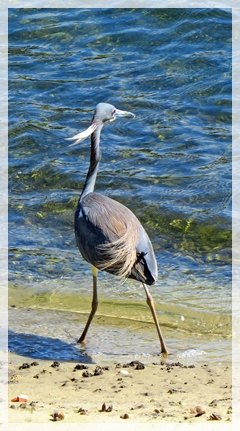
tri-colored heronLast month, a man crashed his car into the frigid waters of the Klamath River in California. Although the accident occurred around 3:00 in the morning, the nearly submerged upside-down car wasn’t reported until 5:30 AM. The dive team finally was able to attach a cable to its undercarriage and tow the vehicle to dry land at 8:00 AM. By this time, thinking it a recovery rather than a rescue operation and with airbags blocking the windows, no one expected to find anyone alive in the car. When the team commander opened the door, however, he heard the words, “Help me!” The car’s driver had survived nearly five hours in icy water while breathing from an air pocket in the car. I have no idea whether the man was a believer but I imagine he might be one now.

This morning, I thought of that man when reading Psalm 88. Although I think the psalmist, Heman the Ezrahite, was writing metaphorically about death drawing near, being “as good as dead,” standing “helpless and desperate,” in “the darkest depths,” with “wave after wave” engulfing him, in a “trap with no way of escape,” and with terrors swirling around “like floodwaters” that engulfed him completely, those words sounded as if they could have been penned by the driver of that submerged car. Alone, in darkness, in a frigid river, desperately trying to keep his head above water, fearful of running out of air, and thinking he’d met his end, I wonder if that frantic man prayed as passionately as did Heman in his psalm.

In his prayer, the despairing Heman doesn’t mince words; nothing is concealed. He lays his miserable life out for God (and everyone else) with brutal honesty. Grieving and in desperate need, estranged from friends and loved ones, he complains that darkness is his closest friend. Yet, in spite of his list of afflictions, there are no accusations, calls for revenge, or anger; there is just woeful resignation, acceptance, and entreaty.

While this is a psalm of lament, it is also one of trust, hope and perseverance. Freely expressing his discouragement and complaint, the psalmist calls to the God of his salvation. Knowing that God is sovereign over his suffering, he also knows God is sovereign over his relief. Even though it seems as if his prayers aren’t being heard, Heman tirelessly continues to pray, crying out to God “day by day” and at night.

I’ve never been gasping for air in an upside down car submerged in icy water and I don’t think I’ve ever been as desperate as Heman must have been when he wrote his psalm. Nevertheless, that doesn’t excuse me from my often sporadic, passionless and perfunctory prayers. Why does it seem that we must be in trouble, in desperate straits, in need of rescue, or in deep despair before we are as forthright, fervent and constant as Heman in our prayers? Shouldn’t every one of our prayers be said with the same level of urgency, ardor, honesty and emotion? Could some of our prayers remain unanswered simply because we haven’t offered them as earnestly as did Heman? What will it take before we pray with his passion? I certainly hope it doesn’t involve an overturned car floating down a river.

When you pray, rather let your heart be without words than your words without heart. [John Bunyan]

I am in a trap with no way of escape. My eyes are blinded by my tears. Each day I beg for your help, O Lord; I lift my hands to you for mercy. … O Lord, I cry out to you. I will keep on pleading day by day. [Psalm 88 8b-9,13 (NLT)]

The earnest prayer of a righteous person has great power and produces wonderful results. [James 5:16b (NLT)]

Copyright ©2019 jsjdevotions. All rights reserved.