
I heard an unknown voice say, “Now I will take the load from your shoulders; I will free your hands from their heavy tasks. You cried to me in trouble, and I saved you.” [Psalm 81:5b-7a (NLT)]
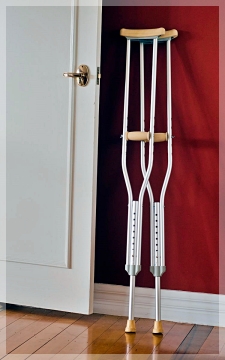 “He’d always looked at religion as a crutch for people who were too scared to do life by themselves,” is the way author Chris Fabry described a character in his book June Bug. That description made me think of Karl Marx’s frequently paraphrased statement: “Religion is the opium of the people.” Sigmund Freud had an equally low opinion of religion and described it as a form of wish fulfillment. Thinking of religion as little more than a man-made coping mechanism for dealing with the harsh realities of life, Fabray’s character, Marx, and Freud disparaged it along with things like crutches and pain relievers.
As the body’s early warning system, physical pain is what tells us there’s something wrong with our body. But, when excessive pain interferes with our quality of life, it needs to be dealt with. Pain relievers work with our body’s cells, nerve endings, nervous system, and brain to mitigate the pain we feel. While I’ve never taken opium, between assorted broken bones, sprains, torn ligaments, compressed nerves, and surgeries, I’ve used a variety of prescription pain medications to ease my pain and promote the healing process.
As for God being my opiate—while prescription medications help me through my physical pain, it is God who leads me through the dark valleys of grief, fear, loss, betrayal, doubt, pain, and depression that assault us in this earthly life. Like pain meds, God can be habit-forming, but the similarities end there. Unlike pain meds, His long-term use is highly recommended, no prescription is necessary, and He has no dangerous side effects. While I was thrilled to say good-by to pain meds, I never want God out of my life! He has lessened the anguish, sorrow, loneliness, and heartache of my life better than any drug ever could. He is the only prescription for the sin sick soul!
Moreover, many of those ailments and surgeries I’ve experienced required me to use crutches, a knee scooter, or a cane in order to make up for my loss of strength, range of motion, stability, coordination, and endurance. When I’ve been left with only one leg on which to stand, those devices helped me balance and stand steady by broadening my support base.
Just as crutches reduce the weight load on a weak or injured leg, a relationship with God certainly reduces the burdens of life. Like crutches, my faith in God supports me; it gives me strength and stability and keeps me from falling. God holds me steady when I’m unsure, keeps me in balance when I’m over-whelmed, and enables me to walk through the rough patches without stumbling! When I step away from Him and fall, He lifts me up again! God is even better than a crutch because, when I can go no further, He’s been known to pick me up and carry me! I will happily live in God dependence, using God as a crutch rather than live in independence only to trip and fall.
While Marx and Fabry’s character look at pain meds and walking aids with disdain, I look to them with gratitude! I don’t take offense at someone thinking of my faith in God as a crutch or drug. When properly prescribed and used, painkillers and crutches help us cope with the challenges of living with broken bodies. While they are man-made and imperfect, God isn’t! It is His hand that touches me and brings healing to my heart and soul as well as my body! I’m more than willing to admit that I’m too scared to do life by myself. It is because of God that I can cope with the challenges of living in a broken world!
As for Freud’s wish fulfillment—God has given me more than I possibly could have wished for in even my wildest dreams. He’s done more than merely fill my cup with enough; because of God, my cup “runneth over” with peace, purpose, love, and joy!
 I lost my first father the same year I gained my second one. I only had my birth father for twenty years, but I was blessed to have my father-in-law for thirty-seven! Dad J lived his life well—with vigor, enthusiasm, joy, laughter, and a whole lot of love. Compassionate and generous, responsible and helpful, good-humored and resourceful, he was a man of faith and integrity (with a large dose of mischief on the side). The Bible might describe him as a man after God’s heart.
 While editing photos, I came to one of a pipevine swallowtail. Seeing it on my computer rather than the camera’s viewfinder, I realized it had seen far better days. Its once beautiful wings were tattered and torn, only one “tail” remained, an antenna was missing, and, with many of its scales gone, its wings were more translucent than iridescent blue. Perhaps it had a close call with a predator, the wind had tossed it around, or it simply was old. In any case, it was damaged goods and no longer beautiful.
 As we continued our brief study on prayer, one person shared that his prayer frequently is for patience. Agreeing, I admitted often praying, “Lord, please give me patience…and give it to me now!” While patience is a fruit of the Spirit, I have a problem getting it to grow in the garden of my life.
 As we came together in worship, each of us bringing the Lord our own private sins, sorrows, doubts, and fears, the hymn’s words, “Just as I am… I come, I come,” seemed a fitting way to start the service. Because its heartfelt words are so relatable, Just as I Am is one of my favorite hymns. Curious about its origin, I learned that its words were written by a Victorian hymn writer named Charlotte Elliott. The daughter of an evangelist, she suffered a serious illness at the age of 32 that left her an invalid for the rest of her life. Angry about what she perceived as uselessness because of her disability, Elliott became severely depressed and spiritually lost. After a visiting minister counseled her to come to Jesus, she asked how she could come to Him when all she had was her anger, sadness, questions, and broken body. The clergyman’s response was simple: “Come to Him just as you are.” Although she gave her life to Christ at that time, she continued to be plagued by depression.
 Devotions of the Heart