
Live like free people, but don’t use your freedom as an excuse to do evil. Live as those who are serving God. [1 Peter 2:16 (ERV)]
 “Get Fuzzy,” a comic strip drawn by Darby Conley, chronicles the life of Rob and his somewhat eccentric pets: Bucky Katt, a temperamental feline with “cat-attitude,” and the gentle Satchel Pooch who frequently is the butt of Bucky’s jokes and the target of his bullying. In one comic, Satchel pondered the concept of free will. “Having free will means you also have the freedom to not,” says the dog, who then resolves, “I choose to exercise free won’t and not get mad.”
In studying the human brain, neuroscientists have discovered that there is a brief instant between when the brain tells the body to get ready to act and the action itself. That nanosecond is when our mind can implement its veto power—when it truly can exercise “free won‘t”!
We are usually so busy touting all of the things we’re free to do, that it is refreshing to consider the things we’re free not to do. Unfortunately, we don’t exercise that freedom nearly enough. Eve and Adam tasted the forbidden fruit, the Israelites worshipped a golden calf, David pursued Bathsheba, Jacob stole his inheritance, Judas betrayed Jesus, and Lot’s wife took a last look. Sadly, they didn’t exercise their freedom to say “No!” Admittedly, I frequently fail at implementing my “free won’t.”
The ability to not choose a thought or action is as important as the ability to choose them. We don’t have to indulge our every notion or whim. Remembering that we can veto as easily as we can approve, all of our choices should be conscious ones—ones where we deliberately choose between will or won’t.
Unfortunately, by the end of the comic strip, Satchel, who had been sorely vexed by Bucky, exclaims that, “I’m starting to get a little free maybe-the-*@#!-I-will after all!” His frustration sounds a bit like us when we try to exercise self-control solely on our own. Fortunately, unlike Satchel, we have a secret weapon: the Holy Spirit. Through God’s power, when tempted, we can exercise the freedom to not respond and make our free will become free won’t!
 When I sit in front of my computer to start writing, I often wonder what makes me think I am qualified to spread the good news of the Gospel. I take comfort in the Apostle Paul’s similar feelings of inadequacy. Of all the people we meet in Scripture, Paul’s credentials (other than those of Jesus) seem to be the most impressive. Fluent in Hebrew, Aramaic, and Greek, from the tribe of Benjamin, and a second-generation Pharisee who had studied and trained under the respected Gamaliel, Paul was well-versed in the Hebrew Bible and passionate for Jesus. Yet, we know that even he sometimes felt inadequate to the task. Although extremely knowledgeable, by his own admission, his preaching ability left much to be desired.
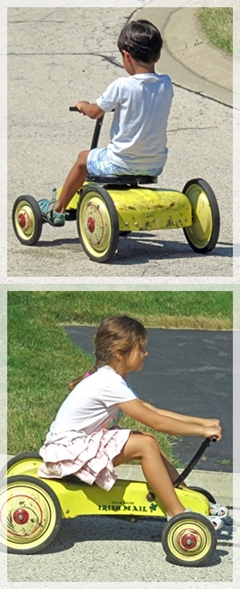 The thing I’ll miss most when we move to southwest Florida permanently is easy access to my grandchildren. This summer I’ve relished watching the little guys frolic in the sprinkler, race their scooters down the sidewalk, climb the monkey bars, decorate the driveway with colored chalk, and play bags with their cousins. They insisted on helping in the kitchen, offered to set the table, listened intently to every story read to them, and never tired of endless games of Crazy-Eights and Kings’ Corners. Their squeals of delight at the holiday fireworks and when they mastered riding the Irish Mail (where they pumped with their arms and steered with their feet) were music to my ears. They asked endless questions and pondered every answer. Wanting to please us, they even were obedient. Seeing their unbridled enthusiasm, energy, and desire both to learn and please, I wondered why I wasn’t like that. After all, God wants us to be like children.
 The book of Genesis is filled with thoughtless decisions that led to trouble. Although Eve knew the forbidden fruit would give her the knowledge of good and evil, I doubt she asked herself why she wanted it, what she’d do with it, or how God would react to her disobedience when she ate it. Look at Sarah with her bright idea to give Hagar to Abraham to make a baby. Did she pause and consider how she’d feel about sharing her husband with her maid or that Hagar and the child would be a constant reminder of her own infertility? Did Lot’s wife think to ask herself why she’d been told neither to stop nor look back at Sodom before she took that fatal last look?
 Her neighbors probably thought she’d lost her mind when she sent her boys out to ask for empty containers. Shutting the door certainly kept out the creditors, naysayers, and doubters along with any talk of unbelief that could hinder the widow’s faith. That closed door shut out interruptions, distractions, anxieties, and whatever else that might have kept the widow from focusing on God. Because that shut door even kept out Elisha, there was no mistaking who was responsible for the flowing oil: God!
 When writing about Elisha, the widow, and the oil, I thought the first conversation between the prophet and distraught woman worth a deeper look. From their exchange, it is clear that the prophet either knew or knew of the widow’s husband. One of Elisha’s followers, the widow reminds the prophet of how much her husband revered and feared the Lord.
 Devotions of the Heart