THE WONDERS OF THE WORLD

Men know about God. He has made it plain to them. Men cannot say they do not know about God. From the beginning of the world, men could see what God is like through the things He has made. This shows His power that lasts forever. It shows that He is God. [Romans 1:19-20 (NLV)]

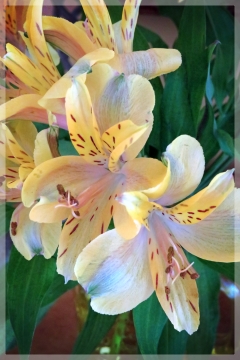
alstromeria - Peruvian lilyIn one of his four-minute essays, Dr. Frank Crane posited that that the Seven Wonders of the World weren’t the most wonderful things in the world; the wonders of everyday life were! I have to agree. The seven wonders are man-made and, of the original seven, only the great pyramid in Giza remains. On the other hand, the night sky has been there since God created it when time began. Within our galaxy there are some 300 billion stars. The Milky Way, however, is just one of some 2 trillion galaxies (making for a total stellar population of roughly 70 billion trillion.) Since that’s just in the observable universe, there probably are plenty more that haven’t yet been detected. That those trillions of stars are orbiting around an ever expanding universe boggles the mind! Nothing made by man even comes close.
I look over at the Alstroemeria (Peruvian lilies) my husband brings me each week. How is it possible that no two of those flowers are exactly alike? Yet, there’s no duplication in them or in snowflakes, zebras, fingerprints, butterflies, and those 70 billion trillion stars either!

As wondrous as God’s creation is, I wonder if we appreciate it. In 2007, a young man exited the metro station in Washington, DC, took out his violin, and began to play. The violinist was virtuoso Joshua Bell and his instrument, made by Antonio Stradivari in 1713, was worth $3.5 million. Bell played for three minutes before anyone even turned a head, another half-minute before someone dropped a dollar into his open violin case, and six minutes before anyone stopped for a moment. Sure that people would notice and recognize Bell, crowd control had been the initial concern for this experiment. There was no need to worry. Although 1,097 people passed by Bell during his 43-minute concert, only seven stopped for at least a minute to listen to a man who easily commands $1000 a minute to play a concert and for whom standing ovations are the norm.

Later, when viewing a video of the experiment, Bell said he understood why a crowd didn’t gather—after all, it was rush hour and people had to get to work. What mystified the violinist was that people didn’t even notice him; it was if he were invisible. There was no applause or acknowledgement of his music until near the end when one woman passed by him. Having been to one of Bell’s concerts, she recognized the violinist and stopped to listen. When he’d played his last note, she thanked him before continuing on her way to work.

Those commuters in DC have become so accustomed to the noisy busy world around them that they totally missed seeing and hearing Joshua Bell. Like them, has the noise and busyness of our lives dulled our senses so much that we no longer see or hear the wonders around us? We don’t need to leave our homes to see the wonders of the world. The Great Wall of China doesn’t hold a candle to the sky on a clear night. As impressive as is Brazil’s Christ the Redeemer statue, it’s really no match for a field of summer wildflowers and the marble structure of the Taj Mahal pales in comparison to the structure of the human genome.

Because God hasn’t hidden His glory from our senses, the Apostle Paul says there is no excuse for not knowing of His existence. Yet, just as people were deaf and blind to Joshua Bell, even those who know God are often as deaf and blind to His glory. We have eyes and ears but, in our rush, we neither see nor hear. Like Bell, God is an artist whose handiwork is worthy of a standing ovation yet, like those commuters, we frequently fail to acknowledge His presence in the everyday wonders of the world. The next time you hear a bird sing, smell a flower, see a rainbow, or bite into a juicy piece of fruit, thank God for the intricacy, beauty, and wonder of His creation. He’s a virtuoso!

O Lord, how many are Your works! You made them all in wisdom. The earth is full of what You have made. … I will sing to the Lord all my life. I will sing praise to my God as long as I live. May the words of my heart be pleasing to Him. As for me, I will be glad in the Lord. [Psalm 104:24, 33-34 (NLV)  

When I look up and think about Your heavens, the work of Your fingers, the moon and the stars, which You have set in their place, what is man, that You think of him, the son of man that You care for him? [Psalm 8:3-4 (NLV)]

Copyright ©2020 jsjdevotions. All rights reserved.

DO NOT DISTURB

clam pass birds naples flBut to you who are willing to listen, I say, love your enemies! Do good to those who hate you. Bless those who curse you. Pray for those who hurt you. If someone slaps you on one cheek, offer the other cheek also. … Do to others as you would like them to do to you. [Luke 6:27-29,31 (NLT)]
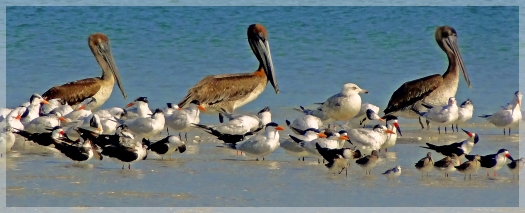
The snowbirds are back; not the retirees who arrive in cars or on planes but the migratory birds, some of whom flew more than 3,000 miles to get here. Their long flight takes a tremendous toll on their bodies. By the time they reach our beaches, they’re exhausted and hungry and many have lost half their body weight. Before I understood the trials they endure in migrating, I never gave it a thought if I happened to disturb them while walking the beach. Granted, it’s a beautiful sight to see hundreds of birds take wing at once but, every time they’re flushed by someone on the beach or a passing boat, precious reserves of energy are used and their nests are left unattended. Now that I understand the birds’ challenges, I am more considerate of their needs. When walking the beach, I keep my distance to avoid unsettling them.

Although they may not be as endangered, hungry, and exhausted as migratory birds, many people have taken a long and arduous journey to get where they are today. While some end up better for the journey, others end up bitter, rude, angry, or demanding. Just as I hadn’t thought about the challenges facing the birds, I rarely pause to consider the circumstances these difficult or toxic people must have encountered to leave them so embittered, short-tempered, or uncivil. While trials, loss, and pain never excuse bad behavior, they often cause it. Not everyone believes in God, has experienced the joy that comes from following Jesus, possesses His peace, or knows they are loved and forgiven.

In these stressful and divisive times, hostility and boorishness seem to be on the rise. Admittedly, upon encountering a toxic person, self-control, patience, kindness, love, and courtesy often fly right out the window. Rather than turn the other cheek, we want to give as good as we got. Retaliation, however, only begets more of the same. Studies have shown that incivility and rudeness are as contagious as yawns, smiles, laughter, and viruses! As followers of Jesus, our job is to make sure we don’t contribute to the problem. We’re expected to treat people with kindness and consideration, not because they’re nice people who deserve it, but simply because it’s what Jesus would do! Hopefully, our even-tempered behavior will make the rest of their journey easier.

We must choose to break the chain of incivility with love, gentleness, a forgiving heart, and by praying for the offender. It helps to remember that difficult people carry a lot of baggage with them and their quarrel, hostility, or complaint may have nothing to do with us. Remembering that we know nothing of their hardships, pain, or fear, let’s cut them a little slack and give them as much space as possible. Like the migratory birds, they’ve had a difficult journey and are struggling to survive the only way they know. “Do not disturb” is wise advice in both instances!

Be kind, for everyone you meet is fighting a hard battle. [attributed to Plato]

Make allowance for each other’s faults, and forgive anyone who offends you. Remember, the Lord forgave you, so you must forgive others. Above all, clothe yourselves with love, which binds us all together in perfect harmony. And let the peace that comes from Christ rule in your hearts. [Colossians 3:13-15a (NLT)]

Copyright ©2020 jsjdevotions. All rights reserved.


HIS CRAFTSMANSHIP

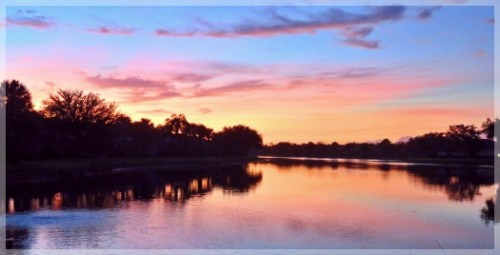
dawnThe heavens proclaim the glory of God. The skies display his craftsmanship. Day after day they continue to speak; night after night they make him known. They speak without a sound or word; their voice is never heard. Yet their message has gone throughout the earth, and their words to all the world. [Psalm 19:1-4 (NLT)]
As I looked at the morning sky, I had to agree with the psalmist: the heavens do proclaim the glory of God. My photo can’t do justice to the magnificence of today’s sunrise. Although I had a good night’s sleep, like many of us during this time of isolation, loss, and unrest, my soul was weary. Nature, however, has a way of restoring weary souls and the vibrant colors of the breaking day lifted my spirits. They reassured me of God’s eternal power and divinity.

It’s not just the skies that display God’s amazing craftsmanship. From the smallest insect to the largest mountain and the heavens above, God continually reveals himself through his amazing creation. His power and might are visible in oceans, mountains, blizzards, rainstorms, lightening, and even mighty hurricanes like Laura. Yet, one look at a spider’s web, butterfly’s wings, dandelion puff, or violet tells us He has a gentle touch as well.

Although life sometimes feels random, illogical, and unpredictable (as it does right now), nature assures us that God is not arbitrary, capricious, unthinking or careless. A Creator who made flowers that lure bees with nectar and pollen so they’d be pollinated and the bees could then make honey definitely had a plan. The God who gave every one of us a unique set of fingerprints and every zebra a distinctive design of stripes without repeating himself is limitless and certainly attentive to detail. A master at creativity, He gave us eggs that turn into chicks, legless tadpoles that become hopping frogs, acorns that grow into giant oaks, and enabled water and wind to wear away rocks. He knows what He’s doing!

Creation is more than a witness to God’s eternal power and divinity; it tells us about Him. Without a doubt, the designer who covered a rat with armor and made an armadillo, assembled the wildebeest from what appear to be spare parts, fashioned the long snout of the anteater, and provided kangaroos with built-in pockets has a sense of humor and believes in laughter. The One who gave us the sound of waves crashing on the beach, the smell of a pine forest, the feel of a gentle breeze, and the fragrance of sweet honeysuckle and gardenias wants us to enjoy His creation. When He decorated our world, God boldly used every color on his heavenly paint palette and His abundance is evident in the fall colors, rainbows, orchids, painted buntings, and glacial lakes He’s given us to enjoy.

Not every sunrise is as flamboyant as was this morning’s nor is every sunset as gaudy as was last night’s. Nevertheless, one look at the sky is more than enough to assure us of God’s existence. Rest assured that the One who painted spots on the ladybug, gave the peacock his showy tail, and put the sweet taste into strawberries has not forgotten His children. Let us open our eyes to His creation and sing the words penned by Maltbie Babcock more than 100 years ago: “This is my Father’s world; Oh let me not forget that though the wrong seems oft so strong, God is the ruler yet!” As fallen and broken as the world seems, it still belongs to God! He’s at large and in charge!

Forbid that I should walk through Thy beautiful world with unseeing eyes: Forbid that the lure of the market-place should ever entirely steal my heart away from the love of the open acres and the green trees: Forbid that under the low roof of workshop or office or study I should ever forget Thy great overarching sky: Forbid that when all Thy creatures are greeting the morning with songs and shouts of joy, I alone should wear a dull and sullen face.

For ever since the world was created, people have seen the earth and sky. Through everything God made, they can clearly see his invisible qualities—his eternal power and divine nature. [Romans 1:20a (NLT)]

Copyright ©2020 jsjdevotions. All rights reserved.

THE BUTTERFLY EFFECT

Remember the things I have done in the past. For I alone am God! I am God, and there is none like me. Only I can tell you the future before it even happens.  Everything I plan will come to pass, for I do whatever I wish. [Isaiah 46:9-10 (NLT)]

For want of a nail the shoe was lost, For want of a shoe the horse was lost, For want of a horse the rider was lost, For want of a rider the battle was lost, For want of a battle the kingdom was lost, And all for the want of a horseshoe nail. [Poor Richard’s Almanack (1758)]

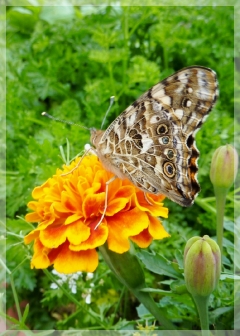
painted lady - marigoldOf course, in another time or place, a missing nail might have better consequences. Without the nail, horseshoe and rider, the horse wouldn’t have been on the road, reared at the sight of a snake, and thrown off his rider (who died from his injuries)! Life is unpredictable.
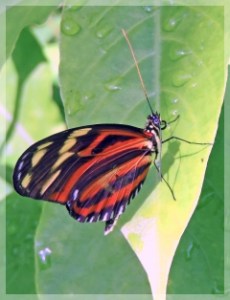
Theorizing that weather prediction models are inaccurate because knowing the precise starting conditions is impossible and a tiny change can throw off the results, meteorology professor Edward Lorenz posed this question in 1972: “Does the flap of a butterfly’s wings in Brazil set off a tornado in Texas?” Of course, a single act like the butterfly flapping its wings won’t cause a cyclone but Lorenz’s point was that nature’s interdependent cause-and-effect relationships are too complex to resolve. Small variations in conditions can have massive, minor, or imperceptible consequences and it is impossible to predict which will be the case.

As if the magnitude of this pandemic isn’t proof enough, Lorenz’s “butterfly effect” reminds us that life is amazingly unpredictable. We often pray that God will fix, heal, repair, reverse, or resolve situations or people and are disappointed when it seems that God has turned a deaf ear to us. The answers to our prayers, however, are not up to us—they are up to Him and the people and situations we want God to change are frequently the people and circumstances that God is using to change us!

As weather forecasters have learned with the “butterfly effect,” we mortals can’t possibly see all of the consequences of the changes we request in our prayers. God is the only one capable of knowing the repercussions of any alteration. While we have a limited concept of what the future will bring, His view is all-encompassing; He sees not just our lives, but all of the lives before us, with us, and those yet to come. God knows exactly what will happen if He grants our prayers, not just to us but also to everyone else. Our faith is not that God will give us what we want but that God will give us what is best!

In retrospect, I can only offer thanks that God, in His infinite wisdom and love, didn’t give me everything for which I asked. When Garth Brooks thanked God for unanswered prayers, he was wrong. God always answers prayers; it’s just that sometimes He answers with a “No!”

Sometimes I thank God for unanswered prayers.
Remember when you’re talkin’ to the man upstairs
That just because he doesn’t answer doesn’t mean he don’t care.
Some of God’s greatest gifts are unanswered prayers. [Garth Brooks]

Oh, how great are God’s riches and wisdom and knowledge! How impossible it is for us to understand his decisions and his ways! For who can know the Lord’s thoughts? Who knows enough to give him advice? [Romans 11:33-34 (NLT]

Copyright ©2020 jsjdevotions. All rights reserved.

THE LEIDENFROST EFFECT

I praise God for what he has promised. I trust in God, so why should I be afraid? What can mere mortals do to me? [Psalm 56:4 (NLT)]

leidenfrost effect

Two businessmen were touring a foundry. When they entered the smelting area with its vats of molten metal, their guide said it was possible to safely pour that hot metal over someone’s hand if the hand was first dipped into water. When he asked if either gentleman cared to give it a try, the first man said, “I’ll just take your word for it.” The second man agreed and dipped his hand in a tub of water. When the molten metal was poured over the wet hand, it streamed off without causing him pain or injury. Although the first man said he believed the guide, the second one showed his faith in the man by acting on his belief.

Because of something called the Leidenfrost Effect, you really can dip your hand into water and then pour a stream of molten metal over it without pain or injury; a tiny layer of steam would insulate and protect your damp hand from the hot metal. Just because we could do it, however, doesn’t mean we should. The effect is short lived and I don’t suggest trying it at home!

I understand the Leidenfrost Effect and have seen it demonstrated; in theory, I believe in it. In actuality, however, I’d never trust it enough to give it a try! I’m like the Israelites during the Exodus. Although they witnessed God’s power over and over again in the plagues God visited on Egypt and when they safely crossed the Red Sea, saw the defeat of Pharaoh’s army, drank sweet water that once was bitter, gathered both quail and manna from heaven, and saw water spring from a rock, they continued to doubt. In spite of God demonstrating the truth of His promises throughout their journey, the Israelites spurned the God of miraculous provision while camped at Kadesh by refusing to enter Canaan, the land He’d promised to them. How much proof did they need that God would be true to them? Sometimes, even seeing isn’t enough to truly believe and trust.

It’s easy to have faith when the outcome is known. Our challenge is to believe and trust when the outcome is unknown or there is an element of risk, such as third degree burns or formidable foes. Because the power to believe a promise depends on our faith in the one who makes the promise, I wouldn’t have trusted the factory guide enough to put my wet hand under molten metal and, without trusting that God would be true to His promises, the Israelites wouldn’t obey Him!

Unlike the Israelites, do we have faith in the One who guides us through life? In the end, the difference between intellectual belief and actual faith is a willingness to take action: to step out in obedience. We have more proof of God’s faith, love, and power in Scripture than all the YouTube videos about the Leidenfrost Effect. Yet, there are many who probably would place their damp hands under molten metal before trusting their unknown fate to a known God! Isaac Watts said, “I believe the promises of God enough to venture an eternity on them.” What about you? Who do you trust? In whose hands have you rested your fate?

God never made a promise that was too good to be true. [Dwight L. Moody]

For the word of the Lord holds true, and we can trust everything he does. [Psalm 33:4 (NLT)]

Let us hold tightly without wavering to the hope we affirm, for God can be trusted to keep his promise. [Hebrews 10:23 (NLT)]

Copyright ©2020 jsjdevotions. All rights reserved.

THE SONG OF HOPE

Rejoice in our confident hope. Be patient in trouble, and keep on praying. [Romans 12:12 (NLT)]

Let all that I am wait quietly before God, for my hope is in him. He alone is my rock and my salvation, my fortress where I will not be shaken. [Psalm 62:5-6 (NLT)]

northern mockingbirdA family of mockingbirds has moved into a nearby bush and they frequently serenade us from their vast repertoire of songs. Hearing their exuberant and joyful warbles is a perfect antidote to the sameness of life during this pandemic. While being charmed by their avian concerts, I thought of Emily Dickenson’s poem “‘Hope’ is a thing with feathers.”

What exactly is hope? In the world’s view, hope is like wishful thinking: an “I don’t know what will happen tomorrow, but I hope it will be something good!” attitude. We hope for a cure, a job, a raise, or a phone call without knowing if we’ll receive them. Worldly hope can fail us—the cure isn’t found, the job falls through, the raise doesn’t materialize, or the phone doesn’t ring. We live in a fallen world where we will be disappointed and our hopes often are dashed.

Biblical hope, however, never disappoints because it is based on God’s promises; it is confident that something will come to pass because God has promised it! We may hope our circumstances will improve while knowing they might not but that uncertainty about our circumstances or how God will answer our prayers doesn’t mean we don’t have hope. Ours is a living hope; while it looks to the future, it is grounded in the present. We put our trust in God because His promises became a reality in Jesus. We don’t have to dream of a better life tomorrow because Jesus had given us a better life today. Our Christian hope is a confident expectation that God will work “for the good of those who love God and are called according to his purpose for them.” [Romans 8:28] It tells us that eventually God will deliver us and that our salvation is secure.

Although raised in a Christian family, Emily Dickenson never made a public profession of faith in Jesus, explaining, “I feel that the world holds a predominant place in my affections. I do not feel that I could give up all for Christ, were I called to die.” She was, perhaps, more honest than many of us. Nevertheless, several of her poems reveal her Christian roots. I think she understood a Christian’s hope in her metaphor of hope as a bird. Just as a bird perches on a branch, hope rests in our soul. Like a bird, Christian hope sings its pleasing song endlessly and, undeterred by hardship, hope’s song sounds sweetest in a storm. The bird’s song can be heard from the coldest land to the strangest sea and Christian hope can be found from the bleakest of conditions to the most inexplicable of situations. Even in the harshest circumstances, the bird never asked anything of Dickenson and our hope, the hope offered by Christ, asks nothing of us. We can’t earn it or buy it; it is there for the asking if only we believe!

For many right now, this is a time of darkness and fear and it seems like hope has taken flight. It hasn’t! God doesn’t change—He’s still there—the promises He made yesterday hold true today. God promises to be with us—both on the hilltop and in the valleys. Promising provision, His grace is sufficient for us. Promising to empower us, He tells us that, when we are weak, He is strong. As I listen to the mockingbirds’ songs, it seems as if they know God’s eyes are upon them and that He will take care of them. [Matthew 6:26,10:29] They remind me to live with hope perched in my soul.

“Hope” is the thing with feathers –
That perches in the soul –
And sings the tune without the words –
And never stops – at all –
And sweetest – in the Gale – is heard –
And sore must be the storm –
That could abash the little Bird
That kept so many warm –
I’ve heard it in the chillest land –
And on the strangest Sea –
Yet – never – in Extremity,
It asked a crumb – of me.
[Emily Dickenson]

We can rejoice, too, when we run into problems and trials, for we know that they help us develop endurance. And endurance develops strength of character, and character strengthens our confident hope of salvation. And this hope will not lead to disappointment. For we know how dearly God loves us, because he has given us the Holy Spirit to fill our hearts with his love. [Romans 5:3-5 (NLT)]

Copyright ©2020 jsjdevotions. All rights reserved.