
All the believers devoted themselves to the apostles’ teaching, and to fellowship, and to sharing in meals (including the Lord’s Supper,) and to prayer. [Acts 2:42 (NLT)]
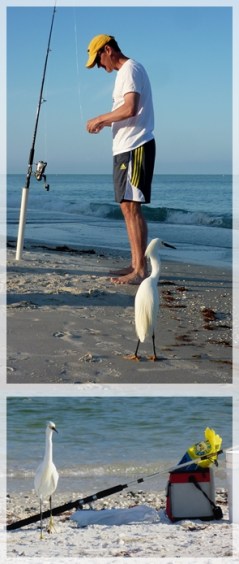 I watched the snowy egret at the beach and couldn’t quite decide if he was an exceptionally smart bird, just plain lazy, or a little of both. Egrets are excellent fishermen and will wade in the shallows stirring up the water with their feet to flush out delicacies like fish, frogs, and crayfish. Other times, they exhibit great patience as they stand nearly immobile for several minutes just waiting for their prey to come near enough for them to strike and catch dinner.
This egret, however, wasn’t wading in the water; he was cruising the beach and visiting various fishermen. Cast netting for bait, the anglers were hurling their nets into the surf. While pulling in the bait-filled nets and dumping the contents in a bucket, a few of the minnows always fall out and that’s what this bird was awaiting. Apparently, he prefers carry-out to hunting and may even prefer shop-lifting if he snatches minnows out of the buckets. Clearly, he wants others to do the work while he reaps the benefits. I look at our churches and think we have a lot of people who are like that egret—people who are willing to let the other guys do most or even all of the work.
The early church devoted itself to learning from the Apostles, eating together, prayers, and fellowship. They didn’t just have fellowship, they dedicated themselves to it. Today, many church-goers would define Christian fellowship as having coffee with other parishioners before or after church. Fellowship in the first century, however, meant much more than that and continues to mean more today. Christian fellowship is concern and commitment to one another; it is caring for and sharing with one another. Moreover, we need to share more than our beliefs, activities, interests, communion or coffee. For true Christian fellowship, we need to share our responsibilities and work, especially if we are to fulfill the call to care for one another.
The volunteers at our church were recently recognized while the rest of the congregation stood and gave them a round of applause. Remembering that we don’t just attend a church but are part of one, rather than giving our church volunteers a hand, we need to think about giving them both of our hands, sharing in their responsibilities, and enjoying true Christian fellowship with our brothers and sisters in Christ!

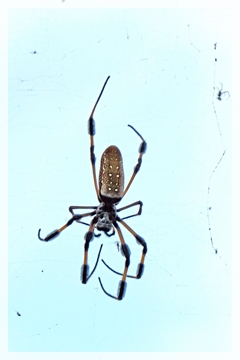 I have a love-hate relationship with my camera and its autofocus. An enormous golden silk spider hangs over the boardwalk we take through the mangroves to the beach. Officially the Nephila clavipes, the female of this species is the largest non-tarantula-like spider in North America. This impressive arachnid has spun her giant orb-like web high above the walkway. She often scares tourists when they glance up to see her suspended above their heads. While I managed to get a shot that of spider, I’d hoped to get a few more of others that have spun their webs down closer to the boardwalk. Autofocus, however, was my enemy. Because their webs were nestled in the trees, the camera looked right through the spiders and focused on the large branches and leaves behind them. My camera focused only on the spider when nothing was behind the creature, but it had plenty on which to focus when pointed at the spiders in the mangroves. The ease of having a small point-and-shoot camera that is so easy to use keeps me loving (but occasionally hating) it.
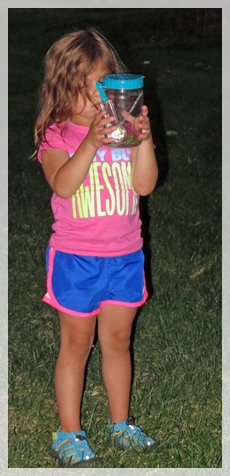 Warm summer nights at the lake mean campfires, s’mores and fireflies. As the darkness descends, bug jars appear and the children start chasing these fascinating insects. How odd that the same child who will shirk away from any insect during the day will give chase to and capture these flashing winged beetles at night. By the end of the evening, the children have collected a jarful of tiny flying stars (that will be released as soon as the little ones are tucked into bed).
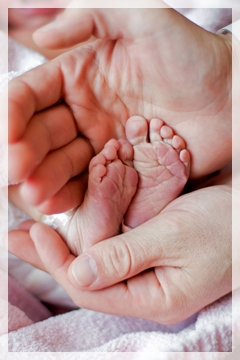 Writing about my granddaughter yesterday made me think about birth defects. In actuality, all of us have what could be called birth defects—it’s just that some are more obvious than others. While all of God’s children have defects, none are defective. I consider a young man at our Florida church. Cerebral palsy keeps him strapped into a wheel chair and his physical limitations are immense. There is, however, nothing defective about this bright young man. I ponder the enthusiastic grocery worker with Down’s syndrome. She may have an extra chromosome, but there is nothing defective about her. I think of a fellow at church who has no ears. He may be deaf but there is nothing defective about him, nor is there anything defective about a friend’s grand born with only a partial arm and hand or my grand, with her heart defects and learning issues. They are all marvelously made—different from others, but no less wonderful.
 Devotions of the Heart