
I tell you the truth, I haven’t seen faith like this in all Israel! [Matthew 8:10]

Coming from a career in the military where, as the commanding officer, his word was law, my brother-in-law had a rude awakening when he retired from the Navy and returned to civilian life. If, at his word, a squadron of planes could be on the runway and ready for flight at 0700 sharp, he didn’t understand why the cable man or plumber couldn’t be counted on to arrive on time (let alone, at all)! Unfortunately, the power and authority he had as a commanding officer didn’t transfer to his new role as a private citizen.
Like my brother-in-law, the Roman centurion who asked Jesus to heal his servant was used to the power of his words. When the centurion spoke, he spoke with the emperor’s authority and he knew he didn’t need to be present to have his orders carried out by the 100 men he commanded. Recognizing Jesus as more than an itinerant rabbi, the centurion knew that, when Jesus spoke, He spoke with God’s authority. Like the centurion, Jesus didn’t need to be present to exercise His power—all that was needed was His command!
Typically, people were amazed by Jesus but, that time, Jesus was amazed by the centurion. Turning to the crowd around him, He commended the Gentile’s faith—saying he’d not seen so great a faith in the land. Reminding his listeners that the Kingdom of Heaven was open to everyone, both Gentile and Jew, He warned them that faith, rather than heritage, would determine attendance at the Messianic banquet and cautioned that some Israelites would not be there!
The only other time Scripture records Jesus’ amazement is when, after being scoffed and scorned in Nazareth, Jesus expressed amazement at his fellow Jews’ lack of faith. Mark tells us that was why Jesus could perform only a few healings (but no miracles) in his home town. The lack of miracles, however, doesn’t mean that Jesus didn’t have the power to perform them; it means that He chose not to do so in an atmosphere of unbelief. Rather than being subject to our faith, God acts in response to it! God’s power is unlimited but He will not force His blessings on those who don’t believe. Let us remember that the One who spoke the universe into existence is capable of far more than we can ask! The centurion had great faith in Jesus; we should follow his example!
 Yesterday, I made reference to the story of Jael. Her story takes place about 200 years after the Israelites entered Canaan in the time of the Judges—a time when “all the people did whatever seemed right in their own eyes.” [17:6] Because of Israel’s disobedience, the Lord allowed King Jabin of Hazor to subjugate the people of Israel. Sisera led Jabin’s army and, with their 900 iron chariots, the Canaanites had oppressed the Israelites for twenty years. Deborah, a prophetess, was judge at the time.
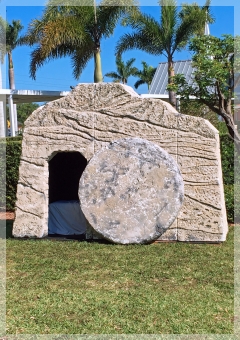 Although Jesus repeatedly predicted that He’d rise from the dead, the women didn’t bring clean clothes for a living man that Sunday morning when they went to the tomb. Instead, they brought burial spices of their own with which to anoint His dead body. Because of the Sabbath, Jesus’ burial was rushed and His body laid in a borrowed tomb. Although Joseph and Nicodemus had anointed Him, perhaps the women were concerned that, in the men’s haste to finish before sunset, they hadn’t done a proper job of preparing the body. The spices they brought would conceal the stench of decay and, out of love for Jesus, they wanted to complete the burial rites properly.
 In writing about Blaise Pascal yesterday, I mentioned that he, along with Pierre de Fermat, laid the groundwork for probability theory back in 1654. I remember a school friend writing her term paper on probabilities who began by testing what’s called the “birthday paradox:” in a room of 23 people, there is a 50% chance that two people will have the same birthday and, out of 75 people, there is a 99.9% chance of two people’s birth dates matching. Imagine her surprise when the first two people she asked had the same birth date! That, of course was sheer coincidence but, if the next 30 people she asked also had the same birth date, another explanation would have been necessary.
 The Synsepalum dulcificum is a West African fruit better known as the “taste berry” or “miracle fruit.” This almost tasteless red berry can make lemons, Dijon mustard, Brussels sprouts, pickles and even vinegar taste sweet. A protein in the berry temporarily binds to the tongue’s taste buds and causes sour or acidic foods to taste sweet. Miracle fruit tablets, powder, freeze-dried berries and plants can be purchased from several websites. Along with suggesting using the berry as a way to get fussy eaters to eat their fruits and vegetables, sellers suggest hosting “flavor-tripping parties” where guests get a berry and a strange buffet of foods like sauerkraut, kimchi, radishes, grapefruit, cheap tequila, goat cheese, vinegar, and Tabasco sauce. Why anyone would want to alter the delicious flavors of kiwi, pineapple, strawberries, Granny Smith apples, grapes, or tomatoes is beyond me and I certainly have no desire to drink pickle juice or Sriracha chili sauce.
 Devotions of the Heart