
MARIA’S SON

blue flag iris - blue-eyed grass - pansyLook carefully then how you walk, not as unwise but as wise, making the best use of the time, because the days are evil. Therefore do not be foolish, but understand what the will of the Lord is. [Ephesians 5:15-17 (ESV)]

So teach us to number our days that we may get a heart of wisdom. [Psalm 90:12 (ESV)]

Maria, an elderly woman, used to come to our Tuesday Bible study but stopped when she could no longer drive. Last Christmas, her son gave her a beautiful gift: the promise to drive her to Bible study every week. This was no small gift; she lived nearly an hour from her son and a half hour away from church. By the time you add the son’s driving time to and from his house to hers, to and from her house to the church, the hour of class, and the time it took to get his mother (and her walker) in and out of the car four times, this gift was nearly a five hour obligation every week. Maria’s health eventually failed and, today, we learned that she went home to Jesus.

I didn’t know Maria or her son but I do know about time. I spent enough hours shuttling my daughter to and from dance classes to know that a mere hour between drop off and pick up is not enough time to accomplish anything in the way of running errands. By the time you get to Costco or Target you have to turn around and come back. Time is a precious commodity and, once spent, can never be recovered. Maria’s son spent his hours as would Jesus—in loving service. Can we say the same thing?

We have plenty of labor saving devices: food processors, instant pots, microwaves, automatic sprinklers, power drills, washers, dryers, dishwashers, pressure cookers, power mowers, computers, and even a virtual assistant in Alexa. In theory, with all these modern conveniences, we should have plenty of time. Yet, when I speak with others, a common complaint is a lack of time. What do we do with all the time we save?

Rather than a shortage of time, perhaps the problem is in our priorities. Since God gave us the Sabbath, I don’t think He has a problem with rest and recreation. Nevertheless, He didn’t put us here just to have a good time. He’s trusted us with the gift of time; could it be that He’s also testing us to see what kind of stewards we are of that gift?

Forbidden to reap their harvest right up to the edge of their fields and or strip their vineyards bare, the Israelites were to deliberately leave produce for the poor. The way we use our time is a little like harvesting it. Rather than leaving wheat and grapes in the field, perhaps we should deliberately leave some time in our lives for the needs of our families and our brothers and sisters in Christ.

What would Jesus do with our spare minutes? How can they be gleaned for God’s purposes? How can we use our time to magnify God and further His kingdom? Where can we spend it to improve the lives of others? The answer may be as easy as taking someone to Bible study.
One gives freely, yet grows all the richer; another withholds what he should give, and only suffers want. [Proverbs 11:24 (ESV)]

Do not be conformed to this world, but be transformed by the renewal of your mind, that by testing you may discern what is the will of God, what is good and acceptable and perfect. [Romans 12:2 (ESV)]

Copyright ©2018 jsjdevotions. All rights reserved.

LOVE LIKE A CHILD

And do everything with love. [1 Corinthians 16:14 (NLT)]

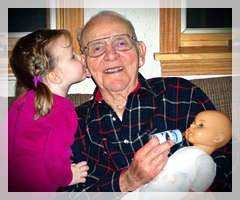
GrandpaI actually thought the prayer’s words that Sunday asked God to show us what children can teach us about love. Looking through old photos of my children and grands later that day, I thought about the ways children love. Unconcerned with decorum (or potential lawsuits), they’re demonstrative: touching freely and unabashedly. They cuddle and climb on laps, hold hands, and spontaneously give hugs and kisses. They burrow under the covers with us and aren’t bothered by morning breath or bed head. It doesn’t matter if they’re soaking wet from the sprinkler or their faces are covered with jelly or chocolate nor do they care if we’re sweaty and dirty from working in the garden or dressed in our finest for a night on the town. Children know that touch, whether a high-five or hug, is an important part of love.

Children don’t need words to express their love—rather than talking about it, they show it. In his nineties, Grandpa was frail, nearly deaf, and partially blind by the time the first great-grand arrived. Nevertheless, they didn’t need to talk; the little one knew how to speak with love and the two of them communicated silently, playing games only they understood. Another grand sought out a shy child in her pre-school who wouldn’t speak at all. The girls became fast friends because they didn’t need words to communicate. Perhaps children don’t need discussion because they know that loving actions speak far louder than do words.

Children love with gifts and service and the adults they love become the recipients of a wide assortment of shells, dandelions, painted rocks, pot holders, feathers, rubber band bracelets, drawings, beaded jewelry and pinch pots. As for service: my grands have been known to fight over who gets to help me water the plants, set the table, wipe my counters, dust the furniture or help fold the laundry. Children know that giving of self is a fundamental part of love.

Children love unconditionally and with forgiving hearts. Both of our foster daughters continued to love (and defend) the parents that failed them time and time again. They’d wait all afternoon for the promised visit that never happened only to faithfully wait again the following week. They loved even when the love was undeserved and forgave what seemed unforgivable (and I pray they still do). Children love without judgment.

Children love with generosity and without embarrassment. Last year, when the cousins were at our house, the eldest boy introduced the little ones to the dress-up box. After helping them into princess and pirate get-ups, they wanted him to dress up, too. There was just one costume that fit him and the little guys begged him to wear it. Without complaint, the fourteen-year old donned a Cinderella dress for his young cousins and allowed them to accessorize it with a lady’s hat, purse, and beads. He did this with a smile because children love generously, unselfconsciously, and with joyful laughter.

It wasn’t until I was done with this devotion that I re-read the words to that Sunday’s prayer and discovered it asked God to show us what children can teach us about Him. I thought of the story about a little girl who was busily drawing a portrait. When the teacher asked who it was, she replied, “God.” Reminding her that no one knows what God looks like, the girl said, “They will when I’m done!” God is love and children certainly know how to love; perhaps the face the little girl drew was that of a child. Indeed, children can teach us a great deal about both love and God.

Dear friends, since God loved us that much, we surely ought to love each other. No one has ever seen God. But if we love each other, God lives in us, and his love is brought to full expression in us. … God is love, and all who live in love live in God, and God lives in them. [1 John 4:11-12.14b (NLT)]

Copyright ©2018 jsjdevotions. All rights reserved.

A HEAVY LOAD

And we know that God causes everything to work together for the good of those who love God and are called according to his purpose for them. [Romans 8:28 (NLT)]

When troubles of any kind come your way, consider it an opportunity for great joy. For you know that when your faith is tested, your endurance has a chance to grow. [James 1:3b-3 (NLT)]

viceroy butterfly“He will deliver us from our troubles or carry us through them. Either way, we will be free of them eventually.” How easily these words can be uttered until, of course, those troubles apply to us. Had Job’s friends been Christian and said those words, I don’t think they would have been any more comforting than what was said. While true, they won’t bring back the amputated limb or cancerous breast, pay the staggering medical bills, tuck the motherless child in bed at night, change the diagnosis of Parkinson’s or schizophrenia, or bring back an abused child’s innocence. While true, those words can’t wipe the tears of a mother holding her stillborn baby, the husband watching his wife vanish into dementia, or the man whose body is in mutiny because of ALS.

The valleys I have traversed have been neither as deep nor as dark as those others are traveling. I’ve never climbed mountains as steep as the mountains they face daily. The storms that battered my soul pale in comparison to the tempests others endure. They grow weary from carrying burdens heavier that I can imagine. It’s not just the victims of life’s afflictions and misfortune that bear a burden. Everyone who loves and cares for them becomes part of their arduous journey; they shoulder heavy loads, as well. I cannot fathom the emotional and physical weight they carry nor the exhaustion they must experience on a daily basis.

I know enough not to say, “I know what you’re going through,” because I truly don’t. Even with the same diagnosis, no two people share the same circumstances. Reminding someone that God works all things for good or that we grow through suffering may be of little comfort to those who are in anguish and pain. Suffering isn’t a riddle that needs to be solved and it won’t end once we know what it is God is teaching us or what good will come from it. No matter how well meant our words may be, they can sound trite and hollow.

The kindest thing Job’s friends did was sit quietly with him for seven days; perhaps, we should follow their example. Rather than words, we can offer love: our presence, support, sympathy, compassion, patience, encouragement, ears, or even food. Rather than telling people to rejoice in all circumstances, we could find ways to bring joy into their lives. Most of all, we can offer our faithful and heartfelt prayers.

Lord, we offer prayers for the ill and infirm, the troubled, weak and helpless and for those brave souls who love, comfort and care for them. Reassure them of your loving presence. Endow them with courage and faith as they pass through dark valleys, scale steep mountains, and endure powerful squalls. Strengthen them and give them hope. Give us wisdom and show us how to lighten their burdens, lift their spirits, relieve their pain, and ease their fears. Let us know when to remain silent and what to say when we should speak.

When we honestly ask ourselves which person in our lives means the most to us, we often find that it is those who, instead of giving advice, solutions, or cures, have chosen rather to share our pain and touch our wounds with a warm and tender hand. The friend who can be silent with us in a moment of despair or confusion, who can stay with us in an hour of grief and bereavement, who can tolerate not knowing, not curing, not healing and face with us the reality of our powerlessness, that is a friend who cares. [Henri Nouwen]

Share each other’s burdens, and in this way obey the law of Christ. [Galatians 6:2 (NLT)]

I urge you, first of all, to pray for all people. Ask God to help them; intercede on their behalf, and give thanks for them. [1 Timothy 2:1 (NLT)]

Copyright ©2018 jsjdevotions. All rights reserved.

SUZANNE FROM SINGAPORE

aster - nodding onion - deptford pinkWalk in wisdom toward outsiders, making the best use of the time. Let your speech always be gracious, seasoned with salt, so that you may know how you ought to answer each person. [Col. 4:5-6 (ESV)]

Revealing her roots with her English accent, Suzanne told me she lives in Singapore, is the CEO of a foreign corporation, and was taking a holiday at her beach home in southwest Florida. We had a few minutes before class started and, trying to find common ground, I asked if she had any children or grands coming to visit. Replying that her children were still single, Suzanne said she doesn’t much care for children and hoped to never have any grands. After telling me that a young family had recently visited her London apartment, she disclosed her annoyance at the small child who’d touched her priceless antiques and run across her valuable Persian rugs. When Suzanne added that she had no idea how anyone could host guests for more than a few hours without having full time staff, I realized how far her world is from mine and most of the other women present in the room. I’d have to dig deeper to find common ground!

Although dressed beautifully, Suzanne didn’t flaunt her wealth by wearing a Chanel suit, Manolo Blahnik heels, and Harry Winston diamonds to a lunch time Bible study. Her words, however, were equally as ostentatious. Clearly, she is a powerful wealthy woman who lives a privileged life but she seemed oblivious that most of the world doesn’t live her way. I think she would have been surprised to know that I’d just hosted guests for a week without having a maid or cook, that the elderly woman at the next table still works so she can pay for her health insurance, that the woman beside her has been single-handedly caring for her handicapped husband for the last eight years, or that the woman beside me is raising two grandchildren by herself.

While I’m pointing a finger at Suzanne, I’m also pointing three at me. My conversation with her made me realize how often I am unaware and insensitive to other people’s circumstances. Just as I assumed Suzanne would love small children, I often assume other people have the same politics, history, finances, family situation, interests and preferences that I do. Like hers, my words have been patronizing, oblivious, and tactless more times that I care to admit.

I thought about that conversation when reading Paul’s words about seasoning our conversation with salt. Salt makes food palatable and our words should be palatable to all who hear them. Suzanne’s insensitive words were heard by only a few Christian women at Bible study but what if they’d been heard by unbelievers who may not have been so forgiving? What if those unbelievers had judged Christians by her pretentious manner?

A popular piece of advice for speakers is to “know your audience” and businesses spend thousands of dollars in market research to do just that. This sage advice applies to us, as well. Let us remember that we are walking advertisements for Jesus; as His spokespersons, we must be respectful, tactful, kind, humble, and compassionate in our words. When we are finished conversing with people, they should feel that they heard something of value and, more important, that they are valuable both to us and to God.

They may forget what you said but they will never forget how you made them feel. [Carl W. Buehner]

Finally, all of you, have unity of mind, sympathy, brotherly love, a tender heart, and a humble mind. … always being prepared to make a defense to anyone who asks you for a reason for the hope that is in you; yet do it with gentleness and respect. [1 Peter 3:8,15 (NLT)]

But the fruit of the Spirit is love, joy, peace, patience, kindness, goodness, faithfulness, gentleness, self-control; against such things there is no law. [Galatians 5:22-23 (ESV)]

Copyright ©2018 jsjdevotions. All rights reserved.

VAMPIRES

vampires and ghoulsBut the Holy Spirit produces this kind of fruit in our lives: love, joy, peace, patience, kindness, goodness, faithfulness, gentleness, and self-control. There is no law against these things! [Galatians 5:22-23 (NLT)]

Tonight, we’ll probably see people costumed as skeletons, pirates, Disney princesses, super heroes, and Harry Potter characters. Although some people may dress as Dracula, no one ever dresses up as an emotional vampire. Unlike fiction’s vampires with their deathly white skin, blood red lips, high collared black capes and fangs, emotional vampires look just like everyone else. Instead of sucking our blood, they suck the life out of us with their self-absorption, selfishness, sense of entitlement, unending drama, defensiveness, lack of boundaries, and other toxic qualities. Once attacked, we’re drained: emotionally exhausted, anxious, depressed, and feeling used and abused.

Unfortunately, being Christians (people filled with the fruit of the Spirit) makes us excellent targets for these predators. Loving God and loving others as ourselves, however, does not mean we have to allow anyone to inject his or her poison into our lives. Turning the other cheek does not mean lying down and getting walked over or enduring unhealthy relationships.

In the old vampire movies, the victim had to invite the vampire inside and we must be wary of doing the same thing with emotional vampires. Jesus’s life was not taken from Him—it was His choice and He willingly gave it up for us. While we can choose to be martyrs for Jesus, we must never allow someone to turn us into martyrs for them. The cross we are asked to carry is ours alone; emotional vampires, however, want us to carry theirs, as well!

Although emotional vampires don’t recognize boundaries, it’s important for us to know and keep ours. Jesus did that when He refused to settle a legal dispute between a man and his brother. [Luke 12:13-14] Like Jesus, we need to know when a mess isn’t ours to fix, the responsibility isn’t ours to take, we’re not the ones at fault, or the demand on us is unreasonable. It’s not easy to deny these bloodsuckers but we must remember that carrying one another’s burdens does not mean taking the blame, getting taken advantage of or being victimized. While enabling people often seems easier in the short run, it is never kinder or wiser. As loving as Jesus was, His exchanges with the scribes and Pharisees tell us He didn’t tolerate or enable bad behavior; neither should we!

We can hand candy to the vampires that knock in our doors tonight but we must never hand our lives to emotional vampires. The only one to whom we are to surrender our lives is Jesus! The Apostle Paul told us, “For we are each responsible for our own conduct.” [Galatians 6:5] That also means we are not responsible for anyone else’s conduct. Rather than using garlic, silver bullets, or wooden stakes, we must remember that walking in love never means getting walked on like a doormat!

No one can take my life from me. I sacrifice it voluntarily. For I have the authority to lay it down when I want to and also to take it up again. For this is what my Father has commanded. [John 10:18 (NLT)]

Then Jesus said to his disciples, “If any of you wants to be my follower, you must give up your own way, take up your cross, and follow me. If you try to hang on to your life, you will lose it. But if you give up your life for my sake, you will save it. And what do you benefit if you gain the whole world but lose your own soul? Is anything worth more than your soul? [Matthew 16:24-26 (NLT)]

Copyright ©2018 jsjdevotions. All rights reserved.

RATINGS

Obviously, I’m not trying to win the approval of people, but of God. If pleasing people were my goal, I would not be Christ’s servant. [Galatians 1:10 (NLT)]

passion glower - pasqueflower“Over 1 million served,” was the sign Ray Kroc posted at his first McDonald’s franchise in 1955. That number became 100 million in 1958 and was 1 billion in 1963. When the number of burgers served surpassed the 99 billion mark in 1994, operators were told to change their signs to “Billions and Billions Served!” Executives at McDonald’s claim they no longer keep track of how many are served but I don’t believe it! Someone there knows exactly how many of those hamburgers have been sold, along with the number of Egg McMuffins and chocolate shakes.

People gauge their success with numbers and I’m no different. Before quitting my work for the day, I often check the stats for my web site. How many people visited and how many views did they take? Did I get any new subscribers? Worse, did I lose any? I doubt that I’m alone in checking stats; we all seek approval and use some sort of yardstick to measure our success. The restaurant measures sales, the YouTuber his subscribers, the author his place on the best seller list, the student his class rank, and the blogger her followers. We live our lives measuring and comparing: how many likes on the posting, hits on the website, orders taken, compliments on the outfit, friends on Facebook, or Christmas cards received.

Granted, publishing a blog is a little like speaking into a radio station microphone and not knowing if anyone is listening. Nevertheless, I had to ask myself, “Whose approval do I seek?” Like most people, I tend to seek tangible approval from people when the only approval that matters is that from God. It’s not who or how many people follow me; the only thing of importance is that I follow Him!

Our pastor shared the story of a successful evangelist who literally lost his voice. No longer able to preach, he asked God, “Don’t you care about my ministry?” The answer clearly given to him was, “No! I care about you!” I think of his story whenever I struggle with my writing ministry—when the words don’t come or I feel like I’m speaking to an empty auditorium. God cares about us—not about our triumphs and certainly not about how many people hear our voices or read our words. That pastor’s voice returned when he understood that God loved him rather than his accomplishments. Consider the Old Testament prophets: with Haggai (at whose urging the temple finally was rebuilt) being the exception, most of the prophets’ messages fell on deaf ears. Misunderstood, persecuted, ridiculed and ignored, by human standards they were failures. God, however, uses an entirely different kind of measuring stick. The prophets’ lives tell us that the success of our endeavors is not what matters; what matters is our obedience to God’s word and the doing of His will. It’s not about our glory; it’s about our bringing glory to God!

So, my dear brothers and sisters, be strong and immovable. Always work enthusiastically for the Lord, for you know that nothing you do for the Lord is ever useless. [1 Corinthians 15:58 (NLT)]

Copyright ©2018 jsjdevotions. All rights reserved.