AND TO GOD WHAT IS HIS!

“Should people cheat God? Yet you have cheated me! But you ask, ‘What do you mean? When did we ever cheat you?’ You have cheated me of the tithes and offerings due to me. You are under a curse, for your whole nation has been cheating me. Bring all the tithes into the storehouse so there will be enough food in my Temple. If you do,” says the Lord of Heaven’s Armies, “I will open the windows of heaven for you. I will pour out a blessing so great you won’t have enough room to take it in! Try it! Put me to the test!” [Malachi 3:8-10 (NLT)]
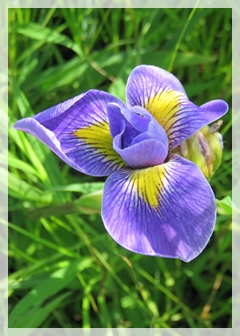
blue flag irisWhen I was a little girl, I once went to mass with my Roman Catholic cousins. Before leaving for church, my mother pressed two shiny quarters into my hand. “For the offering,” she reminded me. Part way through the service, long-handled offering baskets were extended down each row and people dropped their offering envelopes and money into them. “Who will know?” I thought as I reached into my pocket and pulled out just one quarter for the offering. Almost immediately, another basket came down our row. “God saw me!” I thought in a panic. “God knows I was holding out on Him and now the priest has sent the basket back.” I quickly reached into my pocket for the second quarter. As I dropped it into the basket, I heaved a great sigh of relief; I was safe from Hell for at least one more day. My only consolation was that I clearly wasn’t the only sinner; other people had dropped money into that second basket. Looking back, I think the second basket probably was for a special offering of some kind. To my child’s mind, however, that second basket was for those of us who hadn’t given God what belonged to Him.

Yesterday, I wrote about Jesus’s response to the Pharisees that we should “give to Caesar what belongs to Caesar.” [Matthew 22:21] Sometimes we forget that there was more to His response. Jesus added that we should “give to God what belongs to God.” Jesus was speaking of more than our tithes and offerings or little girls who hide quarters in their pockets.

Since Caesar had minted those silver coins with his name and picture on them, Jesus said they were Caesar’s. Let us never forget that God created us in His image and His mark is on us. By Jesus’s reasoning, that would seem to mean that we are God’s! His words were a not so subtle reminder that God wants our lives used for Him and for His glory. It’s not just our finances, but also our time, talent, hearts, worship and obedience that belong to God. Do we truly give God all that is His? Does He have all of us or are we keeping something hidden in a pocket?

Giving is more than a responsibility—it is a privilege; more than an act of obedience—it is evidence of our faith. [William Arthur Ward]
The heavens are yours, and the earth is yours; everything in the world is yours—you created it all. [Psalm 89:11 (NLT)]

You must each decide in your heart how much to give. And don’t give reluctantly or in response to pressure. “For God loves a person who gives cheerfully.” [2 Corinthians 9:7 (NLT)]

Copyright ©2019 jsjdevotions. All rights reserved.

BITTERROOT AND BINDWEED

Look after each other so that none of you fails to receive the grace of God. Watch out that no poisonous root of bitterness grows up to trouble you, corrupting many. [Hebrews 12:15 (NLT)]

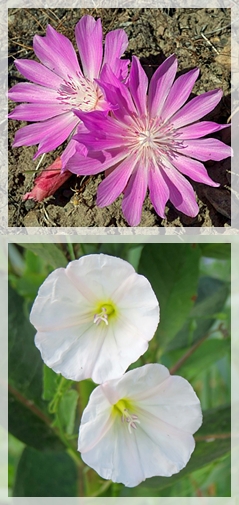
bitterroot - hedge bindweedThe bitterroot plant was a staple in the Native American diet; just a few ounces of the dried root provided enough nourishment for a meal. Bitterroot could also settle an upset stomach, relieve the itch from poison ivy, and numb the pain of a sore throat. Unlike the bitterroot, however, the root of bitterness is anything but life-sustaining or healing.

With its large pink flowers, the bitterroot is lovely and welcome; the root of bitterness is not. Bitterness is more like bindweed, a wild relative of the morning-glory. Both look harmless enough at first but, before you know it, they take root. Bindweed wraps itself around every plant nearby and bitterness wraps itself around our hearts. The roots of both bindweed and bitterness can reach deep and spread wide. Gardeners often call bindweed the “zombie plant” because it’s nearly impossible to kill; the same goes for bitterness. Without continual effort to keep cutting down bindweed and cutting out bitterness, both may be here to stay.

It’s hard to avoid bindweed, and the same goes for bitterness. We’ve all had people who’ve hurt us in seemingly unforgiveable ways. When bitterness rears its ugly head, we may find ourselves wishing ill upon them or taking secret joy if adversity hits them. Their inexcusable behavior makes us feel justified in allowing this bitter root to grow. The longer bitterness and bindweed are allowed to grow, the deeper their roots go and the more they destroy the garden or life hosting them.

Forgiveness is the only way to eradicate the root of bitterness and it doesn’t come easily. A desire for justice, revenge, and retribution is the natural response to injury. While we think that someone should pay for the harm that’s been done to us, we forget that Jesus has already paid that debt. If we ask how we possibly can forgive those who’ve hurt us, we must also ask how God possibly can forgive us. When Jesus saved us from God’s condemnation, we lost any right to condemn other people; we are no less a sinner than anyone else.

It takes patience, perseverance, and determination to rid a garden of bindweed and the same goes for ridding our lives of bitterness. As with bindweed, whenever we spot bitterness sprouting in our souls, we need to prune it back to weaken its roots. Praying for our enemies kills bitterness in much the same way herbicide kills bindweed. We should improve our soil with God’s word and consider cultivating new friends—ones who won’t share our bitterness, feed our resentment, encourage our hostility, listen to our complaints, or tolerate our anger. It can take three to five years of concentrated effort to eradicate bindweed from a garden; ridding ourselves of bitterness doesn’t happen overnight either.

There is one similarity between the root of bitterness and the bitterroot plant. Bitterroot’s scientific name is Lewisii (in honor of Meriwether Lewis) and rediviva (meaning “reviving from a dry state”) because of its root’s ability to grow again after being dug up, dried whole, and stored for several months. Like the bitterroot, the root of bitterness often can find a way to revive when we think it’s dead and gone. Then again, we must remember that both bitterroot and the root of bitterness can only revive if we replant and water them.

Love keeps no record of wrongs, but bitterness keeps detailed accounts. (Craig Groeschel)

Bless those who curse you. Pray for those who hurt you. [Luke 6:28 (NLT)]

Get rid of all bitterness, rage, anger, harsh words, and slander, as well as all types of evil behavior. Instead, be kind to each other, tenderhearted, forgiving one another, just as God through Christ has forgiven you. [Ephesians 4:31-32 (NLT)]

Copyright ©2019 jsjdevotions. All rights reserved.

GLOW IN THE DARK

Jesus spoke to the people once more and said, “I am the light of the world. If you follow me, you won’t have to walk in darkness, because you will have the light that leads to life.” [John 8:12 (NLT)]

photoluminiscent exit signsA business friend took us upstairs at his corporate center and then turned out all of the lights. With blackout curtains covering the windows, we were in complete and utter darkness. As our eyes adjusted to the dark, we saw glowing strips marking the perimeter of the room and around the door. A luminous exit sign was above the door and the doorknob was marked with a glowing circle around it. In spite of the blackness, we easily found our way to the door. When we opened it, another glowing sign warned us “Caution—watch your step.” Although the stairwell was pitch black, we weren’t frightened because the hand railing, baseboards, and edges of every stair were marked with glowing strips and another exit sign, outlined door, and marked doorknob indicated the way out of the dark stairway. That luminous greenish light safely guided us even when we couldn’t see where we were going.
My friend manufactures photoluminescent tapes and signs and it was his products that were glowing in the dark. He explained that photoluminescence occurs when a substance is capable of absorbing energy photons, storing them and then emitting them as a glowing greenish or yellow light. His products also glow in the light but, because of the ambient light, our eyes don’t see the glow; they seem brightest in the darkness!

Light and dark in the Bible are usually metaphors for good and evil, God and Satan, believers and unbelievers. Maybe it’s because I write Christian devotions but, after seeing how that glowing light led us through the building, I couldn’t help but think about the light of Christ that leads us. Just as the purpose of those photoluminescent products is to give off light, Christians are called to be the light of the world. Needing neither electricity nor batteries, those tapes and signs must absorb external light before they can make light of their own and it is Christ’s light that enables us to illuminate the world’s darkness; we can’t do it on our own. And, just as those photoluminescent tapes and signs seem brightest in the dark, the light of Christ shines brightest in the shadowy and troubled times. While darkness can never overpower God’s light, His light can overpower the world’s darkness.

Photoluminescent products continually absorb ambient light and, when fully charged, can glow brightly for about 90 minutes. But, without being recharged by light, they’ll eventually run out of energy and stop glowing. While 90 minutes is more than enough time to guide one out of a burning building, Jesus expects us to have more than a mere hour-and-a-half worth of His energy in us; we are to shine 24/7! Moreover, if photoluminescent tapes and signs get dirty or covered with paint, they can’t do their job. The same goes for Christ’s followers, but it won’t be dust, mud or paint that will soil us; rather, the filth of the world can keep us from lighting the way. We must keep ourselves free from sin and continually recharge with prayer, Scripture, fellowship, study, worship, praise and thankfulness.

Jesus led us from darkness into light. Are we doing our part to lead people to the fire exit and safely home to the Lord? Do we live as people of the light and glow with the glory of the Lord?

The fundamental principle of Christianity is to be what God is, and he is light. [John Hagee]

For once you were full of darkness, but now you have light from the Lord. So live as people of light! [Ephesians 5:8 (NLT)]

You are the light of the world—like a city on a hilltop that cannot be hidden. No one lights a lamp and then puts it under a basket. Instead, a lamp is placed on a stand, where it gives light to everyone in the house. In the same way, let your good deeds shine out for all to see, so that everyone will praise your heavenly Father. [Matthew 5:14-16 (NLT)]

Copyright ©2019 jsjdevotions. All rights reserved.


YOUR GIFT IS NEEDED

There are different kinds of gifts, but they are all from the same Spirit. There are different ways to serve but the same Lord to serve. And there are different ways that God works through people but the same God. God works in all of us in everything we do. Something from the Spirit can be seen in each person, for the common good. [1 Corinthians 12:4-7 (NCV)]

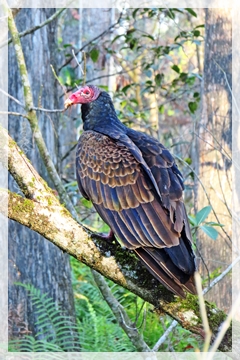
turkey vultureYesterday, when I compared vultures to mankind, I did vultures a disservice. Although unattractive, smelly, and with rather disgusting eating habits, vultures play a valuable role in keeping our ecosystem healthy and clean by disposing of rotting carcasses and preventing the spread of disease.
When in Tanzania, we came upon a committee of Rüppell’s vultures gathered by an impala carcass. The animal had collided with a vehicle and lay by the roadside—perfectly intact but clearly dead. The birds, however, weren’t eating and seemed to be waiting patiently while dinner lay right in front of them. When we asked our guide why they weren’t dining, he explained they were just waiting for the arrival of more vultures (but not out of politeness). The waiting vultures, while well-equipped to stick their heads into an animal’s carcass, didn’t have strong enough beaks to tear into its unbroken hide. They were awaiting the Lappet-faced Vultures who, with their strong beaks, could tear open the impala’s tough hide and through tendons and other coarse tissue to expose its insides. Being the larger dominant birds, the Lappets eat first. Once done, plenty of food remains deeper in the carcass for the medium-sized vultures like the Rüppell’s who, with their bald heads and necks are perfectly designed for getting down and dirty into the remains. Once they’re done, the Hooded Vultures get to eat. With their smaller heads and beaks, they are perfectly designed to extract the last bits of meat found deep in the animal’s remains. Last to dine is the Bearded Vulture. Unlike its cousins, this vulture has a feathered head making it ill-suited for eating flesh; fortunately, it likes the bones. When each vulture has done its part, their job of cleaning up the carcass is complete. When we wondered how all the different vultures managed to find this one dead animal, we were told that the White-backed Vulture has excellent eye sight and will “wheel” in the sky as a sort of dinner bell to alert all the others. Unable to tear open a carcass, it eats with the Rüppell’s.

There are twenty-three different species of vultures and God has equipped each one of them in a slightly different way. They all have the same assignment—to be nature’s garbage men—but each is equipped to do that in different ways. The White-backed Vulture signals, the Lappet-faced Vultures get the job started, the Rüppell’s do the dirty work, the Hooded-Vultures pick the bones, and the Bearded Vultures finish the job. Each vulture needs to do its part if their joint mission is to be accomplished.

God gave the vultures their assignment and, in Matthew 28:19-20, He gives us ours: “So go and make followers of all people in the world. Baptize them in the name of the Father and the Son and the Holy Spirit. Teach them to obey everything that I have taught you.” Within that greater assignment of expanding God’s Kingdom, however, we each have a distinct position to fill and a gift that will enable us to fulfill it. Like the vultures, the church cannot survive unless everyone uses his or her gift but, unlike the vultures, our gifts are rarely as obvious as a strong beak or a bald head.

While the Holy Spirit has gifted us, it is our obligation to determine the nature of His gift. In all of his discussion of spiritual gifts, however, the Apostle Paul gave no directions for recognizing those gifts. Perhaps he felt no need for guidance because recognizing our gift really isn’t so terribly difficult. All we really need to do is ask ourselves where we can best serve. Are we the guys with the big strong beaks or the ones who pick the bones clean? When we find the place where we can best serve effectively, we will have discovered our spiritual gift and we can get to work using it to further God’s kingdom.

Each of you has received a gift to use to serve others. Be good servants of God’s various gifts of grace. [1 Peter 4:10 (NCV)]

The most important thing is that I complete my mission, the work that the Lord Jesus gave me—to tell people the Good News about God’s grace. [Acts 20:24 (NCV)]

Copyright ©2019 jsjdevotions. All rights reserved.


WHICH ARE YOU? 

I will appoint over them four kinds of destroyers, says the Lord: the sword to kill, the dogs to tear, and the vultures and wild animals to finish up what’s left. [Jeremiah 15:3 (TLB)]

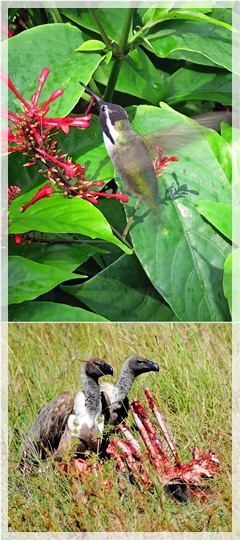
hummingbird - vulturesWe were enjoying hundreds of exotic butterflies amid tropical plants in the conservatory of a nearby botanic garden when I turned around to see a hummingbird hovering nearby. In spite of the building’s double-door containment procedures, this beautiful little bird managed to find his way into what, for him, must be paradise and no one seemed to mind. Seeing him reminded me of a question asked several years ago: “Which would you rather be—a hummingbird or a vulture?”  I thought, “That’s a no-brainer!” as I watched the iridescent bird hover over the flowers; then I remembered the question wasn’t what we wanted to be but rather what we actually were.
Most of us want to think we’re hummingbirds—those beautiful delicate birds with the fluttering wings—but I’m not sure we always are. Hummingbirds may be small but they’re fearless; they’ll even pursue hawks in defense of their nest. Are we that fearless? Hummingbirds are optimists who always look for the bright and sweet in the garden of life. Do we? These avian helicopters, often thought of as harbingers of good luck, are welcome everywhere. Does seeing us bring joy the way seeing a hummingbird does or is the reaction to us more like that of seeing vultures at the side of the road—something like “Yuk!”

When we search for something or someone to pick apart, we’re like the vultures soaring in the sky and sniffing for the stink of rotting carcasses. Rather than road kill, we’re sniffing around for rumor and scandal so we can dine on other people’s misery or disgrace. When we discourage rather than build up or disparage rather than praise, we’re not much different than the hungry vultures who gather as the swamp dries and anxiously wait for the fish to die so they can pick at the remains. When we remorselessly spew hate, bigotry, or anger, we’re like vultures that, with a well-aimed shot of acidic vomit, can slime someone or something they don’t like. When we choose to live with resentment, bitterness, and the rotten leftovers of yesterday, we’re not much different than vultures who defecate on their feet.

If we want to be hummingbirds, there can be no more concentrating on the unpleasant garbage of our lives or the lives of others. There can be no more feasting on sour guilt, fetid anger, foul-smelling regrets, or the rotten remains of past relationships and issues that died long ago. Hummingbirds don’t just seek out the sweeter things in life; they are one of those sweet things. As hummingbirds, we can’t just enjoy the happiness we find, we must bring joy to those we meet. After all, people plant brightly-colored flowers and hang special feeders for hummingbirds, but I’ve never heard of anyone trying to entice vultures into a garden.

The hummingbird and vulture have no choice—they are what they were born to be. We, however, can decide if we’re going to be hummingbirds and welcome spreaders of joy, or vultures, those unwelcome omens of misery. The choice is ours!

Lord, guide us in our thoughts and actions so we can be like hummingbirds from this day forth!

Always be full of joy in the Lord; I say it again, rejoice! … Fix your thoughts on what is true and good and right. Think about things that are pure and lovely, and dwell on the fine, good things in others. Think about all you can praise God for and be glad about. [Philippians 4:4,8b (TLB)]

Copyright ©2019 jsjdevotions. All rights reserved.

THE SERVANT SAVIOR

They replied, “When you sit on your glorious throne, we want to sit in places of honor next to you, one on your right and the other on your left.” … When the ten other disciples heard what James and John had asked, they were indignant. So Jesus called them together and said, “You know that the rulers in this world lord it over their people, and officials flaunt their authority over those under them. [Mark 10:37, 41-42 (NLT)]

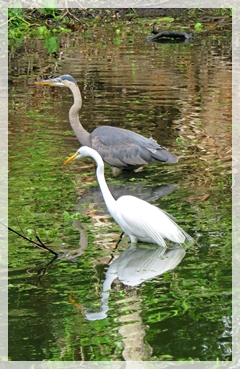
great blue heron - great egretThe day’s gospel was from Mark 10 and, as the sermon began, the pastor shared having spent three hours earlier that week in a tiresome meeting on evangelism. The speakers had been lauded for the high number of “first public professions of faith” in their parishes. As the meeting went on, the pastor furtively checked his phone to see if memory had served him right. Indeed, his church far exceeded the numbers of the keynote speakers. Part of him (the bad part), like James and John, wanted to boast and be honored but the other part reminded him that ministry is about people and not numbers. He ate a little humble pie and said nothing. As often happens in long meetings, his mind wandered and he thought back to an encounter some twenty-eight years ago when he first came to the parish.

In 1991, both the church and our nation had much less liberal views about alternative lifestyles and homosexuality. An era of homophobia, there often were economic, social, and even physical repercussions to coming out. AIDS was the leading cause of death among men 25 to 44 and, in an attempt to raise AIDS awareness, the Red Ribbon Project had just launched.

That year, Wayne, an elderly retired minister in the parish approached the pastor. “This homosexual thing,” he said, “I just don’t comprehend it and I can’t condone it. But,” he added, “all people are God’s children and are of sacred worth.” Wayne then spoke of the many gay men dying in the area. In those early years, most families abandoned their gay AIDS infected sons and brothers. Fearing contagion, AIDS patients were touched only by hands in rubber gloves and, because of surgical masks, they saw only the eyes of those who attended them. Facing death and without a support system, they felt alone, unloved, and worthless. Reiterating that he neither understood nor approved of homosexuality, Wayne added that he couldn’t stand by and do nothing. He asked permission to serve AIDS patients in the local hospitals. “I don’t want them to die without feeling the touch of a warm hand, seeing a smile, or knowing that they have value. I can’t let them die alone or without telling them that Jesus loves them.” The pastor immediately agreed to Wayne’s ministry of love because being a servant is what Jesus was and what He told us to be.

As the pastor thought back to Wayne’s selfless and loving service, he understood why his church’s growth numbers are exemplary. It wasn’t evangelism techniques, community events, baseball team sponsorship, or advertising; it was that the church and its members serve as Christ’s hands and feet. Through service, they both tell and show people that Jesus loves them.

When the pastor wanted to brag about his numbers, he realized he was being like James and John when they wanted their place of honor in God’s kingdom or the other disciples who were indignant at the thought they might not be honored as well. When he thought back to Wayne, however, he thought of Jesus’ words: “For even the Son of Man came not to be served but to serve others…” As Christ followers, we don’t need to understand or condone, we just need to serve our brothers and sisters (and all are our brothers and sisters).

One of the principal rules of religion is to lose no occasion of serving God. And, since he is invisible to our eyes, we are to serve him in our neighbour; which he receives as if done to himself in person, standing visibly before us. [John Wesley]

But among you it will be different. Whoever wants to be a leader among you must be your servant, and whoever wants to be first among you must be the slave of everyone else. For even the Son of Man came not to be served but to serve others and to give his life as a ransom for many. [Mark 10:43-45 (NLT)]

Copyright ©2019 jsjdevotions. All rights reserved.