
And he said to his servants, “The wedding feast is ready, and the guests I invited aren’t worthy of the honor. Now go out to the street corners and invite everyone you see.” So the servants brought in everyone they could find, good and bad alike, and the banquet hall was filled with guests. [Matthew 22:8-10 (NLT)]
 In Jesus’ Parable of the Wedding Dinner, after the initial guests refused to come, the king’s servants invited everyone they could find. Since it was a royal wedding, you’d expect the new guests to be dignitaries but everyone was to be called—regardless of social standing, race, nationality, wealth, or even moral character.
What seems like a beautiful example of God’s grace takes a turn when we learn that the king seems to have set a condition—a wedding garment must be worn. When I’m going to a wedding, it takes days (and probably a shopping trip or two) to put together the proper apparel and this was a royal wedding! People came from all walks of life and, with little time to prepare or purchase fancy clothing, we’re surprised when the king notices a man not wearing wedding clothes. Confronting the guest, the king asks how he could be there without proper attire. When the man has no reply, the king has him bound and cast into “the outer darkness.”
It’s easy to think the host’s problem is that the man is poor and has only rags to wear but the host’s anger seems so unlike Jesus that I was troubled by this part of His story. Scripture, however, never says the man was poor or dressed in tattered clothing and the speechless man, by never explaining himself or even asking how to get such a garment, seems to know he doesn’t belong at the feast.
By eating with sinners, touching lepers, healing on the Sabbath, and talking theology with a Samaritan woman, Jesus never seemed overly concerned with propriety or etiquette so it’s hard to think He took much notice of clothing. Some commentators speculate that the king must have furnished all of his guests with suitable apparel and that the man slighted the king by refusing to wear it. While it makes for a convenient explanation, there is no evidence of this being a Jewish custom so I’m not sure Jesus’ listeners would have understood it that way. Then again, perhaps “proper clothes” shouldn’t be taken too literally!
Rather than fabric and jewelry, could the wedding garment be the righteousness of Christ? By accepting the invitation, the evicted guest professed his belief, but the absence of a wedding garment testified to the falseness of his profession. A wedding garment would be the evidence of salvation—a way of life showing rebirth, repentance, and the works of righteousness. If we want to enjoy the feast, lip service is not enough; we must be righteous in character!
Jesus concludes the parable by saying, “For many are called, but few are chosen.” [22:14] God will not have an empty banquet hall and His invitation has been extended to all. He will, however, reject those who refuse His offer (as did the first invitees) along with those who are false in their acceptance (as was the man without the wedding garment.)
When sinners come in repentance, trusting in Christ, then He clothes them with the garment of salvation, with the robe of righteousness. This is the wedding garment that makes one presentable at the marriage supper. [Harry Ironside]
 A few miles from our Illinois home, a giant ski jump towered over the treetops. Originally erected in 1905 by Carl Howelsen and a group of Norwegian skiers living in Chicago, it’s been rebuilt over the years and is still used today. In a curious coincidence, in 1913, the man who loved the mountains and deep snow found his way to the Colorado mountain town we once called our winter home. Although Howelsen returned to Norway in 1922, he left an indelible mark on the town by introducing it to recreational skiing and ski jumping. Not far from the hill named for him, stands a statue of the man known as Flying Norseman.
 In ancient times, when an iron tool became dull, another iron implement was used to give it a finer polish and sharper edge. It’s not just tools that can become dulled—so can minds and spirits. Good Christian friends who act as whetstones can make us accountable, keener, stronger, and more enthusiastic and valuable. Rather than allowing us to grow dull and settled in our comfort zones, they sharpen us with challenges that make us better disciples for Christ.
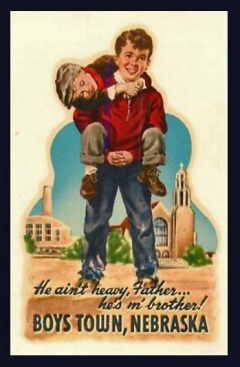 After saying we must carry each other’s burdens, the Apostle Paul seems to reverse himself three sentences later when he tells us we each must carry our own loads. It’s confusing; if we’re all supposed to carry our own loads, then nobody should need help carrying their burdens!
 Since we tend to think of burdens as demanding and often unwelcome duties or responsibilities, we’re certainly not anxious to take on a burden, especially one that actually belongs to someone else! Yet, that is exactly what we’re told we must do if we are going to fulfill Christ’s mandate. And what is that command? To love one another in the way God loves us.
 Yesterday, I wrote about Jesus’ Parable of the Three Servants, often called the Parable of the Talents. Although I used it as an example of excuse making, that’s not what the parable is about. This parable comes right after Jesus’ description of the end times and the Parable of the Ten Bridesmaids in which He urged readiness for the Day of the Lord. Immediately following this parable about the talents, Jesus spoke about the final judgment. The story of these three servants makes it clear that, when that last day comes, the master will settle accounts: faith will be rewarded and the righteous servants separated from the false ones.
 Devotions of the Heart