
You heard that it was said, “Love your neighbour and hate your enemy.” But I tell you: love your enemies! Pray for people who persecute you! [Matthew 5:43-44 (NTE)]
 No respecter of early mornings, an annoying woodpecker was busy drumming on the gutters of a nearby house. A few streets later, I spotted a woodpecker determinedly drilling into the stucco of another house. As it excavated a roost hole in the decorative trim, the determined little bird was doing as much damage with his beak as a heavy sledge hammer. A plaster patch nearby told me this wasn’t the first time the wall has been under attack! Throughout our community I see reflective streamers, children’s pinwheels, life-sized plastic owls, and strips of aluminum foil hanging from the eaves of houses. Nothing, however, seems to deter these birds from their drumming and drilling.
I thought of relentless woodpeckers after talking with a friend who recently experienced a stressful (but unavoidable) time with extended family. I could hear the exasperation in her voice as she spoke of the visit. As followers of Jesus, we’re supposed to reflect God’s love to everyone but she wondered if there’s an expiration date for that command when we get nothing but rudeness, deceit, or put-downs in return? How do we continue to love others when they are unlovable? We should be channels of God’s grace but what if we’re channeling that grace into what seems to be a bottomless pit of nasty? We’re supposed to be giving but when do we get a chance to receive? If other people can be selfish, under-handed, and bad-mannered, why can’t we?
Perhaps we need to remember that other people, no matter how unpleasant, demanding, or quarrelsome, are not the real foe—it is Satan. Like the woodpecker, he doggedly pokes, prods, and pesters us and our frustration, impatience, and annoyance with troublesome people is Satan chipping away at us a little bit at a time. Given enough time, instead of a stucco wall, he hopes to break through the wall of self-control. Instead of turning the other cheek, he wants us to lash back with some of the same!
In Jesus’ call to love our enemies, the word used was agapate which is the very kind of love God has for His sinful, disappointing, deceitful, troublesome, stiff-necked, difficult, selfish, and argumentative children! His love for us is active, unconditional, consistent, and permanent—a love that builds up rather than tears down. When Satan pecks at us with unpleasant people and difficult situations, let us remember that grace—unconditional love toward a person who does not deserve it—is exactly what we got from God and what He expects us to pass on to others! Admittedly, there are times we’re sorely tempted to retaliate rather than love but, just as God never takes a break from loving us, we don’t get to take a break from loving our enemies!
Fortunately, instead of plastic owls, we have God’s armor and the shield of faith to fortify us against Satan’s attacks. While loving our enemies is impossible on our own, God’s power enables us to resist Satan’s attacks and continue to pass on God’s grace to everyone (not just the nice deserving ones).
Agape is disinterested love. Agape does not begin by discriminating between worthy and unworthy people, or any qualities people possess. It begins by loving others for their sakes. Therefore, agape makes no distinction between friend and enemy; it is directed toward both. [Martin Luther King, Jr.]
 Jeopardy contestant James Holzhauer became known for his 32-game winning streak, massive winnings, and his “all-in” hand gesture while putting all of his winnings on the line when answering a Daily Double. A new champion is in the making with Ph.D. student Matt Amodio. Like Holzhauer, he plays an aggressive game and is not timid when it comes to the Daily Double. Last Wednesday, after saying “all-in,” he wagered his entire holdings of $8,000 and lost it all; undeterred by the previous night’s Daily Double loss, he again went “all-in” with a $10,400 wager the next day. His willingness to go “all-in” has paid off handsomely and, by the end of the week, he’d won 28 games and amassed $1,004,001.
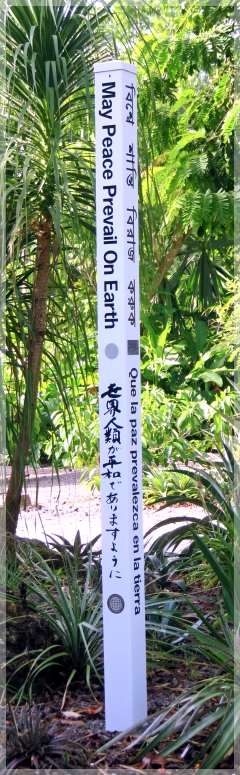 COVID kept us from the Botanic Gardens for well over a year. When we finally returned to one of our favorite places, we came upon a peace pole planted among the palms, bamboo and bromeliads. Although a similar pole is in the city park downtown, I don’t remember seeing one here when last we visited. These poles are just two of the more than 250,000 that have been erected in over 180 nations. Symbolizing the oneness of humanity, the words “May Peace Prevail on Earth” are written in eight different languages. The languages chosen for this pole were English, Arabic, Bengali, Chinese, Hawaiian, Hindi, Japanese, and Spanish—the languages of people who, like us, live at the 26th parallel north. Peace poles stand as a visual reminder to pray for peace on earth and to think, speak and act in the spirit of harmony and peace.
 Found in Buddhism and Hinduism, the concept of karma is the idea that how you live your life now determines the quality of life you’ll have after reincarnation. Christians, however, believe that “each person is destined to die once and after that comes judgment,” [Hebrews 9:27] which means that karma, with its continual opportunities to get it right, is not compatible with Christianity. Nevertheless, the karmic idea of good and bad actions yielding similar consequences—that “what goes around comes around”—is present throughout the Bible. Because many of the Bible’s metaphors about cause and effect have to do with agriculture and farming, a pastor friend likes to call this concept “farma.”
 In a sermon, J.C. Ryle (1816-1900) called Matthew 5:38-48 “our Lord Jesus Christ’s rules for our conduct towards one another.” The Anglican bishop added, “They deserve to be written in letters of gold: they have extorted praise even from the enemies of Christianity. Let us mark well what they contain. The Lord Jesus forbids everything like an unforgiving and revengeful spirit.” Indeed, these ten verses describe a Christian as he or she is meant to be (which explains why I’ve spent the last three days writing about them).
 When Paul addressed a Christian’s relationship with his enemies, he said never to return evil for evil and to act honorably so we don’t reflect badly on the Gospel. Paul qualified his direction to live in peace with all by adding, “if possible, so far as it depends on you.” While some people don’t want to live in peace, as Christians, we must refuse to instigate, escalate, or participate in conflict. Since peace-loving people who won’t return evil with more of the same tend to be the sort of people who are taken advantage of, Paul then addresses the issue of revenge. Quoting Deuteronomy 32:25, he makes it clear that we are not to retaliate; vengeance is solely God’s department, not ours.
 Devotions of the Heart