LAS POSADAS – LUMINARIA (3)

Again Jesus spoke to them, saying, “I am the light of the world. Whoever follows me will not walk in darkness, but will have the light of life.” [John 8:12 (ESV)]

I have come into the world as light, so that whoever believes in me may not remain in darkness. [John 12:46 (ESV)]
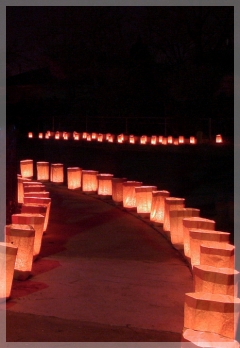
luminariaHundreds of years ago, when Las Posadas was first celebrated, people gathered piñon pine branches into square piles to burn small vigil fires called luminaria to light the way for the Peregrinos as they searched for lodging. On Christmas Eve, bonfires were lit along the roads and in the church yard to guide people to midnight mass. Just as Las Posadas moved into the southwestern states as the Spanish and Mexicans came northward, so did the luminaria. When inexpensive flat-bottom paper bags appeared on the Santa Fe Trail in the 1870s, people started folding down the bag tops, anchoring the bag with a few handfuls of sand, and setting a small candle inside. Better than using precious fire wood, these luminaria (also called farolitos) became the popular tradition that continues in the southwest today.

While I probably won’t be part of any Las Posadas celebrations when I’m in New Mexico next week, I will see plenty of luminaria, even though many of those who set them out know nothing of Las Posadas. Although some of those lanterns will be made of hard plastic and powered by electricity rather than candles, the warm glow of their flickering lights illuminate the walkways, sidewalks, driveways and flat roof tops throughout the state each December.

For those who celebrate Las Posadas, the luminaria serve to light Joseph and Mary’s way as they seek lodging. For others, luminaria guide the way to Christmas Eve worship, are a way of welcoming the Christ child into their homes, or remind them of the star of Bethlehem. Sadly, for many more, their luminaria are lit simply to guide Santa’s gift-laden sleigh to their houses.

Wherever we are this Christmas season, we’re sure to encounter holiday light displays. Whether they’re luminaria, projection spotlights, mini-string or large colored bulb lights, let their brightness remind us that Jesus is the Light of the World. When Christ’s light came into the world, it did more than illuminate our sins. It brought us salvation by guiding mankind out of the darkness of sin and death and into the light of Christ! Jesus called us to lead others into His light but we mustn’t stop at merely pointing the way to Christ. Jesus calls us to be the light—to be His luminaria and provide light for others.

The light of Christ shines brightest in dark and troubled times—and these are dark and troubled times. On a dark night, one individual paper bag holding a flickering candle in it isn’t very impressive and it certainly doesn’t shed much light. Collectively, however, hundreds of luminaria are an impressive sight. Darkness can never overpower God’s light but His light can overpower the world’s darkness. Let us be the world’s luminaria, not just at Christmas, but all year long!

Darkness cannot drive out darkness; only light can do that. Hate cannot drive out hate; only love can do that. [Martin Luther King, Jr.]
You are the light of the world. A city set on a hill cannot be hidden. Nor do people light a lamp and put it under a basket, but on a stand, and it gives light to all in the house. In the same way, let your light shine before others, so that they may see your good works and give glory to your Father who is in heaven. [Matthew 5:14-16 (ESV)]

This is the message we have heard from him and proclaim to you, that God is light, and in him is no darkness at all. If we say we have fellowship with him while we walk in darkness, we lie and do not practice the truth. [John 1:5-6 (ESV)]

Copyright ©2021 jsjdevotions. All rights reserved.

LAS POSADAS – LODGING (1)

And while they were there, the time came for her to give birth. And she gave birth to her firstborn son and wrapped him in swaddling cloths and laid him in a manger, because there was no place for them in the inn [Luke 2:6-7 (ESV)]

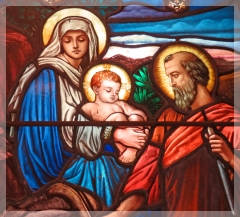
Holy FamilyTomorrow (December 16) is the first day of Las Posadas. Originally a solemn Christmas novena, it was brought to Mexico in 1587 by Spanish priests. Perhaps, because it occurred during the Aztec celebration of the birthday of their pagan god Huitzilopochtli, what began as formal nine-day prayer vigil eventually moved out of the church and into the community where it became a nine-day religious pageant.

Posadas is Spanish for “lodgings” or “accommodations” and the ritual commemorated Mary and Joseph’s trip from Nazareth to Bethlehem. At dusk December 16, people dressed up as Mary and Joseph, angels, and shepherds reenacted the couple’s journey and their unsuccessful search for lodging. Going to several houses each night, the pilgrims (called Peregrinos) were sent away until the ninth night (Christmas Eve) when they finally were given shelter. People along the route decorated their homes’ entrances with luminaria to light the way. This tradition spread into our nation’s southwest when Catholic settlers migrating from Spain and Mexico came northward.

When reenacting Mary and Joseph’s quest for housing, the participants sang a carol called “Pidiendo Posada” and the verses alternated between those outside seeking lodging and those responding from behind their doors. “In the name of the heavens I request lodging from you…,” sang the pilgrims while, from inside, they’re told it’s not an inn and the door won’t be opened because they could be scoundrels. The song went back and forth as the pilgrims begged for mercy and promised God’s reward but were answered with denials, excuses, and threatened with a beating. Although the Peregrinos identified Mary as “the Queen of Heaven,” the response was doubt that a queen would travel without an entourage. Not until the last house and entrance was gained was the final verse sung: “Enter holy pilgrims. Receive this haven. That although it’s a poor dwelling I offer it to you from the heart.”

When a homeowner received the Peregrinos, they were welcomed with food and a piñata shaped like a seven-pointed star. Like everything else about Las Posadas, the star had religious significance. Representing the star of Bethlehem, each of its points represented one of the seven deadly sins, and its bright colors denoted the lure of sin. Participants were blindfolded and made to turn around 33 times before trying to hit and break the piñata with a stick. The 33 turns represented the years in Jesus’ life and the resulting dizziness denoted the disorientation caused by temptation. The blindfold signified Christians’ blind faith that good will triumph over evil, the stick represented the virtue needed to overcome sin, the breaking of the piñata symbolized the triumph of good over evil, and the candy and fruit that spilled out once the piñata broke open signified the riches of the kingdom of Heaven. The rituals of Las Posadas served as a perfect way to teach a largely illiterate population the Christmas story and the gospel message.

Through the centuries, piñatas have lost most of their religious connotation and can be found in all sorts of shapes and sizes at all times of the year. While Las Posadas celebrations continue wherever a large Hispanic population is found, its observance has changed, as well. Rather than the original nine days of  processions, it often is observed only one night. Like the piñata and many of our Christmas traditions, it even has become secularized in some places with Santa’s appearance.

Beyond its pageantry and symbolism, what does Las Posadas mean to those of us who are neither Roman Catholic nor of Hispanic origin? Since it’s about welcoming strangers in need, we might recall that this beautiful tradition was brought to our country hundreds of years’ ago by immigrants who, like the Holy Family, were seeking a place of refuge. There are parallels between Joseph and Mary’s pilgrimage to Bethlehem (and their escape from Herod into Egypt) and the challenges today’s migrant families face when they flee their countries. While Las Posadas is about the importance of finding room for Jesus in our hearts so that His Spirit can live in us, it also is about finding room in our hearts for others who, like Joseph and Mary, seek safe shelter. A local Hispanic pastor explained that Las Posadas is about “doing right by Christ.” Let us remember that Jesus made it clear what doing right by Him meant.

There was no room that night so long ago, will we make room for Him today?

Then the King will say to those on his right, “Come, you who are blessed by my Father, inherit the kingdom prepared for you from the foundation of the world. For I was hungry and you gave me food, I was thirsty and you gave me drink, I was a stranger and you welcomed me, I was naked and you clothed me, I was sick and you visited me, I was in prison and you came to me.” Then the righteous will answer him, saying, “Lord, when did we see you hungry and feed you, or thirsty and give you drink? And when did we see you a stranger and welcome you, or naked and clothe you? And when did we see you sick or in prison and visit you?” And the King will answer them, “Truly, I say to you, as you did it to one of the least of these my brothers, you did it to me.” [Matthew 25:34-40 (ESV)]

Copyright ©2021 jsjdevotions. All rights reserved.

THE SECOND MILE

If a soldier demands that you carry his gear for a mile, carry it two miles. If you are kind only to your friends, how can you be different from anyone else? Even pagans do that. [Matthew 5:41-42 (NLT)]

great egretIn Jesus’ day, Roman law allowed a soldier to compel any able-bodied man in a conquered province to carry the soldier’s gear one mile. A Roman mile was 1,000 paces of five feet each (a little less than our mile) and a soldier’s pack could weigh as much as 100 pounds. In a similar way, Roman soldiers forced Simon of Cyrene to carry the cross of Jesus out of Jerusalem. Such impressment by an occupying army was viewed with outrage by the Jews and yet Jesus told them to willingly carry the load beyond what demanded by the soldier.

We don’t live with an occupying army so what does this command mean to us? Is the second mile simply bringing up a neighbor’s trash cart after we’ve brought up ours or is it more? Most life/career coaches tell their clients that going the extra mile is the secret to business success. The employee who gets promoted usually is the one who went above and beyond what was demanded. Is self-promotion the purpose of taking the second mile?

The second mile Jesus demands is more than another 1,000 paces, bringing in a neighbor’s trash bins, or being an exemplary employee. The first mile is loving, helping and praying for our neighbor; the second mile is loving, helping, and praying for our enemies or those we don’t know. That first mile is the mile we can see; the second mile is the one we can’t—the one that might have rough terrain, steep hills and slippery slopes, and without the promise of positional or financial gain. Jesus lived in the second mile. He touched the untouchable, loved the unlovable, and bore the unbearable. As Christians, how willing are we to take that extra mile?

Let us remember that, when Simon of Cyrene carried the cross to Golgotha, he didn’t carry it for the soldiers; he carried it for Jesus. When we go the extra mile, we’re not doing it for our neighbor, boss, or even our enemy; like Simon, we’re doing it for the Lord!  A Christian’s second mile is carried willingly and doesn’t stop at 5,280 feet; there is no end to our second mile because there is no limit to our love. Rather than first mile believers, we must be second mile disciples!

When we love the Lord, obedience ceases to be a burden. Obedience becomes a delight. [Joseph B. Wirthlin]

You have heard the law that says, “Love your neighbor and hate your enemy.” But I say, love your enemies! Pray for those who persecute you! In that way, you will be acting as true children of your Father in heaven. [Matthew 6:43-45a (NLT)]

Copyright ©2021 jsjdevotions. All rights reserved.

NO WON’TS ALLOWED

Will any one of you who has a servant plowing or keeping sheep say to him when he has come in from the field, “Come at once and recline at table”? Will he not rather say to him, “Prepare supper for me, and dress properly, and serve me while I eat and drink, and afterward you will eat and drink”? Does he thank the servant because he did what was commanded? So you also, when you have done all that you were commanded, say, “We are unworthy servants; we have only done what was our duty.” [Luke 17:7-10 (ESV)]

black-crowned night heronWhen she lived in Florida, my mother-in-law hired a woman to do the cleaning. In spite of representing herself as a “cleaning service,” this woman had a long list of “won’ts”—won’t do windows, mirrors, get on step ladders, move furniture, or bend over to wipe the baseboards, etc. Nevertheless, she always had a long list of complaints and financial needs that she was more than willing to share.

I wonder if that’s how we are in our relationship with God. Instead of being a willing servant who snaps to attention when his master calls and does what is asked, we have a list of “won’ts”—won’t obey, give, forgive, love, go where Gods sends us, or inconvenience ourselves. Nevertheless, in spite of our unwillingness to do for Him, we always have a long list of things we want from Him or complaints about the blessings we’ve already received.

Thinking we have a master probably makes us uncomfortable; we don’t want to think we’re subservient to anything or anyone. Instead of a master/servant relationship with our Lord, we’d prefer having a giver/receiver relationship with Him. Rather than serving Him, we’d prefer Him serving us and, as our generous benefactor, He continually would bestow gifts and blessings on us. When we think of God as our father, we’d prefer an indulgent father who’s long on generosity and short on discipline rather than one who expects obedience from His children. We’re happy to think of God as a protector shielding us from harm, a heavenly bail bondsman bailing us out of problems, or a pleasant and undemanding friend, but not so thrilled about having a master. While we’d prefer God being a trusted advisor whose advice we would follow if we liked it, He’s more of a dictator (albeit a benevolent one) whose word is law and whose plan is to be followed (like it or not)!

Make no mistake about it—God is more than a provider, parent, defender, rescuer, comrade, or counselor. God is our master and we are His servants. Rather than serving God with a list of “won’ts,” let us approach our master with the willing, eager, and obedient heart of a servant. Unlike that house cleaner, rather than serving for a reward of some kind (and complaining all the while), good servants whole-heartedly and joyfully serve God because they know, love, and trust Him. The central theme of Scripture is servanthood; may we always serve as did Jesus—the greatest servant of all.

Do nothing from selfish ambition or conceit, but in humility count others more significant than yourselves. Let each of you look not only to his own interests, but also to the interests of others. Have this mind among yourselves, which is yours in Christ Jesus, who, though he was in the form of God, did not count equality with God a thing to be grasped, but emptied himself, by taking the form of a servant, being born in the likeness of men. And being found in human form, he humbled himself by becoming obedient to the point of death, even death on a cross. [Philippians 2:3-8 (ESV)]

Copyright ©2021 jsjdevotions. All rights reserved.

THE LAST SUPPER (Part 1 – Servant Leadership)

Whoever wants to be a leader among you must be your servant, and whoever wants to be first among you must become your slave. For even the Son of Man came not to be served but to serve others and to give his life as a ransom for many. [Matthew 20:26-28 (NLT)]

monarch butterfly - thistleWhen picturing the Last Supper, we probably visualize it much like Leonardo da Vinci’s famous mural with the men seated on chairs at one long table. While visually appealing, the picture is inaccurate. Instead of sitting on chairs with their feet concealed under the dinner table, Jews and Romans in Jesus’ day lounged on low sofas or cushions surrounding a low three-sided table called a triclinium. The cushions or couches were placed on the outside of the three sides which left the inside open for serving and entertainment.  Diners would recline on their left sides, lean into the bosom of the person on their left, support their heads with their left arms, eat and drink with their right hands, and stretch their legs out to the right.

Crowded together, each person’s head wouldn’t be that far from someone else’s feet. Considering where people’s sandaled feet had walked and what they’d walked in, we now understand why providing for foot washing was an expected part of hospitality. Sometimes, a servant (usually the lowest one in the household) did this task. In the absence of a servant, however, it was customary for the host to leave out a pitcher of water, a basin, and a towel so that the guests could wash their own feet. This must have been the case that Thursday night when Jesus and the disciples gathered in the upper room.

Just a few days earlier, after the mother of James and John requested honored places for her boys in the coming kingdom, Jesus told all of the disciples, “Whoever wants to be a leader among you must be your servant, and whoever wants to be first among you must become your slave.” If everything they needed to wash their feet was there, why did the disciples walk right past the pitcher and towel? They certainly didn’t expect Jesus to wash their feet but, with no slave present to do it for them, why didn’t the men pause long enough to wash their own? Author Adam Hamilton posits that the men didn’t stop to wash their own feet because they feared that, by stopping, they might actually have to act the servant and wash someone else’s feet. In spite of Jesus’ words, it appears that the disciples still didn’t understand what it meant to be a servant leader.

Jesus was the leader and they were His followers; He was the teacher and they were His students. In truth, they were the ones who should have been washing His feet but Jesus reversed all social expectations. Wrapping the towel at his waist and filling the basin with water, He took the lowest servant’s part, knelt by each man, and washed his feet. Those were the feet of betrayers, deniers, and deserters; Jesus knew what they’d done and what they soon would do. Rather than a job for God incarnate, this was a menial chore for the lowest servant but Jesus did it anyway! He showed us all what it means to be a servant leader. May we always follow His example!

After washing their feet, he put on his robe again and sat down and asked, “Do you understand what I was doing? You call me ‘Teacher’ and ‘Lord,’ and you are right, because that’s what I am. And since I, your Lord and Teacher, have washed your feet, you ought to wash each other’s feet. [John 13:12-14 (NLT)]

Copyright ©2021 jsjdevotions. All rights reserved.

ADVENT LOVE

This, you see, is how much God loved the world: enough to give his only, special son, so that everyone who believes in him should not be lost but should share in the life of God’s new age. After all, God didn’t send the son into the world to condemn the world, but so that the world could be saved by him. [John 3:16-17 (NTE)]

While we’re busy decorating our homes, planning holiday menus, finding the perfect gift for everyone on our list, and stressed about supply chain issues and shipping delays affecting the receipt of those gifts, let’s not forget that we’re in the season of Advent. This is a time for us to prepare for the second coming of Christ and to ponder the gifts of hope, love, peace, and joy we received with His first coming.

Although the observation of Advent has no Biblical mandate and its traditions vary throughout various denominations and nationalities, many churches observe this season with an Advent wreath and candles. At our northern church, last Sunday’s candle was the Prophet’s Candle, the candle of hope. This Sunday’s candle will be the Bethlehem candle, the candle of love. It was on that holy night in Bethlehem long ago that God’s love for His fallen children took on human form. When thinking about this amazing gift of love, the words of Christina Georgina Rossetti’s beautiful poem come to mind. “Love came down at Christmas, love all lovely, love divine; love was born at Christmas, star and angels gave the sign.”

God is love and that baby born in Bethlehem so very long ago was God! When love was made manifest in Jesus, we saw that love is far more than an abstract idea or emotion. We not only saw how much God loved us, but we also saw what real love looks like, and it has nothing to do with expensive gifts, gaily wrapped boxes, beautifully decorated cookies, or wreaths, colored lights, and tinsel. It has to do with serving others, humility, patience, compassion, forgiveness, generosity, mercy, and sacrifice.

In a season marked by materialism, stress, shopping, over-eating (and drinking), travel, and entertaining, let us reflect upon the love of a God who, rather than giving up on his sinful rebellious children, loved us enough to sacrifice his only Son for our salvation. That Son was “love incarnate, love divine” as He put on the flesh of humanity, was born of a woman, suffered and died for us just so He could redeem us with His own blood! Born in Bethlehem over two thousand years ago, He loved us enough to become flesh and blood, not so that He could be with us, but so that we could be with Him!

It’s been pointed out that, while it’s easy to believe in Christmas and even easier to celebrate it, it’s much harder to live Christmas. “Love incarnate, love divine” is the true meaning of Christmas. As God loved us, may we love others in the same way, not just in this season, but all year long.

Love came down at Christmas,
Love all lovely, love divine;
Love was born at Christmas,
Star and angels gave the sign.
Worship we the Godhead,
Love incarnate, love divine;
Worship we our Jesus:
But wherewith for sacred sign?
Love shall be our token,
Love shall be yours and love be mine,
Love to God and to all men,
Love for plea and gift and sign. [Christina Georgina Rossetti]

The one who does not love has not known God, because God is love. This is how God’s love has appeared among us: God sent his only son into the world, so that we should live through him. Love consists in this: not that we loved God, but that he loved us and sent his son to be the sacrifice that would atone for our sins. Beloved, if that’s how God loved us, we ought to love one another in the same way. [1 John 4:8-11 (NTE)]

Copyright ©2021 jsjdevotions. All rights reserved.