
 And I will give you a new heart, and I will put a new spirit in you. I will take out your stony, stubborn heart and give you a tender, responsive heart. And I will put my Spirit in you so that you will follow my decrees and be careful to obey my regulations. [Ezekiel 36:26-27 (NLT)]
Last Friday, doctors in Maryland made history when they transplanted a genetically modified pig’s heart into a human in a last-ditch effort to save the life of David Bennett, Sr. A medical first, Bennett was too ill to qualify for a routine heart transplant or an artificial ventricular assist device. The 57-year-old’s prognosis is uncertain and it will be months before doctors know whether the transplant can be deemed a “success.” As with any organ transplant, the main risk is that of organ rejection and Bennett will need potent immunosuppressing drugs for the remainder of his life.
I remember how astonished the world was back in 1967 when Dr. Christiaan Barnard performed the first human-to-human heart transplant. The news that a surgeon had cut open someone’s chest, lifted out a diseased heart, and successfully replaced it with a healthy one from a dead donor was astounding. Although that first heart transplant recipient lived only eighteen days, today’s recipients have an 85% chance of living one year and a 69% chance of surviving five. The survival rate continues to decrease through the years with only 50% of heart transplant recipients living ten years and just 15% making 20 years. In spite of the risks, last year over 50,000 transplant candidates worldwide vied for the 5,000 hearts that were available. Sadly, there just aren’t enough hearts to go around.
54 years ago, the medical journals were wrong when they credited Dr. Bernard with the first heart transplant; God has been replacing hearts for ages! He takes our damaged hearts of stone, hearts unwilling to respond to Him, and replaces them with a new heart and spirit. After accepting His new heart, we have no need for immunosuppressive drugs because the new heart won’t be rejected. Unlike transplant candidates, we don’t have to meet specific criteria or put our names on a waiting list. Everyone qualifies and all we have to do is repent! The best news is that there’s no heart shortage and we don’t have to wait for someone to die; Jesus did that for us 2,000 years ago!
Even with a pig’s heart, Mr. Bennett won’t to want to live in a sty, cool off with a mud bath, snuffle in the soil, or start eating a mix of corn, soybeans, sorghum, and wheat. While his new heart will give him a new lease on life (at least for a short time), it will not change him. He will be the same man with the same favorite activities, world view, media preferences, attitudes, likes and dislikes, morals and principles he had before surgery. On the other hand, the new heart God gives us will make a huge change in us. We will have a new mind, new preferences, new spiritual gifts, new beliefs and morals, a new love for who and what we may have hated, and a new aversion to things we once might have loved. Rather than getting immunosuppressant drugs, we will receive an infusion of love, joy, peace, patience, kindness, goodness, faithfulness, gentleness, and self-control! Getting a new heart in God’s hospital also yields a far better survival rate—no death, only eternal life!
O Holy Spirit, descend plentifully into my heart. Enlighten the dark corners of this neglected dwelling and scatter there thy cheerful beams. [Augustine]
 In immersion baptism, a person is completely submerged in the water and, every time I witness a full immersion baptism done in the Gulf of Mexico, I think of what it must have been like when John baptized Jesus and the Holy Spirit descended on our Lord. Since the Greek word used to describe this event was baptizo, meaning to dip, sink, or submerge, we can safely assume His was a full immersion baptism.
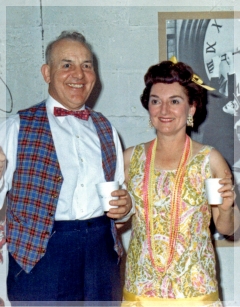 My in-laws were great ones for giving theme parties. When they hosted a “Backwards Party,” guests entered through the back door, wore their clothes backwards (which my mother-in-law admitted made it difficult for the men), and ate dessert before dinner. At another get-together, attendees came dressed as children, received jump ropes and jacks, pulled taffy, and played games like “Mother May I?” and “Pin the Tail on the Donkey.” My introduction to their parties was in 1966 when they turned their house into a Prohibition era speakeasy and guests needed a password to enter. Women dressed as flappers while the men wore fedoras, vests, and spats. Another party had the theme, “Come as You Wish You Had Been.” My mother-in-law, dressed in shorts with a whistle around her neck, came as the PE teacher she once dreamed of becoming and my father-in-law dressed as the train conductor he once aspired to be. Other attendees dressed as ballerinas, weight lifters, princesses, cowboys, or baseball players.
 Every breakfast, lunch and dinner, a recent house guest consumed between five and fifteen supplements like flaxseed and fish oils, magnesium, vitamin D, calcium, turmeric, ginger, cinnamon, and resveratrol (among others). Annually, people like our guest spend around $35 billion on supplements, vitamins, minerals, botanicals, and other substances to enhance their health. It doesn’t stop there; every year, five million diet books are published, at least 17 million cookbooks are purchased, and $33 billion is spent on weight loss products. Add to that all of the magazines, food channels, websites, blogs, and podcasts dedicated to nutrition, recipes, and weight loss and you have a nation of people who seem obsessed with what goes into their bodies.
 Whenever we were with my mother-in-law, she would say, “Come, sit down, and rest for a bit.” Since I usually was busy preparing a meal or doing some task for her, I’d say, “Not now, Grandma, maybe later!” Now that she’s gone, I wish I’d spent a few more minutes sitting and resting with her. I thought of her this morning when reading Jesus’ words urging the disciples to find a quiet place to rest awhile.
 When speaking to the Pharisees, Jesus delivers what could be called the ultimate good news/bad news scenario. The good news is that, no matter how evil, vicious or long-lasting the sin, any sin (even blasphemy) is forgivable. The good news, however, comes with a “but” when Jesus says blasphemy against the Spirit will never be forgiven.
 Devotions of the Heart