
He said to them, “Let the children come to me. Don’t stop them! For the Kingdom of God belongs to those who are like these children. I tell you the truth, anyone who doesn’t receive the Kingdom of God like a child will never enter it.” Then he took the children in his arms and placed his hands on their heads and blessed them. [Mark 10:14b-16 (NLT)]
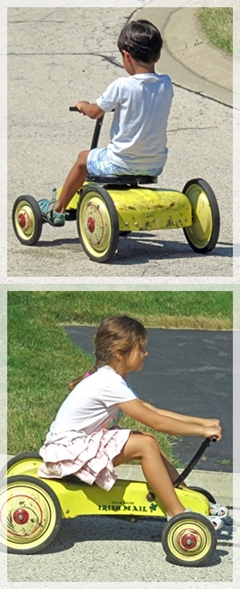 The thing I’ll miss most when we move to southwest Florida permanently is easy access to my grandchildren. This summer I’ve relished watching the little guys frolic in the sprinkler, race their scooters down the sidewalk, climb the monkey bars, decorate the driveway with colored chalk, and play bags with their cousins. They insisted on helping in the kitchen, offered to set the table, listened intently to every story read to them, and never tired of endless games of Crazy-Eights and Kings’ Corners. Their squeals of delight at the holiday fireworks and when they mastered riding the Irish Mail (where they pumped with their arms and steered with their feet) were music to my ears. They asked endless questions and pondered every answer. Wanting to please us, they even were obedient. Seeing their unbridled enthusiasm, energy, and desire both to learn and please, I wondered why I wasn’t like that. After all, God wants us to be like children.
We’re mistaken if we think Jesus’s words about receiving the Kingdom like a child mean that we should be unquestioning and unthinking. Anyone who has experienced the never-ending queries of children knows how inquisitive and persistent they are. As soon as one question is answered, another will be asked. If a child wonders where the sun goes at night, the next question will be where the moon goes during the day, followed by a raft of other questions that strain our limited astronomical knowledge. While children’s inquiring minds inundate us with questions, they differ from adults because they actually care about understanding the answer. We adults, on the other hand, are rarely as anxious to learn something new since we’re sure we already know most anything worth knowing. God doesn’t mind our asking questions but He does want us to listen and learn from His answers as would a child.
Youngsters are also brutally honest (if a bit tactless), unreservedly enthusiastic, and genuine. They love freely, don’t try to impress, rarely judge and, for the most part, want to please their parents. They may carry a blanket or stuffed animal with them, but they never cart around guilt. Their parents, however, are often afraid to love, frequently less than honest, sometimes hypocritical, tend to be judgmental, and often haul a suitcase of guilt and regret wherever they go. While children are drawn to kindness and gentleness, their parents usually are more impressed by power and riches. We adults tend to rebel rather than obey and, rather than God, the one we most want to please usually is ourself.
I’ve never once heard a child say, “You shouldn’t have!” when offered a gift. My little guys certainly didn’t say they weren’t worthy or deserving of their ice cream cones, the trip to the lake, or the boat ride to watch the fireworks. Why then is it so difficult for adults to accept God’s gift of grace? Of course, we don’t deserve it and haven’t earned it, but it is ours for the taking. Like little children, we need to grab hold of this precious gift and relish it; only then will we enter the Kingdom of God.
 After the Apostle Paul established the church in Thessalonica, he encountered persecution from both the Jews and city officials so he abruptly fled with Silas. In his first letter to the Thessalonians, Paul sends words of comfort, edification, and encouragement to the new church. Along with some practical advice on Christian living, he reassures the new converts in their persecution and 1 Thessalonians 5:16-18 are some of my favorite verses.
 Because of my foot surgery, I was stuck in an air boot (and “air” definitely does not mean “light as air”) for five weeks. Weighing just a little over three pounds, it felt more like thirty by the end of each day. Wearing a cumbersome boot that never quite matched the height of any of my shoes took its toll on me. Eventually, my foot didn’t hurt as much as did my knee, hip, and back from hobbling along in my heavy unmatched footwear. Carrying extra loads of anger, resentment, worry, heartache, guilt, or regret can weigh us down in much the same way that boot affected my body and gait. Instead of walking with confidence and strength, we limp along in fear, discomfort and doubt. The difference, of course, is that there was purpose to my burdensome boot but there is no purpose in being saddled with emotional baggage. Jesus asks us to give Him our burdens; with Him in our lives, we don’t have to carry any extra weight in our hearts.
 As a friend’s father used to say, “I couldn’t have made the day any better myself!” The temperature was perfect, the humidity had dropped, the pink of the sunrise tinged the early morning sky, and the aroma of jasmine made every breath a pleasure. When I looked one way, I still could still see the full moon and, when I looked the other, I saw the golden fire of the rising sun. Like a mirror, the lake reflected the clouds and colorful sky. Mocking birds were singing their joyful songs, rabbits were munching the grass, squirrels were chasing one another, ducks effortlessly glided through the water, and a few woodpeckers were tapping on the palms. It seemed like God had given me the beautiful morning as a special birthday gift. Of course, I know He didn’t do it just for me but it felt that way. I was especially appreciative of these little everyday things because I knew it would be my last walk for many weeks; the following day I was having foot surgery and faced a long recovery. As I tried to gather in the morning’s memory to keep me content for the next several weeks of inactivity, I wondered why I didn’t appreciate every morning as much as that day’s.
 To explain her sisters’ bitterness and sour outlook on life, my mother-in-law would say, “Well, their lives didn’t turn out the way they’d hoped.” Those women had no reason to complain when comparing their lives to Naomi (the mother-in-law in the book of Ruth).
 We all know drama queens (and kings) who don the crown of martyrdom. On occasion, we even may have worn that crown ourselves. Along with the crown, we put on a robe of selfishness and self-righteousness. Dressed for the part, we see outer circumstance only in the light of how they negatively affect our lives (ignoring how they may be affecting those around us). Rather than asking, “What can I learn from this?” we protest, “I don’t deserve this!” as if anyone else does! Forgetting that God only wants our best and there is purpose in our pain, we find our troubles the perfect excuse for resentment, complaints, bitterness, and an all-out pity party.
 Devotions of the Heart