
He has filled me with bitterness and given me a bitter cup of sorrow to drink. [Lamentations 3:5 (NLT)]
 To explain her sisters’ bitterness and sour outlook on life, my mother-in-law would say, “Well, their lives didn’t turn out the way they’d hoped.” Those women had no reason to complain when comparing their lives to Naomi (the mother-in-law in the book of Ruth).
Talk about things not turning out the way you’d hoped! Naomi endured famine, a move to an enemy nation, pagan daughters-in-law, no grandchildren, the death of her husband and then the death of her two sons. Poverty stricken, with no relatives to help her in Moab, Naomi decided to return to Israel. When her two daughters-in-law started back with her, she tried to deter them, telling them to go back to their parents where there may be another marriage in their future. While one woman returned home, Ruth stayed with her mother-in-law.
Widowed and childless, neither woman’s life seemed headed for a “happily ever after.” When the bereaved Naomi arrived back in Bethlehem, she told her old friends to call her Mara, meaning “bitter.” She explained that, “The Almighty has made life very bitter for me. I went away full, but the Lord brought me home empty.” Like my husband’s aunts, Naomi was resentful that life hadn’t turned out as she’d expected. What she didn’t understand was that God was busy at work behind the scenes. Her bitterness even blinded her to fact that she didn’t come home empty—she’d come home with Ruth, a woman described by Naomi’s friends as “better to you than seven sons!” Embittered, Naomi didn’t see her blessing in a daughter-in-law who loved and honored her and would labor in the fields for her.
You know the rest of the story. Ruth gleaned grain in the fields of Boaz. He took on the role of “kinsman redeemer,” purchased land that had belonged to Naomi’s husband, and married Ruth. The couple had a son, Naomi became a grandmother, and that little boy would be grandfather to the future King David.
We all have been given reason to call ourselves bitter. But, as followers of Jesus, we can become better rather than bitter and not because a kinsman redeemer buys our land, marries us, pays our bills, solves our problems, and takes us away from our troubles. We don’t become bitter because we have a Redeemer God who walks with us through our trouble and enables us to find joy in our new normal. We don’t become bitter because we know our life is better than we ever dared hope. We don’t become bitter because we know life, in the world yet to come, can only be better!
 We all know drama queens (and kings) who don the crown of martyrdom. On occasion, we even may have worn that crown ourselves. Along with the crown, we put on a robe of selfishness and self-righteousness. Dressed for the part, we see outer circumstance only in the light of how they negatively affect our lives (ignoring how they may be affecting those around us). Rather than asking, “What can I learn from this?” we protest, “I don’t deserve this!” as if anyone else does! Forgetting that God only wants our best and there is purpose in our pain, we find our troubles the perfect excuse for resentment, complaints, bitterness, and an all-out pity party.
 The faithful love of the Lord never ends! His mercies never cease. Great is his faithfulness; his mercies begin afresh each morning. I say to myself, “The Lord is my inheritance; therefore, I will hope in him!” [Lamentations 3:22-24 (NLT)
 We were enjoying hundreds of exotic butterflies amid tropical plants in the conservatory of a nearby botanic garden when I turned around to see a hummingbird hovering nearby. In spite of the building’s double-door containment procedures, this beautiful little bird managed to find his way into what, for him, must be paradise and no one seemed to mind. Seeing him reminded me of a question asked several years ago: “Which would you rather be—a hummingbird or a vulture?” I thought, “That’s a no-brainer!” as I watched the iridescent bird hover over the flowers; then I remembered the question wasn’t what we wanted to be but rather what we actually were.
 Not that I was ever in need, for I have learned how to be content with whatever I have. [Philippians 4:11 (NLT)]
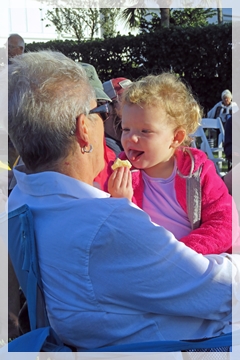 As we sang carols at the beach Christmas Eve, Sarah’s grand sat on her lap while finishing off a holiday cookie. By the time the little one was done with the cookie and cuddling her gram, Sarah’s shirt was a wrinkled mess of frosting, crumbs and cookie drool. I couldn’t help but think of the gospel story of parents bringing their children to Jesus for a blessing. Even in the first century, I imagine little children meant grubby hands, sticky fingers, and runny noses. From what we know of Jesus, though, I picture him welcoming those children onto His lap along with all of the mess that came with them. Perhaps some even left drool on his robe.
