
Therefore, go and make disciples of all the nations, baptizing them in the name of the Father and the Son and the Holy Spirit. [Matthew 28:19 (NLT)]
 Last year my eldest grand took advanced calculus. I could neither understand what she was doing nor the purpose in doing it (other than gaining entrance into a good university). This year she is taking something called Discrete Math, the definition of which leaves me in the dust. Apparently used in computer science, I didn’t even know that numbers could be discrete. Fortunately, I’m not the one taking SATs and making application to colleges so I don’t need to make sense of her difficult curriculum.
As confusing and difficult to explain as Calculus and Discrete Math is the concept of the Holy Trinity. Although my grand has to fully understand the concepts taught in her math classes, I don’t have to completely comprehend the Trinity to believe in it (which is good since the Trinity can seem as confusing as algorithms, algebraic combinatorics, and hypergraph theory.)
While various analogies are often used to describe the Holy Trinity, none seem to work completely. The Trinity has been compared to an egg with its three parts: yolk, white and shell. Although each is part of the same egg, the analogy fails because none of the three are the egg themselves. All three distinct parts of the Trinity are God rather than just part of Him. Others analogies compare the Trinity to water with its three properties of liquid, solid (ice) and vapor or steam. Although they all are water, the analogy fails since the same water can’t be all three at the same time. God, however, is Father, Son and Holy Spirit simultaneously. In previous devotions, I’ve compared the Trinity both to a chef’s mirepoix and the three dimensions of a book; while close, they weren’t perfect either.
While viewing a waterfall recently, I remembered an analogy used by one of my pastors. Picture yourself standing at the foot of a beautiful and powerful waterfall. You look up to the top. You can’t see the river that is the source of the water and yet you know it is there. The river, the source, is like God the Father. Then you look ahead and see the water pouring down over the rocks. The water you can see is Jesus (the Son who comes from God). Finally, you feel the spray on your face, breathe it in through your mouth and nose, and the water becomes part of you. That mist is the Holy Spirit.
The doctrine of the Trinity is central to our Christian faith. God is one being who exists as three coexistent, equal, eternal and divine Persons: the Father, the Son and the Holy Spirit. While they are all God, none of the three are any of the others. The Father is not the Son or Spirit; the Son is not the Father or Spirit, and the Spirit is neither Father nor Son. That we can’t fully comprehend this incredible phenomenon is understandable. God is God and we are not and His ways are beyond our limited human understanding. Nevertheless, just because I can’t understand calculus or discrete math doesn’t mean they are false or nonexistent and just because I can’t quite grasp the concept of a Triune God doesn’t mean He doesn’t exist either. His power and presence are not dependent upon my understanding. After all, this is the God who created a vast universe from nothing and scattered countless stars across the sky; fashioned everything from elephants to dragonflies and redwoods to roses; and understands theoretical astrophysics, nanotechnology, quantum physics, calculus and discrete math. Being three in one is probably child’s play to our omnipotent Triune God. Praise Father, Son and Holy Spirit. Amen!
 In the Sunday school stories we learned as children, the Bible’s heroes were larger than life. When we read about them as adults, however, we read the parts skipped in Sunday school and realize they were real people with feet of clay. Yet, it’s their sins and weaknesses that make their lives as relevant today as they were centuries ago. No matter how great, all except Jesus were flawed. Peter denied knowing Jesus, Matthew was a dishonest tax collector, Thomas doubted Jesus’ resurrection, Noah and Lot got drunk, Abraham lied to protect himself, David was an adulterer and murderer, Rahab was a prostitute, Jacob deceived his father, Jonah refused and fled, Sarah doubted and grew impatient, Samson allowed lust to lead him, Paul persecuted Christians, Elijah got so depressed he wanted to die, Gideon dared to question God, and, in spite of his great wisdom, Solomon disobeyed Him. The disciples argued amongst themselves and deserted Jesus, Isaac played favorites with his sons, and both Eli and Samuel tolerated the shameful behavior of their boys. Nevertheless, flawed as they all were, there is much to learn from their stories. We see the possibility of transformation and redemption. The prostitute was instrumental in an Israelite victory and became one of Jesus’ ancestors. The corrupt taxman became a disciple and turned his record keeping skills into gospel writing. The Pharisee became Christ’s messenger throughout the Roman Empire and the fisherman who denied Christ became the leader of the disciples. In spite of their faults, all of them were saints of God.
 The Bible gives us plenty of instances of God directly speaking to His people—Noah, Moses, and Joshua were all given specific directions before building the ark, liberating the Israelites, or crossing into the Promised Land. On the other hand, there are many people who furthered God’s plan without His specific instructions. As far as we know, God didn’t tell Moses’ mother to place her son in a basket and lay him among the reeds of the crocodile infested Nile, yet she did just that. What caused a mother to literally send her beloved baby down the river? Yet, that very action furthered God’s plan; as the son of an Egyptian princess, Moses received a royal upbringing and an excellent education, all of which he needed in his later confrontations with Pharaoh.
 These people are false apostles. They are deceitful workers who disguise themselves as apostles of Christ. But I am not surprised! Even Satan disguises himself as an angel of light. So it is no wonder that his servants also disguise themselves as servants of righteousness. In the end they will get the punishment their wicked deeds deserve. [2 Corinthians 11:13-15 (NLT)]
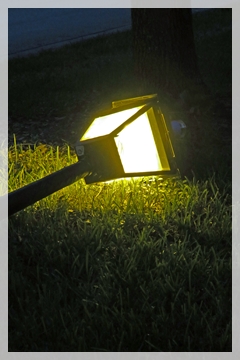 To avoid the southwest Florida heat, I waited until dusk to take my walk. Thanks to Hurricane Irma, most of the street lamps in my neighborhood don’t work. For a light to function, electrical energy has to be converted into light energy and both a source of electricity and a working connection are needed. For many of the lights, the connection was broken when blowing debris shattered their bulbs. For others, Irma’s 150 mph winds broke the connection when it blew off their tops, wrapped their poles around trees, or knocked them to the ground. Without a connection to their source of power, those street lights are useless—they’re just a tangle of wires and a pile of glass, plastic and metal. Even though they don’t work, people have been cautioned to remember that their exposed wires are live. It’s not the electricity that is missing; it’s the connection that is inoperative. Two poles, however, were down but not out. Even though they’d been flattened by the storm, neither wires nor bulb had broken. In spite of the storm’s violence, they remained connected and were beacons in the night’s darkness.
 Devotions of the Heart