
Simeon…took the child [Jesus] in his arms and praised God, saying, “I have seen your salvation, which you have prepared for all people. He is a light to reveal God to the nations, and he is the glory of your people Israel!” Jesus’s parents were amazed at what was being said about him. Then Simeon blessed them, and he said to Mary, the baby’s mother, “This child is destined to cause many in Israel to fall, but he will be a joy to many others. He has been sent as a sign from God, but many will oppose him. As a result, the deepest thoughts of many hearts will be revealed. And a sword will pierce your very soul.” [Luke 2:28,31-35 (NLT)]
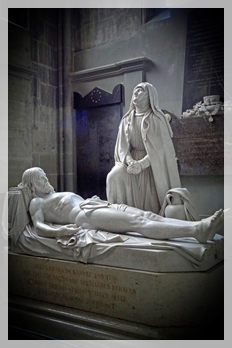 As Mary stood in the shadow of the cross, did she recall Simeon’s words when he held the infant Jesus in his arms? His prophecy came true that day at Calvary; as she watched her son endure such torture, it truly must have felt as if a sword had pierced her very soul. Jesus was supposed to be the glory of His nation but there He was—dying the death of a criminal. Mary didn’t understand why her beloved boy had to perish and she certainly didn’t know that He’d be back in three days. Imagine her sorrow and the emptiness in her heart as she witnessed her son’s agony.
Mary knew she loved her son but I wonder if that day she questioned God’s love for Him. She didn’t know that from the moment Jesus was planted in her womb her boy was headed to Calvary or that His death on the cross was all part of God’s perfect plan. How could she understand that her Son’s death was a deliberate choice: that He was dying for the very people who had placed Him on that cross? How could she know that His death proved the enormity of God’s love for all of humanity?
Like Mary, we don’t know the reason why our loved ones suffer or what will result from their suffering. Unlike Mary, however, we do know the rest of the story. Without the crucifixion, there would have been no resurrection. But, because of Jesus’s death and resurrection, there is another life waiting for us in God’s heavenly kingdom. Jesus’s resurrection means that hope overpowered desperation, love claimed victory over hate, forgiveness prevailed over condemnation, joy conquered despair, and life triumphed over death.
Jesus, the Son of God, was ignored, denied, betrayed, falsely accused, demeaned, scorned and scourged, and finally crucified on a cross. He suffered and died like a common criminal and was buried in a borrowed tomb like a vagrant. The sinless One paid the sinners’ debts. He didn’t have to, but he did. Thank you, God, for your loving redemption.
…death was not Jesus’ penalty; it was His destiny. It was not His lot in life; it was His mission. It was not His unavoidable fate; it was His purpose statement for coming to earth that first Christmas: “Born to die.” [Bill Crowder, from“The Path of His Passion”]
 There’s a therapeutic riding center across the highway from one of the churches we attend. Along with horses, barn cat, and dog, they have a rooster. No matter what the time of day we’re there, that rooster crows. Every time I hear that bird’s loud “cock-a-doodle-do!” I remember Jesus’s words to Peter and ask myself, “Have I denied my Lord today?”
 The next day John saw Jesus coming toward him and said, “Look! The Lamb of God who takes away the sin of the world! [John 1:29 (NLT)]
 Fitbit recently notified me that I’ve logged 4,132 miles and awarded me a badge for having walked the length of the Nile River. And to think—I managed to do it all without ever leaving the country. With the aim of averaging 10,000 steps a day, I was curious to see how close to that goal I’ve gotten since getting the Fitbit. Some complicated math told me that, by now, I should have logged enough steps to be three-quarters of the way from the North to the South Pole. Granted, I haven’t always worn my pedometer and both foot and knee injuries temporarily benched me. Nevertheless, surprised to see how short I was of my goal, I realized how easy it is to think we’ve done far more than we actually have.

 St. Valentine may (or may not) have been the Catholic bishop of Terni, a priest who helped persecuted Christians during the reign of Claudius II, one who suffered in Africa, one who secretly married couples when marriage was forbidden, or one who converted the family of a jailer named Asterius and restored sight to his blind daughter. It was a common name and whether there was only priest named Valentine who did all of these things or as many as three, supposedly he or they were beheaded by the Emperor Claudius II on February 14 around the end of the third century. The confusion about Valentine’s identity led the Roman Catholic Church to drop his saint day from their official calendar of feasts in 1969.

