
The Lord God took the man and put him in the garden of Eden to work it and keep it. [Genesis 2:15 (ESV)]
 Today is Labor Day—the unofficial last day of summer. On a day originally intended to celebrate the accomplishments of workers, it’s somewhat ironic that most of us are doing as little work as possible. Nevertheless, whether it’s just making the bed, grilling the burgers, washing the car, or being called in for an emergency surgery, we’ll all do some work today. We appreciate the day off but we’d much prefer a full-blown vacation—with no chores, deadlines, schedules, or business calls, texts, and emails. On the ideal vacation, all we have to do is relax and enjoy ourselves.
Everyday life, however, requires work of some kind. Some days that work might be stimulating but, other days, it can downright boring. While our labor can be enjoyable, it also can be grueling or hectic. Most of our tasks aren’t what we’d describe as fun. Some are physically demanding, others are tedious, and some are just plain gross! The list of tasks seems never-ending and much of the what we did yesterday, we’ll do again today, and probably tomorrow, as well! Nevertheless, work is a gift from God and, quite likely, the gift we least value.
Surveys show that about 60% of our waking hours are spent working in some way or another. The American Time Use Survey estimates that, out of their 16.2 waking hours, the average employed person spends 8.8 hours working at their job, 1.8 hours on household activities, and 1.2 hours caring for others. No matter how much we love our family, doing the laundry, pulling weeds, grocery shopping, changing diapers, and helping the kids with homework is work. With so much of our life spent in labor, God wants us to enjoy our work and, thankfully, he’s given us the ability to do so.
God worked for six days creating the universe, Jesus accomplished the work God gave him [John 17:4], and the Holy Spirit is working in us right now. Because God is inherently good, anything He does is good, so we know work can’t be bad or evil. It’s simply a fact of life. God didn’t put Adam in the garden to sit in a lounge chair and drink margaritas. He gave him a garden to tend and watch over. Work was a gift not a curse but, because of our sin, God’s curse affected our work! It was only after the fall that work became toil, presented difficulties, and was prone to failure and unintended consequences. Work became more important in our lives simply because it took more labor to yield the desired results!
God wants us to enjoy all aspects of life, not just holidays like Labor Day or those two weeks in the sun while on vacation. Holidays and vacations are just the icing on the cake; He wants us to delight in the cake as well. When we work to the best of our ability with an uncomplaining (and appreciative) heart, work becomes a privilege and a way to honor our Heavenly Father.
Lord, we thank you for the gift of labor. Forgive any grumbling, shoddy workmanship, or lackluster effort on our part. Renew us with your Spirit. Fill us with enthusiasm, competence, and fortitude as we work so that the fruit of our labor brings honor to you and joy and self-respect to us.
Work is a blessing. God has so arranged the world that work is necessary, and He gives us hands and strength to do it. The enjoyment of leisure would be nothing if we had only leisure. It is the joy of work well done that enables us to enjoy rest, just as it is the experiences of hunger and thirst that make food and drink such pleasures. [Elisabeth Elliot]
 The Resurrection story didn’t end on Easter with Jesus’ appearance to ten disciples, Mary Magdalene, Mary the mother of James and John, Salome, and Joanna, along with Cleopas and another believer who broke bread with Him in Emmaus. Appearing and disappearing at will, Jesus remained on earth for forty days. While He probably appeared other times, Scripture tells us He later appeared to Thomas and the ten others, to seven of the disciples beside the Sea of Galilee, to His half-brother James, to over 500 believers at one time, and to the disciples on his last day with them.
 By forgiving people’s sins, Jesus was placing Himself in the role of God because only God can forgive sins. Had Jesus not been God, it would have been blasphemy. When He raised the dead, multiplied food, stilled storms, and healed incurable diseases, Jesus was doing other things that only God could do. His incredible claim that He could bring Himself back from the dead, something only God could do, was another way Jesus claimed His divinity. The undeniable proof of His claim came Easter morning when Jesus demonstrated power over both life and death. The tomb was empty and people saw the risen Christ—they heard Him speak, watched Him eat, saw His wounds, and touched Him. The forty days the resurrected Jesus remained on earth, however, is about more than proof of his claim to be God; it’s about proof of our relationship to God.
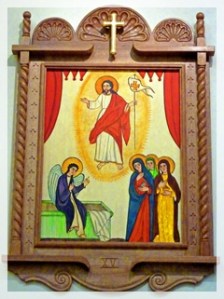 Found in almost every Roman Catholic church (and some Protestant and Orthodox ones), are the Stations of the Cross—a series of fourteen icons or carvings on the walls—each of which depict a moment in the Passion of Christ. Created to help people contemplate the events leading up to Christ’s crucifixion, they start with His death sentence from Pilate and end with His dead and battered body being laid in the tomb. Because Good Friday and Jesus’ death aren’t the end of the story, some churches have begun adding the resurrected Christ as a 15th station.
 While touring an historic house, the elaborately set dinner table reminded me of the large formal dinner parties we had in our younger (and more energetic) days. I’d start preparing the table in advance by adding extra leaves to the table, gathering the extra chairs, and ironing out the creases in the damask tablecloth. From the cupboard in the basement, I’d haul up the crystal salad plates, my mother’s Lenox china, and the hand-painted Bavarian service plates and Czechoslovakian dessert plates that were my grandmother’s. I’d spend hours polishing the silverware and serving pieces. The service plates were set out, the silverware laid, the crystal wine and water goblets carefully placed at each setting, and the napkins artfully folded. I’d set out the silver candlesticks, put in fresh candles, get flowers from the florist, and create what I hoped would be the perfect Martha Stewart-worthy table setting. There was plenty more work to do in the kitchen. I’d spend days perusing recipes, planning the menu, making lists, purchasing food, and preparing it all. I loved doing it because I loved the people for whom I did it. Nevertheless, as nice as my guests were and as much as they enjoyed themselves, I’m not sure they truly appreciated how much effort went into everything that on that table.
 In my last post, I pondered why Jesus chose the men he did as his apostles. As we enter Holy Week and the events leading to the Lord’s arrest and crucifixion, I wonder specifically about Judas Iscariot. We don’t know what Jesus saw in Judas when he was chosen as one of the twelve or even what was in Judas’ heart in the beginning of Jesus’ ministry. We only know that discontent, ambition, and greed had entered his treacherous heart by the end.
 Devotions of the Heart