
In that day he will be your sure foundation, providing a rich store of salvation, wisdom, and knowledge. The fear of the Lord will be your treasure. [Isaiah 33:6 (NLT)]
Dear God, what misery I beheld! The ordinary person, especially in the villages, knows nothing about the Christian faith, and unfortunately many pastors are completely unskilled and incompetent teachers. [Martin Luther]
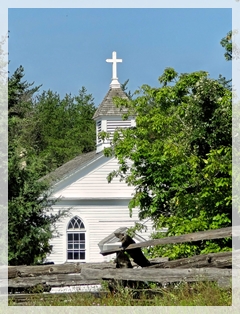 Yesterday I mentioned getting an email with the subject, “How firm is your foundation?” Although it was an advertisement for a new study Bible connecting Biblical teachings to Christian beliefs, that very question has been the topic of discussion in our northern church for the last few weeks. The parish is doing a church-wide study of Martin Luther’s Small Catechism. Back in the 1500s, Martin Luther was appalled at the lack of knowledge of both pastors and their congregations. Not especially tactful, he accused some pastors of being “lazy bellies and presumptuous saints!” His words for their congregations, “simple cattle and mindless pigs!” were no more diplomatic. People who called themselves Christians had no idea what that meant. They didn’t know the Ten Commandments, the Apostle’s Creed or even the Lord’s Prayer, let alone anything else in the Bible. Last week, our Pastor asked us what Luther might say if he visited today’s churches. We agreed that his words for our pastors would be more complimentary but that his words for their congregations might be the same or worse!
To remedy the deplorable lack of knowledge he found, Luther wrote his Small Catechism in 1529. This little book of Christian instruction was written not for theologians and priests but for ordinary people. It covers the Ten Commandments, the Apostle’s Creed, the Lord’s Prayer, Holy Baptism, confession, Holy Communion, daily prayers and even offers a Household Chart of Bible passages describing the duties of people in various walks of life. Much of the catechism is done in question and answer form with the answer succinctly provided. For example, after listing the first commandment, it asks, “What does this mean?” and then explains: “We are to fear, love, and trust God above all things.” In short, Luther’s Small Catechism is a 16th Century version of Christianity for Dummies. Surprisingly, given its age, it is amazingly straightforward. Without theological minutia or argument, it is easily understood and certainly not limited to the Lutheran church.
This brings me back to the question that appeared in my email yesterday, “How firm is your foundation?” Do you know and understand what it is you profess to believe? Do you know why you believe it? How firm is your foundation?
How firm a foundation, ye saints of the Lord,
Is laid for your faith in His excellent Word!
What more can He say than to you He hath said,
You, who unto Jesus for refuge have fled? [John Rippon]
 The damage done by Hurricane Harvey seemed unbelievable until Irma hammered the entire state of Florida. Fortunately, our Florida home was prepared and we were safely situated in the Midwest during Irma’s tirade. Would that all the storms of life announced themselves a week in advance to give us time to put up storm shutters and evacuate to safety.
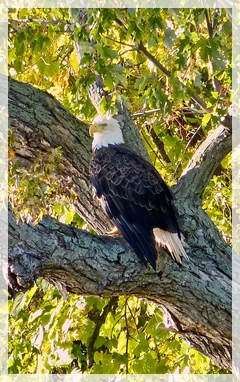 The eagle is mentioned more than any other bird of prey in the Bible. References are made to its swiftness of flight, ability to soar high in the air, excellent vision, the way it sets its nest in high places, and the strength of its wings. The above two verses about eagles, however, are more figurative than literal and have no scientific basis. Although mother eagles do hover over their young, they cannot carry them. A bald eagle’s lifting power is only about a third of its weight. An eaglet ready to fly is as heavy as its parents. If Mrs. Eagle tried to carry junior, they’d both fall! The second verse about being renewed like an eagle is probably connected to an ancient belief that every ten years the eagle disappeared into the sun, dove down into the sea with the setting sun, and emerged young again. There’s a similar urban myth that at 30 years of age, the eagle flies to a high mountain top and makes the difficult decision between death or the painful plucking out of all of its feathers and the destruction of its beak and talons. After waiting several months for everything to grow back again, it will be transformed and the refreshed bird will be able to live another 30 years. Not so; like the rest of us, when it’s time to grow old and die, the eagle has no choice. Like other birds, however, when the eagle molts, old worn feathers will drop and new ones will replace them.
 Ezekiel proclaimed God’s message to the Jewish exiles in Babylon. As the Lord’s prophet, he was commissioned to deliver words of both judgment and hope. Some of the exiles recognized him as a prophet but more did not. Although they found Ezekiel’s message entertaining, they had no intention of putting his words into practice. There’s a lesson here for today’s churches: pews filled with people there only for the music, amusement, food, or activities mean nothing if God’s word is not planted in people’s hearts.
 I passed on to you what was most important and what had also been passed on to me. Christ died for our sins, just as the Scriptures said. He was buried, and he was raised from the dead on the third day, just as the Scriptures said. [1 Corinthians 15:3-4 (NLT)]
 Devotions of the Heart