BE ON THE LOOKOUT – ST. PATRICK’S DAY

That night Paul had a vision: A man from Macedonia in northern Greece was standing there, pleading with him, “Come over to Macedonia and help us!” So we decided to leave for Macedonia at once, having concluded that God was calling us to preach the Good News there. [Acts 16:9-10 (NLT)]

hope cloverI can’t say that I’ve ever had a dream or vision as clear cut as was Paul’s. If I ever did, I’m not sure I’d be as quick as he and his companions were to trust it. In Paul’s case, however, the dream helped him understand why the Holy Spirit previously prevented the men from preaching in the provinces of Asia and Bithynia (modern day Turkey). After hearing the Macedonian man’s plea, Paul finally had a clear sense of God’s direction. Paul, Silas, Timothy, and Luke headed west to Troas, set sail across the Aegean Sea, and made their way to Philippi in the Roman province of Macedonia (northern Greece). Paul’s obedience to that call took the gospel west toward Europe and changed Western civilization forever!

Nearly 300 years later, Irish history was changed when the man we know of as St. Patrick had a similar dream. Born Maewyn Succat around 387 in Roman Britain (Scotland), Patrick was kidnapped by Irish marauders at the age of sixteen. Taken to Ireland, the boy was sold into slavery and labored at herding and tending sheep. According to his memoirs, as Patrick prayed several times a day during his captivity, his faith grew and he felt the presence of the Holy Spirit. After six years of enslavement, he had a dream in which God told him, “Your ship is ready.” The young man escaped, walked 200 miles to the coast, and found some sailors who took him back to Britain. Once home, Patrick had another dream in which he was given a letter titled “The Voice of the Irish.” Upon opening it, he heard the voices of the people who’d once enslaved him calling, “We appeal to you, holy servant boy, to come and walk among us.” Initially reluctant to answer the call because of his lack of education, Patrick began religious training. He returned to Ireland about 15 years after his dream and the man known for explaining the Trinity with the three-leaved single stalk shamrock evangelized all over the land for the next thirty plus years. Patrick is said to have converted over 135,000 people, established 300 churches, and consecrated 350 bishops.

While we’re not likely to have such vivid dreams as Paul and Patrick, we should listen for the “Voice of the Irish” and be looking for a “man from Macedonia” in the people who cross our paths every day. They’ll probably look and sound much like everyone else and yet they’ll have a pressing need to know Jesus. May we respond as readily as did Paul and Patrick. We probably won’t change the world as did they, but we surely can change the world for someone.

God’s plan for enlarging his kingdom is so simple – one person telling another about the savior. Yet we’re busy and full of excuses. Just remember, someone’s eternal destiny is at stake. The joy you’ll have when you meet that person in heaven will far exceed any discomfort you felt in sharing the gospel. [Charles Stanley]
For “Everyone who calls on the name of the Lord will be saved.” But how can they call on him to save them unless they believe in him? And how can they believe in him if they have never heard about him? And how can they hear about him unless someone tells them? And how will anyone go and tell them without being sent? That is why the Scriptures say, “How beautiful are the feet of messengers who bring good news!” [Romans 10:13-14 (NLT)]

Copyright ©2021 jsjdevotions. All rights reserved.

THE LORD’S VICTORY

And he said to him, “Please, Lord, how can I save Israel? Behold, my clan is the weakest in Manasseh, and I am the least in my father’s house.” And the Lord said to him, “But I will be with you, and you shall strike the Midianites as one man.” [Judges 6:15-16 (NLT)]

Because the Midianites were raiding and plundering Israel, we meet Gideon hiding in a large vat. Rather than threshing wheat in the open air so the wind could blow away the chaff, he was cautiously working in the bottom of a secluded wine press when an angel of the Lord delivered a message to the timid man. Addressing Gideon as a mighty warrior, the unlikely hero demurred and claimed to be the least worthy of the weakest clan in the tribe of Manasseh.

After a fair amount of hesitation and questions, the reluctant warrior eventually gathered an army of 32,000 to battle the Midianites, a force of 153,000 men. With the odds against Gideon being four to one, I imagine he was wondering where to find more men when God told him that he had too many! He was instructed to send home all those who were afraid. After 22,000 men departed, God told Gideon there still were too many men. He was to separate them by the way they drank water from a stream—whether they cupped the water with their hands and lapped it up or knelt down to drink from the stream. Only the 300 warriors who drank from their hands were allowed to remain. With an overwhelming ratio of 450 Midianites to one Israelite, Gideon’s defeat seemed inevitable. Nevertheless, while Gideon may have been fearful, he never lost faith. Gideon’s few good men crushed the Midianites. The nomadic tribe never recovered and there was peace in the land for the next forty years.

We might wonder why God chose Gideon—the least of the least—and why He didn’t provide him with as large an army as possible to ensure an Israelite victory. The odds were bad enough when Gideon started with 32,000 men but, with only 300, victory seemed impossible. But that was God’s point! When the angel of the Lord entered Gideon’s life, the Israelites had been oppressed by the Midianites for seven years because they “did evil in the Lord’s sight.” [Judges 6:1] They’d worshipped pagan gods, built an altar to Baal, and erected an Asherah pole. Gideon’s first task, prior to leading the men into battle, had been to destroy those pagan symbols. When Baal did not retaliate, it became clear how worthless the false god was. But, did the people understand how powerful the Lord was?

God chose Gideon, the youngest son of the weakest clan, and only a handful of men because their victory against absolutely impossible odds made it abundantly clear to all that the victory didn’t belong to Gideon or his soldiers; it belonged only to God! Rather than looking at this story as an example of what just a few men (or women) can do, we should look at it as an example of what God can do just with a few! He is, after all, the hero in every story!

Selfish and proud creatures that we are, we tend to blame God when things go wrong but remove Him of any responsibility for our successes. In Gideon’s story, God eliminated any possibility that the Israelites’ strength, skill, or valor had anything to do with their triumph. Victory was the Lord’s! God was the hero of Gideon’s story; let Him continue to be acknowledged as the hero of ours, as well!

The horse is made ready for the day of battle, but the victory belongs to the Lord. [Proverbs 21:31 (ESV)]

Copyright ©2021 jsjdevotions. All rights reserved.

THE HOLY TEMPLE (Cornerstone – part 3)

Therefore, this is what the Sovereign Lord says: “Look! I am placing a foundation stone in Jerusalem, a firm and tested stone. It is a precious cornerstone that is safe to build on. Whoever believes need never be shaken. [Isaiah 28:16 (NLT)]

Together, we are his house, built on the foundation of the apostles and the prophets. And the cornerstone is Christ Jesus himself. We are carefully joined together in him, becoming a holy temple for the Lord. Through him you Gentiles are also being made part of this dwelling where God lives by his Spirit. [Ephesians 2:20-22 (NLT)]

church of st. columba The cornerstone metaphor continues into the New Testament with both Paul and Peter referring to Jesus as the cornerstone of our faith. Nowadays, cornerstones are structurally unneeded and a growing number of commercial buildings no longer have them. Symbolic rather than functional, many serve as time capsules holding material relevant to the building and the year it was built. Because commercial buildings so frequently change hands, even the custom of inscribing the building’s name on a cornerstone is disappearing. The latest practice is a freestanding cornerstone/time capsule resting on a pedestal placed in a prominent part of the building. That way, a new stone can replace the old one every time the building’s owner changes.
While cornerstones may be superfluous to a modern structure, there is nothing superfluous about Jesus as our cornerstone. Moreover, He can’t be exchanged for a newer version or sold to the highest bidder. While buildings may change owners, our owner remains God and we are both His children and His servants. Our cornerstone does not serve as a time capsule of 1st century Judah; Jesus is our living stone and as relevant today as He was 2,000 years ago.

Both Paul and Peter carry the building metaphor further by calling us the stones in God’s temple. Unlike the temple in Jerusalem, this isn’t an earthly building with walls and a roof. Nevertheless, it has a cornerstone in Jesus. Since a cornerstone connects two different walls, the metaphor illustrates how Jesus connected both Gentiles and Jews into one cohesive church.

Peter likens us to living stones and Paul says we are built on the foundation of the apostles and prophets. Let that image sink in for a moment and consider those foundation stones: people like John the Baptist, Paul, Peter, and John. Others in that foundation are less famous but no less essential: people like Lydia, the cloth merchant who housed Paul; Tabitha (Dorcas), the generous seamstress who came back from the dead; the eloquent Apollos, one of the first Christian apologists; the devoted Mary Magdalene; Aquila and Priscilla, the tentmakers who opened their home to Paul; the generous Phoebe, a deacon at the church in Cenchreae; Silas, who sang with Paul when they were prisoners; and Paul’s fellow missionary, Barnabas. Through the centuries, others were added to the structure: defender of the Trinity, Athanasius; Martin Luther, the father of the Reformation; theologian and philosopher, Augustine of Hippo; the martyred Archbishop of Canterbury, Thomas Beckett; Bible translators John Wycliffe and Martin Tyndale; Pilgrim’s Progress author John Bunyan; reformer John Calvin; founder of Methodism, John Wesley; and the “Saint of Auschwitz,” Polish priest Maximilian Kolbe. Set beside these well-known Christians are people whose names we wouldn’t recognize; nevertheless, they too are the stones of the church. Think about it—people just like us are being set into this same edifice with the likes of apologist C.S. Lewis, humanitarian Mother Teresa, Olympian Eric Liddell, evangelist Billy Graham, and the “Prince of Preachers” Charles Spurgeon! We are living stones being mortared into place, shoulder to shoulder, with the apostles and prophets who went before us! We are the temple of God and its cornerstone is Jesus Christ!

You are coming to Christ, who is the living cornerstone of God’s temple. He was rejected by people, but he was chosen by God for great honor. And you are living stones that God is building into his spiritual temple. What’s more, you are his holy priests. Through the mediation of Jesus Christ, you offer spiritual sacrifices that please God. As the Scriptures say, “I am placing a cornerstone in Jerusalem, chosen for great honor, and anyone who trusts in him will never be disgraced.” [1 Peter 2:4-6 (NLT)]

Copyright ©2021 jsjdevotions. All rights reserved.

CORNERSTONE, TENT PEG, AND BOW (Cornerstone – part 2)

From Judah will come the cornerstone, the tent peg, the bow for battle, and all the rulers. [Zechariah 10:4 (NLT)]

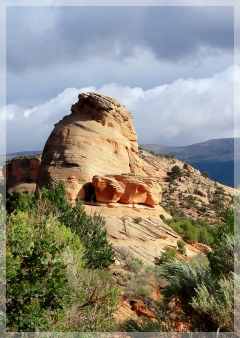
elephant toe - utahIn the Old Testament, “cornerstone” as a metaphor for the Messiah is found in Psalms, Isaiah, and Zechariah. In Zechariah 10, the prophet describes Israel’s need for purification because of their idolatry, fortune-tellers, and false prophets. Holding the nation’s leaders responsible for these transgressions, Zechariah says the people are like lost sheep without a shepherd. Proclaiming the arrival of the ”Lord of Heaven’s Armies” who will look after the flock, the prophet says he’ll come from Judah and describes him as a cornerstone, tent peg, and battle bow.
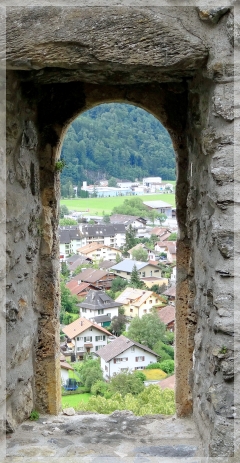
Nowadays, cornerstones are more ornamental or commemorative than functional. In the first century, however, the cornerstone was the first squared stone in the foundation of any structure. Determining the position of the rest of the foundation, every other stone in the wall was aligned to it and a properly set (or true) cornerstone was essential to the structural integrity of any building. The Messiah as cornerstone would be the first and most important stone in God’s Kingdom and would provide a reliable and firm foundation for His people.

While cornerstone is a familiar Messianic metaphor, tent peg and bow are not. At first, the image of the Messiah as a tent peg seems strange but, if you’ve ever pitched a tent, you know its purpose. Pounded into the ground, tent pegs are fastened to the ropes holding up the tent and must be set securely or the tent will sag, rip, or even collapse. Even today’s freestanding dome tents need tent pegs or stakes to keep them from blowing away in the wind. The tent peg is as important to a tent’s stability as a cornerstone was to a building’s. Just as the peg fastened the tent to the ground and kept it from collapsing, so the Messiah’s rule would secure Israel to Himself and keep His people upright.

The third metaphor is that of a battle bow: an offensive weapon symbolic of military power. As God’s warrior, the Messiah would fight to save His people. Whether it would be a physical or a spiritual battle is less clear. The bow, however, is associated with more than warfare; it is connected with God’s power in judgment and speaks of a Messiah who would deliver judgment.

We then come to the fourth term in this short verse: rulers. The original Hebrew had no punctuation and it’s unclear if this is a metaphor. Some commentators believe it refers to the Messiah and means that He will be the rulers of rulers. Many others disagree because the word translated as ruler was nagas which wasn’t used for a rightful king. It meant tyrants, taskmasters, or oppressors. Rather than a metaphor for the Messiah, they interpret this to mean that the Messiah would defeat every oppressor of His people. In either case, the people of Judah interpreted Zechariah’s words to mean the Messiah would wage physical war on the nations that oppressed them. The Messiah, however, wasn’t about an earthly kingdom and earthly oppressors. As Judah’s cornerstone, tent peg, and battle bow, the Messiah would wage war on the nation’s true enemy and oppressor—the tyrant Satan and sin. The Messiah would strengthen His people and, in His might, they would find salvation!

I will strengthen Judah and save Israel; I will restore them because of my compassion. It will be as though I had never rejected them, for I am the Lord their God, who will hear their cries. … By my power I will make my people strong, and by my authority they will go wherever they wish. I, the Lord, have spoken! [Zechariah 10:6,12 (NLT)]

Copyright ©2021 jsjdevotions. All rights reserved.

THE STONE THE BUILDERS REJECTED (Cornerstone – part 1)

The stone that the builders rejected has now become the cornerstone. This is the Lord’s doing, and it is wonderful to see. [Psalm 118:22-23 (NLT)]

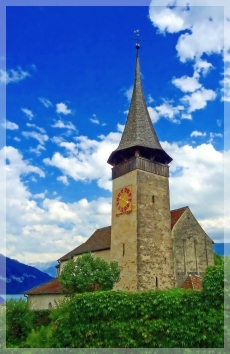
Meiringen-Turm der Burg RestiAfter telling the Parable of the Two Sons, Jesus told one about the Evil Farmers. As parables go, it’s pretty easy to follow. The landowner (God) builds a vineyard (Israel), sets up a protective wall (the Law), and leases it to tenant farmers (religious leaders). When he sends his emissaries (faithful priests and prophets) to collect his rent, the farmers ignored, mistreated and even killed them. The landowner, thinking the farmers would respect his son (Jesus), sends him to the vineyard. Wanting the estate for themselves, the farmers murder him. When Jesus asked his listeners (who were the chief priest and elders) what the landowner would do to the famers when he returns to his land, they responded that he’d kill the tenants and lease the vineyard to new farmers who would honor him with his share of the crop.
It was then that Jesus asked his audience if they were familiar with today’s verse from Psalm 118: “The stone that the builders rejected has now become the cornerstone.” When we encounter the word cornerstone in the Bible, there is some disagreement as to whether it is referring to a cornerstone—the first stone in a building and part of the foundation—or a capstone—the last stone that completes a building. The Hebrew literally means head of a corner so the exact meaning is unclear. Since Jesus is the Alpha and Omega—the first and last—perhaps both meanings apply. He is both the foundation upon which the church is built and the capstone which crowns the whole.

Regardless, in this context, the transition from a metaphor about a vineyard and evil farmers to one of architecture seems odd. Then again, we’re not first century Jews who would have been familiar both with Psalm 118 and the ancient rabbinic legend about the stone the builders rejected. When the first temple was being built, the stones were carefully cut at a quarry several miles away from Jerusalem. Although each stone was shaped to fit perfectly into place at the temple, the story is that the first stone to arrive didn’t seem to fit anywhere. Oddly shaped, the builders tossed it aside where people stumbled over it and weeds grew around it. When construction was nearly complete, it was time to place the final stone, the great lintel, in place over the doorway to the inner sanctuary of the tabernacle. Supported by scaffolding until then, once the capstone was placed, it would stand by itself. The builders, however, could not find the necessary stone. When they sent to the quarry for it, they were told they’d already received it. It was only then that they remembered the stone the builders had rejected. Retrieved from the weeds, it slid perfectly into place. As the capstone of the Temple, it held all the other stones in their proper position.

Just in case the religious leaders missed His point, Jesus told them that, like the vineyard, the Kingdom of God would be given to a new nation who would produce proper fruit. Changing metaphors back to the stone, He warned, “Anyone who stumbles over that stone will be broken to pieces, and it will crush anyone it falls on.” [Matthew 21:44] Until I learned the legend of the rejected stone, this verse troubled me—how could someone trip over a stone that also could fall on him? That rejected stone, however, could do both!

In this exchange, Jesus was telling the religious leaders that He was both the landowner’s son and the stone rejected by the builders—the very ones who should have recognized Him. His final words were a clear warning that the Kingdom of God could not be built without Him. Those who didn’t build on His truth would stumble over it and break while those who tried to pull it down would be crushed by it and destroyed!

For Jesus is the one referred to in the Scriptures, where it says, “The stone that you builders rejected has now become the cornerstone.” There is salvation in no one else! God has given no other name under heaven by which we must be saved.” [Acts 4:11-12 (NLT)]

Copyright ©2021 jsjdevotions. All rights reserved.

FIRM FOOTING

Hear my prayer, O Lord; listen to my plea! Answer me because you are faithful and righteous. … Show me where to walk, for I give myself to you. … Teach me to do your will, for you are my God. May your gracious Spirit lead me forward on a firm footing. [Psalm 143:1,8b,10 (NLT)]

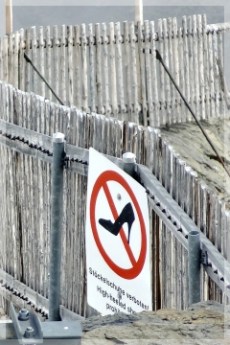
sign on schilthornMany years ago, I was facing a difficult decision about a project. In spite of praying, pondering, searching Scripture for direction, and consulting with wise advisors, I was still in a quandary. Nothing brought me closer to a clear answer to my dilemma. Although it seemed like a good idea (at least in theory) and I felt like I should want to be part of it, doubts kept nagging at me. Wanting God to make known His will, I prayed the words of Psalm 143:10: “Teach me to do your will, for you are my God. May your gracious spirit lead me forward on a firm footing.”

The phrase “firm footing” reminded me of a sign I’d seen at the top of the Schilthorn in the Swiss Alps. Warning that high-heeled shoes shouldn’t be worn while hiking the mountain, the caution seemed to demonstrate a firm grasp of what seemed obvious. The steep slope was covered with scree and would prove precarious even for a properly equipped and skilled hiker! I realized the footing on this particular project felt anything but firm. In spite of its good intentions, it was as ill-considered as wearing a pair of strappy high heels while hiking the Schilthorn. While there’d been no cautions about prohibited footwear, I’d seen plenty of other warning signs about the venture; I just hadn’t wanted to heed them. It’s easy to confuse what we want to do with what God intends for us or to think we’re hearing God’s voice when it is only ours speaking louder than His!

Had I been reading any other Bible translation, rather than “firm footing,” the verse would have read level ground, land of uprightness, level pastureland, or good paths. Whether those words would have resonated with me the way “firm footing” did, I don’t know. But, as God would have it, I was using my NLT Bible and I finally understood the project was not right for me.

God has challenged, admonished, cautioned, and tested me but He has never steered me wrong. Even when I haven’t especially liked God’s task for me, He’s always given me a sense of peace along with His mission, even when it meant stepping into unknown territory. Admittedly, obedience often has upset my plans, meant more work, pushed me out of my comfort zone, or challenged my capabilities, but it always has led to peace. The sense of peace I had as soon as I declined this undertaking told me that I’d finally found and followed God’s will.

If we don’t have peace about a choice we’ve made, if we don’t feel confident in our walk, it’s time to stop, reconsider, and pray. We’ll only know we’re on firm footing and following His plan when God gives us peace about our decision.

Don’t worry about anything; instead, pray about everything. Tell God what you need, and thank him for all he has done. Then you will experience God’s peace, which exceeds anything we can understand. His peace will guard your hearts and minds as you live in Christ Jesus. [Philippians 4:6-7 (NLT)]

Copyright ©2021 jsjdevotions. All rights reserved.