
So to keep me from becoming conceited because of the surpassing greatness of the revelations, a thorn was given me in the flesh, a messenger of Satan to harass me, to keep me from becoming conceited. Three times I pleaded with the Lord about this, that it should leave me. But he said to me, “My grace is sufficient for you, for my power is made perfect in weakness.” [2 Corinthians 12:7-9a (ESV)]
 Paul was speaking metaphorically of his thorn and whether it was a spiritual, emotional, physical affliction, or something else entirely, we don’t know. Since Paul dictated his letters, some speculate that that he had poor eyesight: perhaps cataracts or macular degeneration. Then again, severe arthritis in his hands may have prevented him from holding a stylus. Paul may have had a chronic medical problem such as gout, migraines, severe asthma, or spinal stenosis. It may have been a person: perhaps, Alexander the metalsmith who was harming his ministry. Considering the number of times the apostle was arrested, the thorn may have been an old injury from the many beatings inflicted upon him. Paul even may have suffered from bouts of depression or the 1st century equivalent of Chronic Fatigue Syndrome. The identity of his thorn (or even thorns) is unimportant to us. It is how Paul dealt with his thorn that matters.
This last year has been challenging for many of us; it certainly has been for me. Rather than a single thorn, I feel like I’ve fallen head-first into an enormous patch of thistles or spiny hawthorns. Along with a never-ending pandemic and the disruption Covid-19 has brought to our daily lives, I’ve been dealing with a variety of painful health issues, the deaths of several loved ones, and a recurring case of the glums and gloomies. There has been far too little sleep and laughter and far too many tears and pain.
Like Paul, in my initial prayers I pled for relief. Perhaps, he made the same argument as did I and patiently explained to God how much more effective he’d be in his ministry without that pesky thorn. Unlike Paul, however, I didn’t stop at a mere three times before understanding (and accepting) that God’s power “is made perfect in weakness.” Eventually, I understood that God’s denial of relief didn’t mean He failed a test of His love for me and realized that I was undergoing a test of how much I loved and trusted Him! Although I wanted the emotional, spiritual, and physical pain to go away, God had other plans; He was doing a bit of unwelcome “character building.”
Having just revealed to the Corinthians that he’d been caught up to Paradise where he saw and experienced such amazing things that he was incapable of expressing them, Paul explained that he’d been given the thorn to keep him from becoming proud, arrogant, or big-headed because of what had been revealed to him. Although I haven’t had such an extraordinary spiritual experience as Paul’s, I did need a lesson in Christ-like humility and a few thorns to keep me mindful of my need for God’s power!
Thorns drive us to acknowledge our weaknesses and make us depend on Christ for strength so that His power can surround and enable us! Accepting that God’s grace is sufficient for my needs, my prayers have become simpler and far less demanding. Trusting Him for tomorrow, I simply ask that He grant me grace enough to get through today! Indeed, His power is made visible in my weakness.
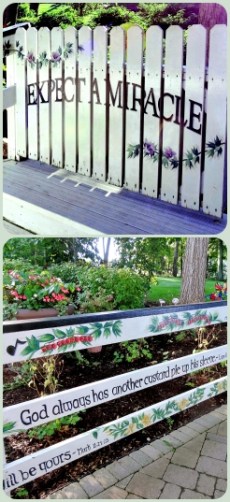 When we lived in the north, we often walked a public path that meandered along the shoreline of a nearby lake. Running through both public and private properties, it crossed the front lawns of historic lakefront estates and stunning homes with beautifully landscaped yards and gardens. One such home placed a lakeside bench for tired walkers that said, “Sit-Pray-Mediate-Enjoy” under a sign that read, “You can trust me. Love, God.” A delightful white fence delineated their private property from the public path. Decorated with whimsey, “Expect a Miracle” was the message on the gate and assorted Bible verses and words of wisdom were painted on the fence’s horizontal slats.
 What do you hope to find tucked into your Christmas stocking or deposited under the tree Christmas morning? From the above words, it’s easy to think God is promising something like Christmas morning every day. Although He promises to hear and answer our prayers, let’s remember that He’s not so specific as to how He’ll answer them.
 Jesus said to him, “For sure, I tell you, unless a man is born again, he cannot see the holy nation of God.” Nicodemus said to Him, “How can a man be born when he is old? How can he get into his mother’s body and be born the second time?” [John 3:3-4 (NLV)]
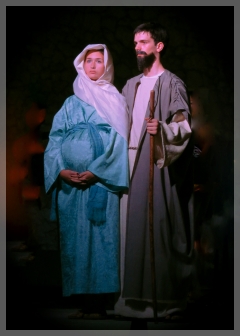 Until learning about Las Posadas, I hadn’t given much thought to the difficulty of Joseph and Mary’s journey to Bethlehem or to how frightened and desperate the couple must have been that night so long ago. As the crow flies, it’s only a 70-mile trip from Nazareth to Bethlehem but Joseph and Mary weren’t crows and the route was not a straight one. Because of the hilly terrain, the most direct route south was the most physically challenging and, because it led right through Samaria, it also was the most dangerous. Wanting nothing to do with Samaritans, Jews typically detoured to the east before going south along the flatlands of the Jordan River, turning west at Jericho, going over the hills surrounding Jerusalem, and on south into Bethlehem—a trip of 90 to 100 miles. The trek from Jericho to Bethlehem would have been the hardest since it was an uphill hike with an elevation change of 3,500 feet! In good circumstances, people could walk about 20 miles a day so Mary and Joseph feasibly could have made Bethlehem in five 8-hour days. Mary, however, was about ready to give birth so a trip of seven to ten days is more likely.
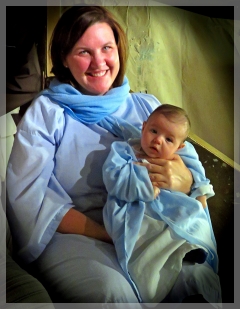 One December evening several years ago, we walked the streets of Bethlehem. Instead of travelling to the Holy Land, however, we traveled back in time at a local church. Our journey began with a stroll through the Christmas story. We walked past Gabriel meeting with Mary, an angel visiting the sleeping Joseph, the shepherds and sheep, Joseph and a very pregnant Mary in a stable, and met the Magi with their camels and gifts. We then went inside the parish hall to the bustling city of Bethlehem. As required by the emperor, we stopped to register for the census and pay our taxes before moving through the crowded marketplace to the shops of the wine merchant, carpenter, leather worker, and oil and spice dealers. After pausing to watch mud bricks being made and fabric being dyed, a young boy took us on a tour through his 1st century Jewish home.
 Devotions of the Heart