CUSTARD PIES

Consider it pure joy, my brothers and sisters, whenever you face trials of many kinds, because you know that the testing of your faith produces perseverance. Let perseverance finish its work so that you may be mature and complete, not lacking anything. [James 1:2-4 (NIV)
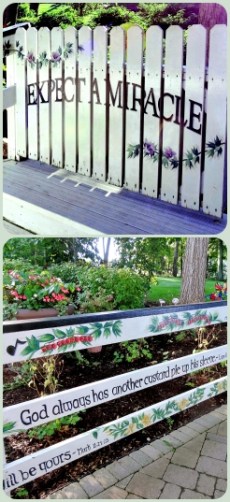
When we lived in the north, we often walked a public path that meandered along the shoreline of a nearby lake. Running through both public and private properties, it crossed the front lawns of historic lakefront estates and stunning homes with beautifully landscaped yards and gardens. One such home placed a lakeside bench for tired walkers that said, “Sit-Pray-Mediate-Enjoy” under a sign that read, “You can trust me. Love, God.” A delightful white fence delineated their private property from the public path. Decorated with whimsey, “Expect a Miracle” was the message on the gate and assorted Bible verses and words of wisdom were painted on the fence’s horizontal slats.

I laughed at actress Lynn Redgrave’s observation that, “God always has another custard pie up his sleeve.” Having grown up watching the Three Stooges, Laurel and Hardy, and Soupy Sales, I knew exactly what she meant! Custard pies are the unplanned quirky episodes of life—the glitches, bugs, hitches, curve balls, obstructions, setbacks, and snags that seem to arise when we least expect them. While they’re not necessarily earth-shattering or tragic, they upset the apple cart of our lives and can throw us off our game!

Sometimes those custard pies come at us the way candy on a conveyor belt did in an old I Love Lucy episode called “Job Switching.”  Working in a candy factory, Lucy and Ethel’s job seemed simple enough: wrap candies as they came down the line. All went well until the line sped up and the candies came faster and faster. Knowing they’d be fired if any unwrapped candy reached the packing room, the women frantically grabbed the candies off the belt and ended up stuffing them in their mouths, hats, and blouses. “I think we’re fighting a losing game,” admitted Lucy.

Most of us can handle one or two custard pies at a time but, when they come flying at us as fast as the candy came to Lucy and Ethel, we feel like we’re playing a losing game and our faith is challenged! As Ms. Redgrave said, it does seem like God has an endless supply of custard pies up his sleeve. For many of us, the last twenty months have been a speeding conveyor belt of those pies and, with months of disappointments, complications, delays, and uncertainty, little went according to our expectations or plans. Before God tosses another pie my way, I wish He’d give me a warning so I could duck!

Nevertheless, as Christians, we know that those pies are part of God’s greater plan for us. Life is unpredictable at best and we need to accept its capriciousness with proper perspective, a positive outlook, a sense of humor, and faith in the One who is in charge. In the meantime, I’ll follow the advice painted by that home owner. Knowing that God loves me, I’ll trust in Him and expect a miracle (or two). I’ll sit, pray, meditate, and enjoy what God has put before me—even if it’s another custard pie!

Challenges are what make life interesting; overcoming them is what makes life meaningful. [Joshua J. Marine]

Though the fig tree does not bud and there are no grapes on the vines, though the olive crop fails and the fields produce no food, though there are no sheep in the pen and no cattle in the stalls, yet I will rejoice in the Lord, I will be joyful in God my Savior. [Habakkuk 3:17-18 (NIV)]

Copyright ©2021 jsjdevotions. All rights reserved.

ANSWERED PRAYERS

And we are confident that he hears us whenever we ask for anything that pleases him. And since we know he hears us when we make our requests, we also know that he will give us what we ask for. [1 John 5:14-15 (NLT)]

May he grant your heart’s desires and make all your plans succeed. [Psalm 20:4 (NLT)]

santaWhat do you hope to find tucked into your Christmas stocking or deposited under the tree Christmas morning? From the above words, it’s easy to think God is promising something like Christmas morning every day. Although He promises to hear and answer our prayers, let’s remember that He’s not so specific as to how He’ll answer them.

Remember the story of King Midas? As a reward for the King’s kindness, Dionysus offered Midas anything he wanted. Coveting wealth, Midas wanted everything he touched to be changed into gold. Although he was warned to think seriously about such a wish, the king insisted. How thrilled he was when the twigs and stones he handled became precious metal. Midas’ joy at his gift began to fade, however, when he discovered that gold roses have no aroma and food became metal before it could be eaten. After a simple touch turned his daughter into a golden statue, the king detested the gift he’d so desired. Taking pity on him, Dionysus told the king to wash in the river Pactolus to lose his golden touch and make things right again.

While the Midas story has pagan beginnings, there is much a Christian can learn from this ancient myth, the first of which is not to love material possessions. When we pray, we shouldn’t act like children looking through Amazon’s “Ready, Set, Play” holiday toy catalog or grown-ups browsing through the Neiman Marcus 200-page Christmas Book and marking the pages with our holiday fantasies. Prayer is not like writing a wish list to Santa for all the gifts we desire and God’s promises are never an excuse for greed or selfishness.

Unlike a mythical Greek deity, God will not give us anything that could harm us. While we’re not likely to ask for a snake or scorpion, we have been known to ask for other things that could bring us harm—the extra money, new job, sexy guy at work, vacation in Vegas, or that big house with an even bigger mortgage. Just like King Midas, our limited (and selfish) perspective cannot possibly see all of the ramifications of our prayer requests. We ask for things without understanding how they may affect our life or the lives of others. We may know what we want but God, in his infinite wisdom, knows what will happen if we get it. If God had given me everything for which I prayed, it would have taken way more than a bath in the river Pactolus to clean up the resulting mess and set things right again. It’s been said that God’s answers are far wiser than our prayers and, indeed, they are. With love and wisdom, in His own time and way, God will always answer our prayers. Let’s give thanks that “Yes” is not always His answer to our requests.

The devil doesn’t come in a red cape and pointy horns. He comes as everything you’ve ever wished for. [Anonymous]

You fathers—if your children ask for a fish, do you give them a snake instead? Or if they ask for an egg, do you give them a scorpion? Of course not! So if you sinful people know how to give good gifts to your children, how much more will your heavenly Father give the Holy Spirit to those who ask him. [Luke 11:11-13 (NLT)]

Copyright ©2021 jsjdevotions. All rights reserved.

METAMORPHOSIS

monarch metamorphosisJesus said to him, “For sure, I tell you, unless a man is born again, he cannot see the holy nation of God.” Nicodemus said to Him, “How can a man be born when he is old? How can he get into his mother’s body and be born the second time?” [John 3:3-4 (NLV)]
The being “born again” concept in Christianity isn’t an easy one to understand, yet we see it demonstrated whenever we look at a butterfly. Take the monarch, for example; it starts out as a tiny egg that hatches about four days after being laid. That’s its first birth. The caterpillar actually eats its way out of the shell before munching on the leaf where the egg was laid. Over the next ten to fourteen days, it eats and grows, shedding its skin every time it gets too tight. The full-grown caterpillar then spins silk and attaches its hind end to a leaf, hangs upside down and sheds its skin for the fifth and final time. When the new skin forms, it hardens and takes the form of a chrysalis. The monarch’s chrysalis is a beautiful jade green with little specks of gold and looks like a case that could be used to hold a jewel. Over the next ten to fourteen days, the caterpillar undergoes a metamorphosis. During this stage, the DNA that makes wings is switched on and something almost miraculous happens. When the transformation is complete, the chrysalis bursts open and out emerges a full-grown butterfly. It is born again! The new butterfly hangs onto the chrysalis for a bit, drying its wings and getting stronger, before taking flight and becoming the thing of beauty God meant it to be.

The monarch caterpillar looks and acts nothing like the monarch butterfly and it’s hard to believe they are actually the same creature but they are! The DNA sequence of the caterpillar is identical to that of the butterfly it becomes. The caterpillar, however, no longer exists—it has to die to become a butterfly, much as a person’s old self must “die” when he becomes a follower of Jesus. When we’re “born again,” like the butterfly, we have the same DNA of the person we once were and yet we’re an entirely different creature.

Unlike the butterfly, however, the change is internal not external. Moreover, caterpillars have no choice about whether or not they will become butterflies—they just keep eating and growing and shedding and nature takes its course. On the other hand, people do have a choice about whether they will experience their metamorphosis. They can choose to remain wrapped up in the dark chrysalis of unbelief, a hidden jewel than will never reach its potential, or choose to be reborn in Christ. While there is a scientific explanation for the near-miraculous transformation of a caterpillar into a butterfly, science can’t explain the miraculous transformation that occurs when we are reborn, the Holy Spirit comes to live in our hearts, and we become the things of beauty God created us to be.

We know that our old life, our old sinful self, was nailed to the cross with Christ. And so the power of sin that held us was destroyed. Sin is no longer our boss. When a man is dead, he is free from the power of sin. And if we have died with Christ, we believe we will live with Him also. [Romans 6:6-8 (NLV)]

You have now become a new person and are always learning more about Christ. You are being made more like Christ. He is the One Who made you. [Colossians 3:10 (NLV)]

I have been put up on the cross to die with Christ. I no longer live. Christ lives in me. The life I now live in this body, I live by putting my trust in the Son of God. He was the One Who loved me and gave Himself for me. [Galatians 2:20 (NLV)]

Copyright ©2021 jsjdevotions. All rights reserved.

LAS POSADAS – NINE MONTHS (2)

And because Joseph was a descendant of King David, he had to go to Bethlehem in Judea, David’s ancient home. He traveled there from the village of Nazareth in Galilee. He took with him Mary, to whom he was engaged, who was now expecting a child. [Luke 2:4-5 (NLT)

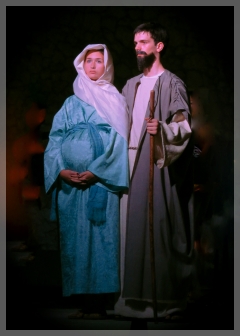
Until learning about Las Posadas, I hadn’t given much thought to the difficulty of Joseph and Mary’s journey to Bethlehem or to how frightened and desperate the couple must have been that night so long ago. As the crow flies, it’s only a 70-mile trip from Nazareth to Bethlehem but Joseph and Mary weren’t crows and the route was not a straight one. Because of the hilly terrain, the most direct route south was the most physically challenging and, because it led right through Samaria, it also was the most dangerous. Wanting nothing to do with Samaritans, Jews typically detoured to the east before going south along the flatlands of the Jordan River, turning west at Jericho, going over the hills surrounding Jerusalem, and on south into Bethlehem—a trip of 90 to 100 miles. The trek from Jericho to Bethlehem would have been the hardest since it was an uphill hike with an elevation change of 3,500 feet! In good circumstances, people could walk about 20 miles a day so Mary and Joseph feasibly could have made Bethlehem in five 8-hour days. Mary, however, was about ready to give birth so a trip of seven to ten days is more likely.
Since the Bible quickly moves from the miraculous conception of Jesus to Mary’s visit to Elizabeth and then to Jesus’ birth, we probably don’t give much thought to what those nine months of pregnancy were like for Mary. Each day of the nine days of Las Posadas, however, represents a month of Mary’s pregnancy. When Scripture says Mary “hurried to the hill country of Judea” to see Elizabeth, we assume she lived nearby. Rather than right around the corner, Elizabeth lived about five miles southwest of Jerusalem in Ein Karem, meaning the newly pregnant girl (who may have suffered from morning sickness) took a similar walk to the one she’d make nine months later! Three months later, she made the same 90 to 100-mile journey north back to Nazareth. Even if Mary traveled in a caravan, it was a dangerous journey for a young woman alone! Ancient travel was no walk in the park.

Pregnancy is a blessed thing but it is a life-changing event full of physical and emotional challenges. Along with the normal mood swings accompanying changes in estrogen and progesterone, Mary had the shock of an unexpected pregnancy, saw her wedding plans turned upside down, lost her reputation, and endured the whispers of the town folk about how she betrayed her fiancé. We know how Joseph reacted to her pregnancy but we don’t know about Mary’s parents or the rest of their family and friends. Were the couple shunned or snubbed? Pregnancy is a blessing but there’s a downside to growing another being in one’s uterus: fatigue, shortness of breath, discomfort as the growing child pushes against internal organs, trying to find a comfortable position in which to sleep, back aches, bloating, frequent urination, and swollen feet (to name just a few). Pregnancy isn’t easy—even when you’re carrying the Messiah!

Once Mary and Joseph found lodging, what of the baby’s birth? Because our nativity scenes focus on the lovely scene of the Holy Family after Jesus’ arrival, we tend to forget the hours of labor leading up to that scene. The conditions weren’t sterile, there were no epidurals, and Scripture makes no mention of a midwife’s presence. Without question, there was discomfort, pain, sweat, aching muscles, tears, fear, mess, and blood. Surely, giving birth away from family, in a cave, in a strange town, and placing her newborn in a feed trough wasn’t what Mary envisioned for the child who would be called “Son of the Most High.”

Mary and Joseph were ordinary people, people like you and me, people who hurt, worry, bruise, get tired, bleed, complain, cry, throw-up, get blisters, and suffer—people who can get upset, frustrated, troubled, doubtful, surprised, disappointed, and sad. Today, consider what those nine months were like for Mary, a girl barely into her teens who became the mother of God, and Joseph, the man who would act as the earthly and legal father to God’s son. They were two ordinary people who did an extraordinary thing! Thank you, God!

And while they were there, the time came for her baby to be born. She gave birth to her firstborn son. She wrapped him snugly in strips of cloth and laid him in a manger, because there was no lodging available for them. [Luke 2:6-7 (NLT)]

Copyright ©2021 jsjdevotions. All rights reserved.

ARE YOU READY?

But you, O Bethlehem Ephrathah, are only a small village among all the people of Judah. Yet a ruler of Israel, whose origins are in the distant past, will come from you on my behalf. [Micah 5:2 (NLT)]

All right then, the Lord himself will give you the sign. Look! The virgin will conceive a child! She will give birth to a son and will call him Immanuel (which means “God is with us”). [Isaiah 7:14 (NLT)]

One December evening several years ago, we walked the streets of Bethlehem. Instead of travelling to the Holy Land, however, we traveled back in time at a local church. Our journey began with a stroll through the Christmas story. We walked past Gabriel meeting with Mary, an angel visiting the sleeping Joseph, the shepherds and sheep, Joseph and a very pregnant Mary in a stable, and met the Magi with their camels and gifts. We then went inside the parish hall to the bustling city of Bethlehem. As required by the emperor, we stopped to register for the census and pay our taxes before moving through the crowded marketplace to the shops of the wine merchant, carpenter, leather worker, and oil and spice dealers. After pausing to watch mud bricks being made and fabric being dyed, a young boy took us on a tour through his 1st century Jewish home.

As congested as the area was, we nearly missed our last stop—Joseph, Mary, and their newborn son. Of course, we had an advantage over the people of Bethlehem because we knew the significance of that baby born so many years ago—He was the promised Messiah! Knowing the significance of His birth, we looked for Him.

Although the Hebrew Bible (Old Testament) was written over a period of 1000 years and completed several hundred years before the 1st century, it contained over 300 prophecies of the coming Messiah. The Israelites had centuries to prepare for their savior and all those prophecies to alert them. But, when God Himself took on human flesh over 2,000 years ago, they were too busy in the streets of Bethlehem to notice His arrival. Other than a few shepherds, no one else observed anything special that night. More than a month later, it only was Anna and Simeon who recognized the infant Messiah at Mary’s purification ceremony in Jerusalem. It was almost two years later when some foreign wise men (who’d been following an astronomical phenomenon) brought gifts and worshipped the long-awaited child. With all those prophecies, why weren’t the people of Judah ready and waiting?

Once we walked out the back door of the parish hall, we returned to the 21st century with its Christmas carols, chocolate chip cookies, hot cocoa, and a machine pumping out artificial snow to squeals of delight from the Florida children. Let us never forget, however, that the story isn’t over. There are still many unfulfilled prophecies in the Bible regarding Christ’s second coming. The people of Bethlehem weren’t ready for His first arrival; will we be ready for His second one?

Be dressed for service and keep your lamps burning, as though you were waiting for your master to return from the wedding feast. Then you will be ready to open the door and let him in the moment he arrives and knocks. The servants who are ready and waiting for his return will be rewarded. I tell you the truth, he himself will seat them, put on an apron, and serve them as they sit and eat! He may come in the middle of the night or just before dawn. But whenever he comes, he will reward the servants who are ready. [Luke 12:35-38 (NLT)]

So you, too, must keep watch! For you do not know the day or hour of my return. [Matthew 25:13 (NLT)]

Copyright ©2021 jsjdevotions. All rights reserved.

GOD-INCIDENCES

Remember the things I have done in the past. For I alone am God! I am God, and there is none like me. Only I can tell you the future before it even happens. Everything I plan will come to pass, for I do whatever I wish. [Isaiah 46:9-10 (NLT)]

monarch butterfly - milkweed

I suspect that most of us live rather ordinary and somewhat predictable lives that are occasionally interrupted by major life events (some of which are welcome and other which are not). For us, it is life’s little surprises—its happenstance and serendipity—that keep our lives from becoming humdrum.

We probably have no problem crediting God with the big blessings of life—things like the birth of a healthy child, a benign biopsy, a successful surgery, 10 years of sobriety, 50 plus years of marriage, the grand’s graduation, the better paying job, or God’s gifts of salvation and forgiveness. On the other hand, we tend to think of the little unexpected blessings—the butterfly or bluebird, the chance meeting, the out-of-the-blue phone call from an old friend, the sermon that spoke directly to our need, making the tight connection at the airport, or the humorous email that arrived when we were in the dumps—as mere coincidence or luck. After all, it seems that our Almighty God must be far too busy running the universe to deal with the minutiae of our everyday lives. Absolutely nothing, however, is unimportant to a God who sees every sparrow fall, knows the number of hairs on our heads, and has etched our names on the palms of His hands. Just as the universe is not run by random chance, neither are our lives!

God can multitask better than a one-armed paper-hanger or a mom with triplet toddlers! While God was keeping the stars and planets aligned back in 470 BC, He also orchestrated Persian King Xerxes’ insomnia and his attendant’s choice of what part of the king’s chronicles was read to him. For that matter, He is the one who placed the villains plotting the Xerxes’ death within ear shot of Mordecai. Rather than coincidences, all of the events in the book of Esther were part of God’s finely crafted plan!

Although we speak to God in prayer, we often chalk up His answer to luck or coincidence. God can speak audibly but He also speaks through seemingly random things—the day’s Bible verse, a chance meeting, a song on the radio, a casual comment, a wrong number, words in a book we accidentally open, and even a bout of insomnia. When we credit the little blessings of life to coincidence, we’re happy. When we credit them to their orchestrator, however, we become thankful. While we’re surprised by these seemingly random or capricious events, our God never is! Everything in our lives has passed through His hands!

Yesterday, we gave thanks for our food, family, health, homes, and all the major blessings of our lives. Today, let’s give thanks for the little blessings, the godsends, that make our ordinary lives so extraordinary—the things that encourage us when we want to give up, put smiles on our faces, fill our hearts with joy, answer our questions, or remind us how much we’re loved. Along with all the big things, let’s be sure to give God credit for the little ones—the God-incidences—that He scatters throughout our days. His fingerprints are everywhere we look!

You can make many plans, but the Lord’s purpose will prevail. [Proverbs 19:21 (NLT)]

And we know that God causes everything to work together for the good of those who love God and are called according to his purpose for them. [Romans 8:28 (NLT)]

Copyright ©2021 jsjdevotions. All rights reserved.