
Then Peter came up and said to him, “Lord, how often shall my brother sin against me, and I forgive him? As many as seven times?” Jesus said to him, “I do not say to you seven times, but seventy times seven.” [Matthew 18:21-22 (RSV)]
 When writing about issumagijoujungnainermik, the Inuit word for forgiveness, I came across a word in the Tshiluba language spoken by the Bantu of the Congo: ilunga. Because isumagijoujungnainermik is made up of several Inuit words, it easily translates as “not-being-able-to-think-about-it-anymore.” Like issumagijoujungnainermik, ilunga has to do with forgiveness but, unlike the Inuit word, it resists an easy translation. In fact, back in 2004, 1,000 linguists gave it the questionable honor of being the world’s “most difficult” word to translate!
Although the official English definition of ilunga is “a person who is ready to forgive any abuse for the first time, to tolerate it a second time, but never a third time” seems straightforward, it misses the cultural nuance. While we might think of it as a “three-strikes-and-you’re-out” kind of person, an ilunga’s tolerance for the offense lessens with the situation and frequency. Worse, ilungas would never practice issumagijoujungnainermik because they need to remember and keep count of every offense! I wonder, do they keep a little scorecard in their back pocket? Do we?
I don’t think Hebrew or Aramaic have a word like ilunga but Jewish tradition held a similar attitude of limits on forgiveness. Although forgiveness was valued, the rabbis taught that it was reasonable to forgive a person only three times for the same offense. By the fourth offense, they believed there was no reason or need to forgive! Considering this Jewish tradition, when Peter asked Jesus how many times he should forgive, I suspect the disciple thought seven times was more than generous. Jesus, however, rejected Peter’s calculations with His answer: “Not seven times…but seventy times seven.” Rather than setting an upper level of 490 on forgiveness, Jesus was using hyperbole. His numbers alluded to Genesis 4 in which God promised a sevenfold punishment on anyone who killed Cain and Lamech later called for a seventy-sevenfold punishment on anyone who harmed him. Jesus’ answer told Peter that our forgiveness is to be as excessive as the vengeance for which Lamech called.
To cement His point, Jesus continued with the Parable of the Unforgiving Servant in which the unforgiving servant owed the King an incalculable amount of money. Even though the servant’s immense debt was forgiven by the King, he refused to forgive a fellow servant a debt just one six-hundred-thousandth of that amount! When the King learned of this, he withdrew his forgiveness and tortured the unforgiving man until the debt was paid.
Since repaying the King the equivalent of billions of dollars was an impossibility, this appears to be a reference to judgment and eternal damnation. On the other hand, it simply may refer to severe discipline from God in this life. Regardless of how this threat is interpreted, it is clear that God will not treat our unforgiveness lightly! Scripture tells us that the way we forgive is how God will forgive us; if we keep count like an ilunga, so will He! Jesus’ parable tells us that no number of offenses against us can compare with our innumerable offenses against God—anything owed to us is but a pittance compared to what we owe to Him.
In light of God’s extravagant and infinite grace to us, we are not to be like an ilunga and our forgiveness of others is not to be limited by the frequency or quantity of the offense. The unlimited forgiveness God extends to us is the kind of forgiveness we must extend to others!
To be a Christian means to forgive the inexcusable because God has forgiven the inexcusable in you. [C.S. Lewis]
 Heather Kaufman’s novel Up From Dust is historical fiction. Based on what Scripture tells us about Martha of Bethany, her sister Mary, and their brother Lazarus, it gives the reader a fictionalized version of their backstories. Kaufman’s extensive research for the novel allowed her to paint a vivid and accurate picture of 1st century life in Judea. Even though the story is a figment of her imagination, it reminded me that the people who spent time with the Lord while He walked on earth were real (and flawed) people like us—each with their own personal history. Ordinary people with parents, friends and, for some, spouses and children, they had jobs, responsibilities, secrets, regrets, and weaknesses. Like us, they were people who worried, disagreed, cried, laughed, loved, rejoiced, and mourned. The only thing that made them different from their neighbors was their love for a man called Jesus!
 While touring an historic house, the elaborately set dinner table reminded me of the large formal dinner parties we had in our younger (and more energetic) days. I’d start preparing the table in advance by adding extra leaves to the table, gathering the extra chairs, and ironing out the creases in the damask tablecloth. From the cupboard in the basement, I’d haul up the crystal salad plates, my mother’s Lenox china, and the hand-painted Bavarian service plates and Czechoslovakian dessert plates that were my grandmother’s. I’d spend hours polishing the silverware and serving pieces. The service plates were set out, the silverware laid, the crystal wine and water goblets carefully placed at each setting, and the napkins artfully folded. I’d set out the silver candlesticks, put in fresh candles, get flowers from the florist, and create what I hoped would be the perfect Martha Stewart-worthy table setting. There was plenty more work to do in the kitchen. I’d spend days perusing recipes, planning the menu, making lists, purchasing food, and preparing it all. I loved doing it because I loved the people for whom I did it. Nevertheless, as nice as my guests were and as much as they enjoyed themselves, I’m not sure they truly appreciated how much effort went into everything that on that table.
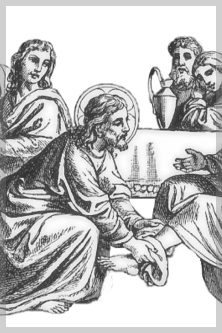 When writing about the Annunciation of our Lord, I came upon some articles by women who take offense at the story of Jesus’ conception. Interpreting Mary’s response as involuntary, they picture the angel Gabriel’s visit to Mary as some weird sort of supernatural rape. This is inconsistent both with Scripture and God as we know Him. The Archangel didn’t say, “Surprise, you’re pregnant!” and leave nor did he physically impregnate her. Read the words as reported by Luke; Gabriel told Mary what would happen, not what had already occurred. It was only after Mary asked how the angel’s words would be fulfilled and Gabriel explained that the Holy Spirit would make it possible that she accepted God’s invitation to motherhood. It was then that the miraculous power of God—the “Most High”—came upon her.
 Psalm 119, the longest of the psalms, is a song in praise of the Word of God. Since we don’t read this psalm in its original Hebrew, we fail to appreciate its intricate construction. Each of its twenty-two sections begin with a letter of the Hebrew alphabet in sequence. Each of the eight verses in those twenty-two sections begin with the letter that introduced it. For example, the first word of the first section begins with alef, as do the next seven verses. In the second section, every line begins with beth. The psalm continues that way up to the 22nd (and last) section where every line begins with the final letter of the Hebrew alphabet, tav.
 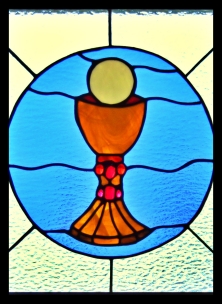 The celebration of the Lord’s Supper/Holy Communion/the Eucharist has been central to Christian worship since the early church. While Protestants think of the Eucharist as the sacrament commemorating the Last Supper with bread and wine, for Roman Catholics and some Orthodox, “Eucharist” specifically refers to the consecrated elements, especially the bread. How ever you define it, the word “eucharist” originally had nothing to do with this beautiful sacrament.
 Devotions of the Heart