CHUCK AND THOMAS

Then Thomas (also known as Didymus) said to the rest of the disciples, “Let us also go, that we may die with him.” [John 11:16 (NIV)]

You know the way to the place where I am going.” Thomas said to him, “Lord, we don’t know where you are going, so how can we know the way?” [John 14:4-5 (NIV)]

red-shouldered hawkIn 1976, Chuck Colson founded Prison Fellowship, the nation’s largest Christian nonprofit serving prisoners, former prisoners, and their families and acting as an advocate for criminal justice reform. Nevertheless, whenever I come across his name, I don’t think of the 36 years he spent in his ministry. Instead, I remember the ruthless man once considered Richard Nixon’s “hatchet man.” Along with being one of the Watergate Seven, Colson was known as a “dirty tricks artist” who tracked down incriminating photographs and leaked damaging and untrue rumors to discredit and blacken the reputations of political enemies. In 1974, as a new Christian, Colson pled guilty to obstruction of justice on a Watergate-related charge and served seven months in prison. It was after his release that he mobilized the Christian Church to minister to prisoners.
Why do we remember the negative rather than the positive about people? Think of the disciple Thomas. Most of us think of him as the doubter rather than a disciple zealous for Jesus. When the other disciples urged Jesus not to return to Judea because of the danger he faced, it was Thomas who urged the disciples to join Jesus and face death with Him!

The next we read of Thomas is at the last supper when the inquisitive man is probably more honest than the rest of the disciples. Not understanding that Jesus had just described His destination—heaven and eternal life—Thomas acknowledged his ignorance and asked the same question the others probably were silently asking. Thomas wasn’t doubting, the eager man just wanted to understand exactly where he was going and how he was to do it.

Although Thomas heard Jesus say that He was “the way, the truth, and the life,” like the other disciples, the man didn’t know what to believe after the crucifixion. One moment of skepticism and that’s what we remember of him but Thomas wasn’t the only one who doubted. Luke tells us that the disciples didn’t believe their eyes when Jesus first stood before them and thought they were seeing a ghost. [24:37] Even after seeing His pierced hands and feet, Luke says they “stood there in disbelief” and it was watching Jesus eat a piece of fish that finally convinced them. [24:41-42]

Let’s remember, Thomas wasn’t there the first time Jesus appeared and it wasn’t Jesus he doubted. He questioned the veracity of the disciples in the same way Mark tells us the disciples doubted Mary Magdalene that Sunday morning [16:11]. He wanted to be sure it actually was Jesus they saw. When Thomas finally sees Jesus, he makes the clearest confession of faith we find in any of the gospels by exclaiming, “My Lord and my God!” If anything, Thomas’ willingness to express his doubt led to a greater faith!

Neither Chuck Colson nor the Apostle Thomas should be remembered for their worst moments yet they probably are. Oddly, we don’t immediately think of Peter as the man who denied Jesus three times. Instead, we first think of him as the rock upon which Jesus built His church. May we grant the same amount of grace to the Chuck Colsons and the “doubting” Thomases we meet in life!

No, the real legacy of my life was my biggest failure—that I was an ex-convict. My greatest humiliation—being sent to prison—was the beginning of God’s greatest use of my life; He chose the one thing in which I could not glory for His glory. [Chuck Colson]

Thomas said to him, “My Lord and my God!” Then Jesus told him, “Because you have seen me, you have believed; blessed are those who have not seen and yet have believed.” [John 20:28-29 (NIV)]

Copyright ©2022 jsjdevotions. All rights reserved.

SUNDAY MORNINGS

Yet a time is coming and has now come when the true worshipers will worship the Father in the Spirit and in truth, for they are the kind of worshipers the Father seeks. God is spirit, and his worshipers must worship in the Spirit and in truth. [John 4:23-24 (NIV)]

The purpose of this Christian society called the “Church” is, first: to glorify God by our worship. We do not go to church just to hear a sermon. We go to church to worship God. [Billy Graham]

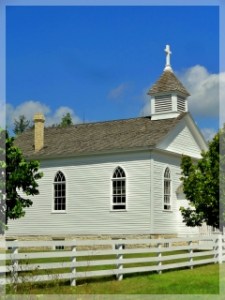
Old World Wisconsin
In this day and age, we refuse to be bored. We watch one of three TVs while on the health club treadmill, stream music or podcasts when out walking, and check our phones at red lights. (Technically, we’re not texting while driving—we’re simply texting while stopping.) We could blame technology, but our penchant for boredom has been a problem since the beginning of time. A golden calf and some “pagan revelry” was the Israelites’ antidote for boredom while Moses was on Mt. Sinai. Then, when they got bored with manna, the Israelites demanded meat. David had at least eight wives but boredom caused his eyes to wander over to Uriah’s house where Bathsheba was bathing. Mankind just seems to be hardwired to tire of the “same old, same old” and, sometimes, that propensity for boredom enters into our worship.

“I laugh so much during church, it seems almost sinful; it’s just so much fun to come!” said a neighbor about her church. Another neighbor urged us to join them at their church because of the musical talents of their pianist/organist who is known for playing six keyboards at once. Neither neighbor, however, mentioned things like the substance of their pastor’s message, the basics of their church’s beliefs, or how their worship affects them. There’s nothing wrong with pastors who insert humor into their messages or great worship music but we must be cautious of thinking of church as entertainment. The center of attention is neither the man in the pulpit nor the musicians; it is the man who hung on the cross for our sins! Jesus was an impressive man while He walked the earth but impressing people was not His goal. If it was, He would have performed far more miracles; instead, He often told people not to tell anyone. His purpose wasn’t showy miracles but the lasting message of salvation.

The purpose of worship is not to praise the pastor, music, or setting; it is to glorify God! Pope Pius X said it succinctly: “Worship is for the glory of God and the sanctification and edification of the faithful.” It’s easy to get the glorifying part—we’re praising the wondrous nature of God, thanking Him for our blessings, and celebrating His glory. Our worship, however, shouldn’t stop there. Sanctification is one of the Christian words we don’t use a lot, but it simply means that our worship is supposed to change us—to set us apart from the world and worldly concerns for God’s holy purpose. As for edification, another churchy word, worship is about helping one another along the road to Christlikeness—the building up of a group of disparate individuals into the body of Christ. Regardless of the pastor’s ability to deliver a sermon or the worship leader’s choice of music, if the service hasn’t glorified God, helped change us for the better, or built up God’s Kingdom, we haven’t worshipped properly.

Is church where we go to be entertained or is it the place we go to be strengthened by His word and grow to be more like Christ? Is it where we go to be distracted from the cares of the world or where we go to worship the Lord and to revel in His glory? While bells and whistles are pleasant, we should remember that the purpose of church is worship not theater. Rather than fluff and stuff, we should be seeking a foundation in God’s word, the presence of Jesus, and the power of the Holy Spirit. If we’re bored during church, the antidote isn’t more pageantry or spectacle, funnier sermons, or better music; it is more mindful worship on our part.

Worship is not about my enjoyment. It is about my enjoyment of God. It is not about my pleasure or my delight or my satisfaction. It is about my pleasure, delight, and satisfaction in God. Worship is not simply about glorifying God. It is about glorifying God by enjoying Him forever. [Sam Storms]

Since, then, you have been raised with Christ, set your hearts on things above, where Christ is, seated at the right hand of God. Set your minds on things above, not on earthly things. [Colossians 3:1-2 (NIV)]

Copyright ©2022 jsjdevotions. All rights reserved.

GOD’S WARDROBE

Since God chose you to be the holy people he loves, you must clothe yourselves with tenderhearted mercy, kindness, humility, gentleness, and patience. Make allowance for each other’s faults, and forgive anyone who offends you. Remember, the Lord forgave you, so you must forgive others. Above all, clothe yourselves with love, which binds us all together in perfect harmony. [Colossians 3:12-14 (NTE)]


When writing to the Colossians, Paul told them to clothe themselves with mercy, kindness, humility, gentleness, patience, and love. A more literal translation would be to sink your heart (or the inner parts of your body) into a garment and wrap yourselves with God’s virtues. The Message translation simply says, “dress in the wardrobe God picked out for you.” When we dress ourselves in His clothing, we’ll begin to look like Christ—not because we’re wearing an inner linen tunic, robe, cincture (belt), sandals, and a cloak—but because we’re acting as Jesus would act!

When my high school presented Jean Giraudoux’s Madwoman of Chaillot, I played one of the madwoman’s elderly and equally mad compatriots. But, at 16, I struggled with getting into the role and feeling like an old woman. It was not until dress rehearsal, when I actually looked like my character, that I truly began to act and feel like her.

The change from teen to old woman began with a make-up base giving me a pallor and continued when shadows were applied around my eyes, under my cheekbones, and along my jawline. Fine lines were drawn on my forehead and around my mouth and a little white grease-paint was sponged onto my eyebrows and hair. The transition continued when I put on my costume—a dark silk dress with petticoats and a bustle along with an elaborate hat and net veil. I wrapped myself with a fringed shawl and picked up the old black umbrella I’d be using as a cane. When I saw myself in the mirror, I gasped at the transformation. It wasn’t just my appearance that changed; once I looked like an old woman, I began to walk, talk, and even feel like one. I felt the aches, pains, and weariness of an octogenarian in a way I hadn’t during previous rehearsals. For a few hours the next several nights, instead of being a junior in high school, I became an eccentric old woman because, once I looked like her, I acted my way into being her!

We are called to live by faith rather than by emotion and it is Scripture, rather than a script, that tells us how to live out our lives. We may not feel like being patient with the co-worker who can’t get the hang of the new system, but we can clothe ourselves with patience and act patient while answering his questions. We don’t have to feel kind, loving, or forgiving to dress in kindness, love, and forgiveness. When we clothe ourselves with the wardrobe of Jesus, we’ll start looking and acting like Him and, the more we act like Him, the more we’ll become like Him! We can act our way into a feeling far easier than feel our way into an action!

Decades ago, I had to look like an old woman before I could act like her and be authentic in my portrayal. Today, in the same way, we must put on Jesus’ wardrobe and act like Him before we can become like Him. When you look in your closet this morning, be sure to put on the garments of God along with your shirt and pants!

Do not waste time bothering whether you ‘love’ your neighbor; act as if you did. As soon as we do this we find one of the great secrets. When you are behaving as if you loved someone, you will presently come to love him. [C.S. Lewis]

For you are all children of God through faith in Christ Jesus. And all who have been united with Christ in baptism have put on Christ, like putting on new clothes. [Galatians 3:26-27 (NLT)]

Imitate God, therefore, in everything you do, because you are his dear children. Live a life filled with love, following the example of Christ. [Ephesians 5:1-2 (NLT)]

Copyright ©2022 jsjdevotions. All rights reserved.

LOVING OUR NEIGHBOR

Then they took the man who had been blind to the Pharisees, because it was on the Sabbath that Jesus had made the mud and healed him. The Pharisees asked the man all about it. So he told them, “He put the mud over my eyes, and when I washed it away, I could see!” [John 9:13-15 (NLT)]

great blue heronIt’s easy to assume the Pharisees were irate just because Jesus had worked on the Sabbath but, for these sticklers for the law, it was as much about how He healed the man! Spitting on the ground on the Sabbath was forbidden because plowing was one of the 39 types of work prohibited on the Sabbath! Using their convoluted logic, that meant that digging any hole was prohibited and, when spittle landed on soil, it might cause a small dent in the ground (which would be digging a hole) and dislocate a small amount of dirt (which would be plowing)! Compounding Jesus’ violation of the law by both healing and plowing, He made mud. Kneading, defined as joining small particles into a mass using any liquid, was another of the 39 kinds work prohibited on the Sabbath. Jesus broke this law the moment his spittle wet the dust; the mixing of his spittle and the dirt together to make mud was an additional offense! To them, the restoration of sight meant nothing when compared to His many transgressions of the law!

When Jesus healed a man who’d been lame for thirty-eight years, it also was on the Sabbath. [John 5] Once healed, Jesus specifically told the man to pick up his mat and walk. Carrying anything more than six feet in a public place, however, was prohibited on the Sabbath. When the Jewish leaders accosted the man for carrying a burden, he explained that Jesus told him to do so after healing him! Again, the Pharisees were more concerned about work being done on the Sabbath than the miraculous healing that occurred!

In all, seven Sabbath healings are mentioned in the gospels. Although Jesus healed Peter’s mother-in-law in private, the rest of His Sabbath healings were done right in front of His critics. When He healed the man with the withered hand, the crippled woman, and the man possessed by evil spirits, Jesus was in the synagogue and He was having dinner at the home of a leading Pharisee (possibly a member of the Sanhedrin) when he healed a man suffering from dropsy (edema).

Like His other Sabbath healings, this didn’t appear to be a life-or-death situation and, for all we know, the man was there as a way of entrapping Jesus into another violation of the law. Nevertheless, after asking the Pharisees if it was right to heal on the Sabbath and not receiving an answer, Jesus healed the man and sent him on his way. He then exposed His critics’ hypocrisy by asking which of them wouldn’t rescue his son or cow if they were to fall in a pit? His question exposed their convoluted thinking since rescuing an animal from a pit on the Sabbath was acceptable even to the Pharisees! In fact, a primary principle in Jewish law is preventing tza’ar ba’alei chayim, the suffering of living creatures, and the Talmud specifically permitted rescuing an animal in pain or at risk of death and even permitted moving prohibited objects to relieve their pain. Yet, the Pharisees seemed unwilling to have compassion on their fellow man!

Once again, when it comes to the law, Jesus made it abundantly clear that every other law is subordinate to the greatest one of loving God and loving our neighbor as ourselves. The next time we see someone in need, along with asking, “What would Jesus do?” we might also ask, “What would I want done for me in a similar situation?”

Do to others whatever you would like them to do to you. This is the essence of all that is taught in the law and the prophets. [Matthew 7:12 (NLT)]

Don’t misunderstand why I have come. I did not come to abolish the law of Moses or the writings of the prophets. No, I came to accomplish their purpose. [Matthew 5:17 (NLT)]

Copyright ©2022 jsjdevotions. All rights reserved.

THROWING STONES

Don’t pick on people, jump on their failures, criticize their faults—unless, of course, you want the same treatment. Don’t condemn those who are down; that hardness can boomerang. Be easy on people; you’ll find life a lot easier. Give away your life; you’ll find life given back, but not merely given back—given back with bonus and blessing. Giving, not getting, is the way. Generosity begets generosity. [Luke 6:37-38 (MSG)]

mimosaYesterday, when writing about the adulterous woman, I wondered what became of the stones that had been gathered in anticipation of stoning her. We know the Pharisees were quick to condemn people for the smallest infraction of the Law. Did they drop those stones in the road or did they put them in the pockets of their robes for another time when they could catch someone else sinning?

My husband was at the Fed Ex store when the woman in front of him dropped several packages and papers. He stooped down and helped the flustered woman gather up her scattered papers and boxes. As she departed, the man behind my husband loudly asked, “Did she even thank you?” and then, without waiting for an answer, angrily continued, “I don’t think she did and she should have. People just don’t say thank you anymore!” I agree with him that good manners seem to be in short supply nowadays; nevertheless, I wondered why he got so angry and felt the need to point out the woman’s faux pas to all around him.

How ready we are to criticize the failures of others while overlooking ours! We all set standards for others and, like that man, get peeved when they’re not met. Yet, when our hearts are filled with criticism and judgment rather than mercy, we’ll go through life picking up stones and looking for opportunities to throw them. Although the critical man cast only a pebble at the woman, it wasn’t necessary. I’m not much different than he and I suspect neither are you. In fact, I might have tossed a small stone at the man in the Fed Ex store! After all, we easily see the failings of others while being blind to ours.

Granted, common courtesy isn’t common anymore and we frequently encounter people who clearly haven’t heard of Emily Post or Miss Manners. But, if Jesus could show mercy to the woman caught in adultery, wash the feet of the men who would betray, deny, or abandon Him, and manage to ask forgiveness for the people who crucified Him, we should be able to cut a little slack for those who commit the petty offenses of everyday life! We certainly don’t need to keep stones in our pockets in case someone offends our sensibilities or look for opportunities to throw them! Maybe people would be nicer if we simply smiled more and grumbled less!

I don’t know why the woman was so frazzled that day or what really was upsetting that man. There’s wise advice in the old proverb: “Never criticize a man until you’ve walked a mile in his moccasins.” Another old proverb reminds people who live in glass houses not to throw stones—and all of us live in glass houses of some kind or another. If we want God’s mercy, grace, and understanding, we must offer those same things to others.

Our days are happier when we give people a bit of our heart instead of a piece of our mind. [Anonymous bit of Internet wisdom]

Don’t pick on people, jump on their failures, criticize their faults—unless, of course, you want the same treatment. That critical spirit has a way of boomeranging. It’s easy to see a smudge on your neighbor’s face and be oblivious to the ugly sneer on your own. Do you have the nerve to say, “Let me wash your face for you,” when your own face is distorted by contempt? It’s this whole traveling road-show mentality all over again, playing a holier-than-thou part instead of just living your part. Wipe that ugly sneer off your own face, and you might be fit to offer a washcloth to your neighbor. [Matthew 7:1-5 (MSG)]

Copyright ©2022 jsjdevotions. All rights reserved.

HOW WILL THEY KNOW US?

But the Holy Spirit produces this kind of fruit in our lives: love, joy, peace, patience, kindness, goodness, faithfulness, gentleness, and self-control. [Galatians 5:22-23a (NLT)]

pomegranateThe culture of the 1st century was agrarian in nature so the analogies used by Jesus and the evangelists often were those of agriculture – seeds, soil, fruit, and vines. For example, when writing about the characteristics in the lives of those who follow Jesus, Paul spoke of the fruit of the Spirit. But, if Paul were writing to modern industrial society, he might have used a different metaphor. Instead of the fruit of the Holy Spirit, we might have the Spirit’s toolbox. Rather than fruit, we’d have God’s tools to help us to build His Kingdom. The saw in the box would be God’s peace that cuts worry and fear out of our lives. The sandpaper would be kindness as it smooths out life’s rough edges. Protective gear like safety goggles and steel-toed shoes would be the self-discipline that protects us from sin. Duct tape and WD-40 would be as essential as love, a flashlight would shine our joy, and we’d have clamps to hold us tight to the faith. God’s word would be our blueprint and, instead of being connected to a vine, the power tools would be plugged into the Holy Spirit’s power. Regardless of the metaphor, the Holy Spirit provides us with what we need to be more like Christ.

My son has a variety of fruit trees on his property but, when he moved to his new home, he wasn’t sure what they all were. It wasn’t until the large tree with the pretty red-orange blossoms and shiny green leaves bore fruit that he knew it was a pomegranate and, until the bushes with the oval leaves and small white flowers bore their fruit, he didn’t know he had lemons. Just as a tree is identified by its fruit, a good builder can be identified by his house. Someone could claim to be a master builder but, if the shutters on his house are hanging from the hinges, the windows shattered, the roof tiles missing, the wooden steps broken, the paint peeling, and the walls collapsing, we’d know his claim was false. Just as trees are identifiable by their fruit and builders by their work, it is our behavior that should identify us as Jesus’ followers. The fruit of the Spirit should be evident in everything we do and say and in the attitude we have when we say or do it.

If you were a fruit tree, would anyone recognize the fruit you bear as coming from the Spirit? If you were a builder, would your work resemble that done by a Jewish carpenter’s son from Nazareth? Whether we think of the characteristics of a Christ follower as fruit or tools, the important thing is to let His Spirit make those characteristics a part of our lives so that we end up looking more and more like Jesus! That’s the way we can build His Kingdom!

You will know them by their fruits. A good tree cannot bear bad fruit, nor can a bad tree bear good fruit. … Yes, just as you can identify a tree by its fruit, so you can identify people by their actions. [Matthew 7:16,18,20 (NLT)]

 Yes, just as you can identify a tree by its fruit, so you can identify people by their actions. [Matthew 7:20 (NLT)]

Copyright ©2022 jsjdevotions. All rights reserved