
Don’t be so naive and self-confident. You’re not exempt. You could fall flat on your face as easily as anyone else. Forget about self-confidence; it’s useless. Cultivate God-confidence. [1 Corinthians 10:12 (MSG)]
Several years ago, my son’s family made plans to move out of state and sold their house faster than expected. Since their children had several weeks of school left in the semester, the four of them lived with us until the end of the school year. Don’t get me wrong; I loved having them and have no complaints. Nevertheless, the relationship between a mother and the woman her son marries can be a shaky one at best, regardless of how much they love each other. Going from two to six in our home was a major change for us empty-nesters and I’m sure it wasn’t any easier for them as they lived out of their suitcases. Needless to say, I prayed a lot during those weeks and, most of the time, I kept an imaginary roll of duct tape over my mouth.
One day, after mentally congratulating myself for being so tolerant, agreeable, and accommodating, I blew it! Without thinking, I made what I thought was a humorous comment about my daughter-in-law’s habitual lateness. Right after speaking, I realized that just because the words came into my head didn’t mean they should have spilled out of my mouth. But, by then, it was too late to retrieve a comment my daughter-in-law took as disparaging and judgmental. I’m sure I heard Satan’s voice in my ear chuckling, “Gotcha!”
Although my apology pacified hurt feelings, this episode points out the danger both of speaking without thinking and of pride. I’d been congratulating myself for my commendable behavior and patting myself on the back for keeping silent about scattered toys, messy bathrooms, dirty dishes in the sink, and the general chaos that comes with family. Focusing on what I considered to be my virtuous and exemplary conduct, I’d become proud of my restraint, tact, and patience. It’s said that “Pride goes before the fall,” and it sure did in that case.
Pleasure at being praised by others isn’t pride but pleasure at praising ourselves is and it leads to self-confidence rather than God-confidence. As far as the enemy is concerned, pride taken when congratulating ourselves for our self-righteousness is as good as any other sin! “Gotcha!” says Satan!
 When speaking of the late director Mike Nichols, actress Anjelica Huston said, “He had that incredible capacity for friendship that makes you think you’re absolutely unique, that nobody matters to him the same way that you do.” Huston’s words were extraordinarily high praise for a friend and probably something we’d all like to have said about us. I wondered if I make every person who passes through my life feel extraordinary and valued. After coming up short on that one, I wondered if I have friends about whom I could say that same thing. While some come very near, there is only one who has the capacity to make each and every person feel unique and that he or she is most important person to Him; that, of course, is our good friend Jesus!
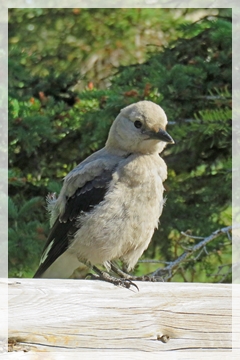
 Dozens of birders have been gathering at the local bird sanctuary to catch a glimpse of a Hammond’s flycatcher. Since these birds look similar to other flycatchers, prefer the mountains to lowlands, and are rarely found within 1,000 miles of Florida, the bird in question could be an imposter. It’s just another little grey bird to me but, to birders, its identification is important. Although they’ll report their sightings to the Florida Ornithological Society, just looking like a Hammond’s isn’t enough. When the Society’s Records Committee meets in August, they will evaluate the submitted sketches, photographs, videos, recordings and detailed accounts of the bird’s behavior along with reports of the surroundings, sky conditions, temperature, and times when the bird was spotted to determine whether it truly is a Hammond’s.
 More than thirty years ago, a friend confided that she wanted her obituary to be a good one. A few years ago, explaining that she wanted an updated photo in case it was needed for her obituary, she asked me to take her picture. Although she was in excellent health at the time, this woman clearly understood the fragility of life. Sadly, she died unexpectedly just a few days ago.
 When living in rural Illinois, I loved walking along the country roads, passing by fields of soy beans and corn, and seeing the horses, cows, goats, and sheep grazing in the fields. Virtue was a common name in the community and I often passed by the Virtue Farm. Thinking Virtue a noble name, I wondered if the Virtue family lived up to its promise of good character and moral excellence.
 A few weeks ago, in Charles Schultz’s classic comic Peanuts, Snoopy sat on his doghouse and decided not to tell his little bird friend Woodstock about Santa Claus. “He’ll never get any presents anyway. Santa Claus never brings presents to tiny, nondescript, nobody birds,” he thought before concluding, “It’s kind of sad at Christmastime to be a nobody bird.” I wasn’t so sure about Santa ignoring the “nobody birds.” The previous day, several from our church had participated in a project that demonstrated just how much “Santa” really does care.
 Devotions of the Heart