LIKE A CHILD

He said to them, “Let the children come to me. Don’t stop them! For the Kingdom of God belongs to those who are like these children. I tell you the truth, anyone who doesn’t receive the Kingdom of God like a child will never enter it.” Then he took the children in his arms and placed his hands on their heads and blessed them. [Mark 10:14b-16 (NLT)]

riding Irish MailThe thing I’ll miss most when we move to southwest Florida permanently is easy access to my grandchildren. This summer I’ve relished watching the little guys frolic in the sprinkler, race their scooters down the sidewalk, climb the monkey bars, decorate the driveway with colored chalk, and play bags with their cousins. They insisted on helping in the kitchen, offered to set the table, listened intently to every story read to them, and never tired of endless games of Crazy-Eights and Kings’ Corners. Their squeals of delight at the holiday fireworks and when they mastered riding the Irish Mail (where they pumped with their arms and steered with their feet) were music to my ears. They asked endless questions and pondered every answer. Wanting to please us, they even were obedient. Seeing their unbridled enthusiasm, energy, and desire both to learn and please, I wondered why I wasn’t like that. After all, God wants us to be like children.

We’re mistaken if we think Jesus’s words about receiving the Kingdom like a child mean that we should be unquestioning and unthinking. Anyone who has experienced the never-ending queries of children knows how inquisitive and persistent they are. As soon as one question is answered, another will be asked. If a child wonders where the sun goes at night, the next question will be where the moon goes during the day, followed by a raft of other questions that strain our limited astronomical knowledge. While children’s inquiring minds inundate us with questions, they differ from adults because they actually care about understanding the answer. We adults, on the other hand, are rarely as anxious to learn something new since we’re sure we already know most anything worth knowing. God doesn’t mind our asking questions but He does want us to listen and learn from His answers as would a child.

Youngsters are also brutally honest (if a bit tactless), unreservedly enthusiastic, and genuine. They love freely, don’t try to impress, rarely judge and, for the most part, want to please their parents. They may carry a blanket or stuffed animal with them, but they never cart around guilt. Their parents, however, are often afraid to love, frequently less than honest, sometimes hypocritical, tend to be judgmental, and often haul a suitcase of guilt and regret wherever they go. While children are drawn to kindness and gentleness, their parents usually are more impressed by power and riches. We adults tend to rebel rather than obey and, rather than God, the one we most want to please usually is ourself.

I’ve never once heard a child say, “You shouldn’t have!” when offered a gift. My little guys certainly didn’t say they weren’t worthy or deserving of their ice cream cones, the trip to the lake, or the boat ride to watch the fireworks. Why then is it so difficult for adults to accept God’s gift of grace? Of course, we don’t deserve it and haven’t earned it, but it is ours for the taking. Like little children, we need to grab hold of this precious gift and relish it; only then will we enter the Kingdom of God.

Jesus called a little child to him and put the child among them. Then he said, “I tell you the truth, unless you turn from your sins and become like little children, you will never get into the Kingdom of Heaven. So anyone who becomes as humble as this little child is the greatest in the Kingdom of Heaven. [Matthew 18:2-4 (NLT)]

Copyright ©2019 jsjdevotions. All rights reserved.

WHERE IS HE?

As the deer longs for streams of water, so I long for you, O God. I thirst for God, the living God. When can I go and stand before him? Day and night I have only tears for food, while my enemies continually taunt me, saying, “Where is this God of yours?” [Psalm 42:1-3 (NLT)]

white-tailed deer - FloridaNot so long ago, it was hard to face my computer with any enthusiasm. Every beginning led to a dead end or took me down a rabbit hole of confusion. The paragraphs over which I’d struggled had come to nothing and my hours at the keyboard seemed an exercise in futility. It’s as if I had little scraps of useless fabric but couldn’t find a way to quilt them together. I wondered where God was when I so desperately needed His guidance.

The best place to go when feeling hollow or hopeless is God’s word and Psalms is where I usually begin. David certainly had plenty of times of downheartedness and he wasn’t afraid to express his exhaustion, frustration, or despair and yet there always seems to be a ray of hope in his words. I turned to Psalm 42 and, having hit a “dry spell,” I knew what the psalmist meant when comparing himself to a deer panting for water and thirsting for God. Like him, I felt like I was dying of thirst.

It was the psalm’s mention of enemies with their taunts of, “Where is this God of yours?” that really hit home. I don’t share David’s flesh and blood enemies but all of us share a common unseen enemy: the doubt and anxiety that comes from spiritual depression.

The palmist asks why God has forgotten him and I think we all know that feeling. While I can get it when I’m staring at an empty page, that sense of desolation may visit others as they wait for the return of a prodigal, sit in a hospital room, endure chronic pain, look at the empty chair once occupied by a spouse, or have too much month left at the end of their money. We’ve all had times when it feels like God has turned a deaf ear to our prayers or has closed His eyes to our situation.

“Where is this God of yours?” is the enemy’s voice. Wanting us to lose faith or wallow in despair, he causes us to question God’s presence in our lives. God hasn’t forgotten about us; even the psalmist, as depressed as he was, acknowledges that God pours out His unfailing love each day. Nevertheless, sometimes, it feels as if God is looking the other way. Feeling defeated, discouraged, lonely, weary, or insecure, it’s easy to forget that our feelings can’t always be trusted. God, however, always is steadfast and trustworty!

In a gentle reproach, the psalmist asks why he is so downcast and reminds himself of the hope he has in God. That we don’t sense God’s presence, feel His love, see His hand, or hear His voice doesn’t mean that our loving God isn’t there. When asked, “Where is this God of yours?” let us never forget that He dwells, not just in heaven above, but also in our broken spirits. There always will be dark valleys to traverse but we are never alone; we have hope in God and, for that, we praise him.

A loss of the present sense of God’s love is not a loss of that love itself; the jewel is there, though it gleams not on our breast; hope…expects the promised boon though present providence stands before her with empty hands. [Charles Spurgeon]

Why am I discouraged? Why is my heart so sad? I will put my hope in God! I will praise him again—my Savior and my God! [Psalm 42:11 (NLT)]

Copyright ©2019 jsjdevotions. All rights reserved.

ELISHA, THE WIDOW, AND THE OIL (Elisha – 2)

Now all glory to God, who is able, through his mighty power at work within us, to accomplish infinitely more than we might ask or think. [Ephesians 3:20 (NLT)]

cassiaDuring the days of Elijah and Elisha, there were several schools or companies of prophets in Israel. Probably some of the 7,000 Israelites who remained faithful to Jehovah, they were the prophets’ disciples, maybe something like an ancient version of the Knights of Columbus. Although they gathered for fellowship and study, had a spiritual calling, and were under the prophets’ guidance, they carried on their ordinary work and family lives.
One of these men died and left bills that his wife couldn’t pay. As payment for the man’s debts, a pitiless creditor threatened to take the widow’s sons as bond servants. Without her boys, the woman had no way to support herself and, with no resources, she was facing a hopeless situation. After the frantic woman told Elisha of her dilemma, the prophet asked how he could help her and what she had in her house. Since she’d probably sold or traded anything of value by that time, I wonder if she thought his question foolish; nothing of value remained. Taking stock, other than her two sons, her cupboards were bare, her purse empty, and all that remained was a flask of oil.

The prophet told her to get as many empty vessels as she could from her neighbors. “Don’t ask for just a few,” he warned. After bringing them into the house, she was to shut the door and then fill all the containers with the oil from her one flask. Although this may have seemed like an exercise in futility, the widow and her sons obediently gathered up all the pots and jars they could and then filled jar after jar with oil. Miraculously, the oil only stopped flowing when no more empty containers remained. The prophet told the widow to sell the oil to pay her debts and then live on the money that remained. This miracle did more than just pay her bills; it would maintain her family until her boys could start earning a living.

The quantity of oil that poured out was not limited by God; it was determined by the woman’s faith. God’s provision knows no limits; there was enough oil to fill just one flask or as many as 100,000 jars. When they’d filled the last jar and the oil finally stopped pouring, I imagine the widow regretted not finding yet another container. We have a God who can do infinitely more than we can ask or imagine.

As faith-filled believers, we know God can do the impossible. Yet, how much of our lives and resources do we commit to Him? If we bring Him just a little, that’s all He can bless. How many jars do we bring to God? What is the limit of our faith?

Give, and you will receive. Your gift will return to you in full—pressed down, shaken together to make room for more, running over, and poured into your lap. The amount you give will determine the amount you get back [Luke 6:38 (NLT)]

Copyright ©2019 jsjdevotions. All rights reserved.

FROM BAD TO WORSE

O Lord, how long will you forget me? Forever? How long will you look the other way? How long must I struggle with anguish in my soul, with sorrow in my heart every day? How long will my enemy have the upper hand? [Psalm 13:1-2 (NLT)]

Once a pampered prince, forty years later, Moses was living as a Midianite shepherd. When speaking to him from the burning bush, God laid out His plan for freeing the Israelites from Egyptian slavery and the pivotal role Moses would play in it. Protesting, Moses made excuse after excuse but God countered every excuse with a solution. Provided with a shepherd’s staff and Aaron as his mouthpiece, Moses reluctantly accepted God’s charge. Before approaching Pharaoh, however, he first met with Israel’s elders to convince them that he was on a mission from God.

Although the elders were convinced, Pharaoh wasn’t. When Moses asked that the Israelites be given just three days to journey into the wilderness and worship their God, Pharaoh didn’t just refuse. Accusing Moses of interfering with his people’s work, he cruelly increased their work load. Instead of having the straw needed for brick making provided, they had to find their own straw while still meeting their daily brick quota. When they failed to do so, the Israelite foremen were beaten. Faced with an impossible task, they approached Pharaoh. Pitilessly refusing to lighten their load, he accused the Israelites of laziness. Protesting to Moses, the foremen blamed him for the harshness of their Egyptian masters. Disheartened at his lack of success and Egypt’s increasing brutality, the Israelites lost all confidence in Moses and God’s promise of relief. Instead of going from bad to better, things had gone from bad to worse.

Sadly, even Moses lost faith. Forgetting that God told him Pharaoh would not let them go easily, the despondent Moses cried out to God. He questioned God’s purpose and even accused Him of doing nothing to help!

Things looked bad for David more than 420 years later. After Samuel anointed him king, David spent the next fifteen years on the run from King Saul who was trying to kill him. Like Moses, he was following God’s plan and yet things had gone from bad to worse for him, too. Like Moses, he cried out and asked God why he’d been forsaken.

Things looked dire for Elijah, as well. Like Moses and David, he wasn’t winning any popularity contests by obeying God. In his case, the prophet was giving unpleasant prophecies to some evil people. The enraged Jezebel was out to kill him and he’d just received her message that he’d be dead within 24-hours. The exhausted man sat under a broom bush and, sure that he was as good as dead, told God to kill him then.

Scripture teaches that, when we’re following God’s plan, we will face opposition in the world. It’s been suggested that if we don’t face the enemy’s opposition, we’re probably not doing God’s work. There will be times when our circumstances look bleak, God seems to be looking the other way, and the enemy seems to be winning.

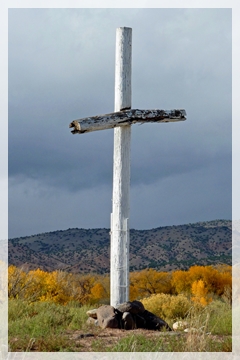
When Jesus’s followers stood at the foot of the cross, watched Him suffer, and heard Him speak the words of Psalm 22 asking God why He’d been abandoned, it probably seemed that all hope was gone and the enemy had won. Three days later, however, it was clear that all hope had arrived! We can’t give up on the power, wisdom and goodness of God because his plan sometimes seems to have gone awry. Let us always remember that God’s promise to the Israelites is as true today as it was over 3,400 years ago: “Do not be afraid or discouraged, for the Lord will personally go ahead of you. He will be with you; he will neither fail you nor abandon you.” [Deuteronomy 31:8 (NLT)]

The Lord hears his people when they call to him for help. He rescues them from all their troubles. The Lord is close to the brokenhearted; he rescues those whose spirits are crushed. The righteous person faces many troubles, but the Lord comes to the rescue each time. [Psalm 34:17-19 (NLT)]

I have told you all this so that you may have peace in me. Here on earth you will have many trials and sorrows. But take heart, because I have overcome the world.” [John 16:33 (NLT)]

Copyright ©2019 jsjdevotions. All rights reserved.

THE GOOD OLD DAYS

Virginia CityDon’t long for “the good old days.” This is not wise. [Ecclesiastes 7:10 (NLT)]

When talking with my centenarian mother-in-law, we often spoke of the “good old days.” She sometimes indulged in what I came to call “wishful remembering” and her past became more like a Hallmark movie than reality. I suppose, to some extent, we all do the same. The sledding hill grows steeper, the house bigger, the friends nicer, the grades better, the paycheck larger, and the success greater while any failure, disappointment, blame, pain, or drudgery diminishes. Not every memory we have, however, is a correct one; rather than an accurate record, our memories are actually what we tell ourselves about the past. Given the choice, it’s far nicer to have wishful good memories than ones of bitterness, regret and sorrow and I never corrected my mother-in-law’s. Nevertheless, we must be cautious of becoming too attached to our memories, especially if our less than accurate version of yesterday keeps us from moving into tomorrow.

Less than a month after God’s parting of the Red Sea and their song of victory and triumph at the defeat of Pharaoh, the Israelites had a serious case of wishful remembering and started to grumble. Instead of recalling the slaughter of baby boys and the back-breaking labor of Egyptian slavery, they remembered sitting around in comfort eating all the bread and stew they desired. Months later, they again complained about their hardships while recalling free fish, fruit and vegetables instead of the price they paid in sweat for that food. Rather than oppression, they remembered the “good old days” of Egyptian provision.

Sodom was the place where a gang of men wanted to attack Lot, sexually abuse his guests, and, for reasons beyond our understanding, Lot offered his virgin daughters to a mob of depraved men. When Lot’s family was told that Sodom was to be destroyed, they were urged to flee immediately and specifically warned to neither stop nor look back. Nevertheless, stopping and turning back is exactly what Lot’s wife did. According to the Moody Bible Commentary, the Hebrew word used for her looking back (vathabbet) has a very specific meaning of looking at something with desire or approval. Lot’s family left their home, possessions, friends, and even their sons-in-law behind. Choosing not to recall the evil, Lot’s wife turned, remembered the “good old days,” and longed for what had been and was no more.

When we follow God, we’re not promised an easy journey; in fact, Jesus pretty much promises we’ll encounter hardships. Stepping out in faith often means moving from comfort, convenience, and familiarity into the disruption, trials and vulnerability of the unknown. In light of new challenges and burdens, it’s easy to repaint the past with wishful memories of “the good old days.” As bad as the past may have been for either the Israelites or Lot’s wife, for them it seemed preferable to their unknown tomorrows. Those wishful memories, however, cost the Israelites an extra 38 years and Lot’s wife her life!

While wishful memories can make the past more palatable, they also can prevent us from experiencing the blessings of the future. We must never remember the good old days at the expense of failing to trust God with the new ones.

This means that anyone who belongs to Christ has become a new person. The old life is gone; a new life has begun! [2 Corinthians 5:17 (NLT)]

But I focus on this one thing: Forgetting the past and looking forward to what lies ahead, I press on to reach the end of the race and receive the heavenly prize for which God, through Christ Jesus, is calling us. [Philippians 3:13-14 (NLT)]

Copyright ©2019 jsjdevotions. All rights reserved.

IT CONTINUES [THE HOLY WAR – Part 2]

The thief comes only to steal and kill and destroy; I came that they may have life, and have it abundantly. [John 10:10 (RSV)]

Lucerne - city wallMankind falls within the first few pages of Genesis as does Mansoul within the first few pages of John Bunyan’s allegory The Holy War. Resembling real life, Bunyan’s King Shaddai sends his son, Prince Emmanuel, to rescue the fallen city. Under Diabolus and his minions Lord Will-be-will and Misters Lustings, Forget-good, No-truth and Unbelief, Mansoul refuses to listen to Shaddai’s captains. The gates to the city are double-locked and Mr. Prejudice and his band of Deafmen guard Ear-gate (the most likely place the King’s forces will try to enter). Nevertheless, Prince Emmanuel delivers Mansoul from the tyranny of Diabolus, Mansoul repents, and Emmanuel forgives. The story, however, is far from over because Diabolus is not done with Mansoul.

Just as the Israelites failed to rid the land of Canaanites and idolatry, Mansoul failed to rid the city of the many Diabolonians who remained in strongholds after Emmanuel’s victory. Lords Blasphemy, Adultery, and Mischief along with Misters Profane and Deceit plot Mansoul’s destruction. Mr. Self-secure misleads Mansoul into thinking it is strong and invincible, beyond the reach of any foe, and not dependent on Emmanuel. Diabolus returns with his army of Doubters and assaults Ear-Gate with incessant drumming. Captains Brimstone and Sepulcher are placed at Nose-Gate; the grim faced Past-Hope at Eye-Gate; and Captains Cruel, Torment, and No-Ease at Feel-gate. Diabolus seeks to fill Mouth-gate, the voice of prayer, with dirt. The town resists but its gates are weak. Diabolus and his Doubters again take possession of the city; this time, however, they cannot take the castle, the heart of Mansoul. On the third day, Emmanuel returns to them and Diabolus and his Doubters are routed from the town. The city again seeks to rid itself of any remaining Diabolonians such a Misters Mistrust, Flesh, Sloth, Legal-life, and Self-love. Mister Unbelief, however, is far too nimble to be caught and Carnal-sense escapes from prison.

Bunyan’s allegory is more than a story of man’s fall and redemption; it tells of the continuing conflict between good and evil for the possession of man’s soul. Starting with innocence, followed by temptation, sin, and repentance, the story doesn’t end there. Sadly, there is more temptation and sin followed by more repentance. With Unbelief and Carnal-sense still at large, the reader is left to believe that will not be the last time temptation and sin rear their ugly heads.

In Emmanuel’s final commission to Mansoul, he warns them not to live by their senses but by his Word. When explaining why Diabolonians are allowed to exist, he says, “It is to keep you awake, to test your love, to make you watchful… My design is that they should drive you, not further off, but nearer to my Father, to teach you war, to make petitioning desirable to you, and to make you little in your own eyes.” He adds, “Love me against temptation, and I will love you notwithstanding your infirmities … I have taught you to watch, to fight, to pray, and to make war against my foes, so now I command you to believe that my love is constant to you.”

For though we live in the world we are not carrying on a worldly war, for the weapons of our warfare are not worldly but have divine power to destroy strongholds. We destroy arguments and every proud obstacle to the knowledge of God, and take every thought captive to obey Christ, being ready to punish every disobedience, when your obedience is complete. [2 Corinthians 10:3-6 (RSV)]

Copyright ©2019 jsjdevotions. All rights reserved.