THE CRÈCHE AND THE CROSS

For this is how God loved the world: He gave his one and only Son, so that everyone who believes in him will not perish but have eternal life. God sent his Son into the world not to judge the world, but to save the world through him. [John 3 16-17 (NLT)]
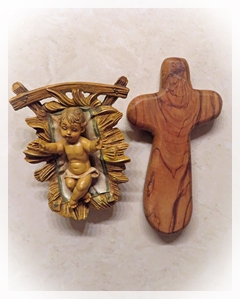
creche and crossPew Research reports that while 90% of Americans celebrate Christmas, more than half of them celebrate it only as a cultural holiday! While they’ll decorate their house with lights and wreaths, trim a tree, send cards, and exchange gifts, Christmas is just an excuse for good food, parties, family gatherings, and presents. While they’re not indifferent to Santa, gifts, merriment, or decorations, like the people of 1st century Palestine, they are indifferent to the Christ child. The shepherds saw the star and sought the babe in the manger and a caravan from the East brought Him gifts, but we don’t read of any townspeople visiting Joseph and Mary. What of the priests and scribes who told Herod where the Messiah would be born? They knew the prophecies but didn’t join the Magi in their quest to find the One who would fulfill those prophecies. Lowly shepherds and men from a faraway land recognized Jesus as the Messiah but most of God’s chosen people ignored the greatest event in all of history.

Some people react to Christmas with antipathy; like Herod, they hate its message. Rather than join the magi and seek the newborn King of the Jews, the enraged Herod slaughtered all of the male babies around Bethlehem in an attempt to kill the king! The “bah humbuggers” are like the atheist who erected a 10-foot 300-pound pentagram just 20-feet from a nativity scene in a Boca Raton park in 2016. Non-believers don’t want a King who might knock them off their pedestals any more than Herod wanted one who could knock him off his throne. They’re uncomfortable with the concepts of sin, salvation, love, sacrifice, obedience and forgiveness that surround Christmas. Then again, maybe they dislike this day simply because Christmas reminds them of the emptiness of their lives.

Some people respond to Christmas as did the angels, shepherds, magi, Simeon, and Anna: with worship. Tonight and tomorrow, people around the world will raise their voices in praise and thanksgiving, light candles, sing carols, kneel in prayer, lift their hands in worship, and share bread and wine at communion. Some will come and adore Him tonight but won’t return to church until next Christmas. But others will ponder the events of this night, as did Mary. They will allow the Christ child to enter into their hearts and lives and affect their every thought, word, and action for the rest of their lives. After extinguishing the Christmas Eve candles, they will continue to let their lights shine all year long. They are the ones who know that God came as a baby and lay in a manger so that He could suffer, die on the cross as a common criminal, and pay the penalty for mankind’s sins. They know that the crèche is meaningless without the cross!

Let us behold, the Lamb of God who takes away the sin of the world!
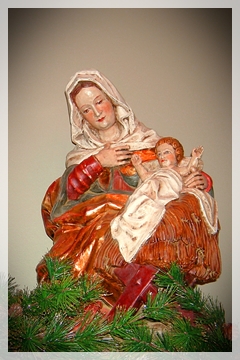
But Mary kept all these things in her heart and thought about them often. The shepherds went back to their flocks, glorifying and praising God for all they had heard and seen. It was just as the angel had told them. [Luke 2:19b-20 (NLT)]

Copyright ©2019 jsjdevotions. All rights reserved.

A HANDMAID’S HEART

And Mary said, “Behold, I am the handmaid of the Lord; let it be to me according to your word.” And the angel departed from her. [Luke 1:38 (RSV)]

Mary - ChristmasIgnoring the fact that most of us in the room couldn’t qualify as virgins, are well-past child-bearing age, and our genealogies don’t link us to the tribe of Judah and the line of David, the pastor leading our women’s Bible study asked if we were the kind of women God would chose to give birth to His son.

Aside from being young, virginal, and of the right lineage, what kind of woman was Mary? At first glance, she seems little different than any other young girl in the obscure village of Nazareth. There is no mention of her having wealth, exceptional beauty, or social status. Looking like any other peasant girl, she seems unsuitable for a job as mother of God. What about Mary set her apart from every other girl in Palestine who met the lineage and virtue requirements?

Rather than looking at outward appearance, God looks into hearts; while we don’t know about Mary’s physical beauty, her character must have been exceptionally beautiful. Faithful, obedient and humble, she was filled with love for God. She risked her entire future when she submitted to Him. In many translations, Mary calls herself the “Lord’s servant.” The original Greek, however, was doule, which means bondmaid, female slave or handmaid. A doule wasn’t hired help who could quit when she wanted. She was someone who surrendered completely to her Master’s will.

I thought about the pastor’s question. Had I fit the physical and lineage requirements, would God have chosen me to bear His son? He wouldn’t have given me a second look when I was Mary’s age—I was far too willful, rebellious, selfish and unsure of myself to ever call myself a servant to anyone, even God! Even if the woman I am today fit the physical and lineage requirements, God wouldn’t consider me. It’s not that He wouldn’t trust me to feed, comfort, teach, love, guide, encourage, and protect His Son; I’d qualify in the mothering department. It’s that submission thing; I don’t think I’d freely surrender my will to His and God will not force Himself upon anyone. Mary had enough faith to yield her will to God but, even with 72 years of experiencing God’s faithfulness under my belt, I’m not sure I have the heart of a handmaiden. Humble and complete submission to the Master’s will does not come easily. “Thy will be done,” are some of the hardest words to pray and truly mean.

Both Mary and Jesus submitted to God’s divine will; should we do anything less? Father, forgive us for choosing our will over Yours. Give us a handmaid’s heart.

And he withdrew from them about a stone’s throw, and knelt down and prayed, “Father, if thou art willing, remove this cup from me; nevertheless not my will, but thine, be done.” [Luke 22:41-42 (RSV)]

Pray then like this: Our Father who art in heaven, Hallowed be thy name. Thy kingdom come, Thy will be done, On earth as it is in heaven. [Matthew 6:9-10 (RSV)]

Copyright ©2019 jsjdevotions. All rights reserved.

A WONDERFUL LIFE

And so, dear brothers and sisters, I plead with you to give your bodies to God because of all he has done for you. Let them be a living and holy sacrifice—the kind he will find acceptable. This is truly the way to worship him. [Romans 12:1 (NLT)]

irisAround this time of year, I frequently return to Bedford Falls and get reacquainted with the conflicted George Bailey, the money-grubbing Mr. Potter, and Angel 2nd Class, Clarence Odbody. This year’s version of It’s a Wonderful Life was somewhat different. Rather than seeing the movie, I attended a theatrical production set in a New York City radio station in the 1940s. The well-known story unfolded as if it were a live radio broadcast. Just five actors took on all of the roles (along with producing the various sound effects required for a radio show). In spite of the unusual adaptation, the production remained true to the original movie’s message.

George Bailey, a building and loan banker, is an unlikely hero. Having abandoned his dreams for a life in Bedford Falls, he feels that life has passed him by. About to be thrown into jail because of his uncle’s carelessness (and Mr. Potter’s dishonesty), George realizes he’s worth more dead than alive. The other unlikely hero is Clarence Odbody, an ineffective guardian angel desperately trying to earn his wings by helping this despairing man on the brink of suicide. In spite of the story’s incredibly flawed angel theology, it’s a good tale. When George wishes he’d never been born, Clarence shows him what an ugly depraved community Bedford Falls would have been had he never lived. When George Bailey realizes how many lives would have been ruined, lost, or never even have happened, he chooses life.

While George’s perspective changes and there is a happy ending, it’s not a happily-ever-after one. Unlike Scrooge in A Christmas Carol, the evil Mr. Potter doesn’t transform. We know he’ll persist in trying to take over the town and that George will continue to have too little money at the end of the month. The challenges, disappointment, and disillusionment of George’s life don’t disappear. His sacrifices cost him dearly; his aspirations were surrendered, he lost his hearing, never attended college or traveled, worked in a job he hated, and endured financial hardship. Nevertheless, it’s a happy ending because George finally understands the sacrifice was worth it! He realizes the most important work we do is not the work we ever planned on doing.

The missing $8,000 wasn’t what caused George’s despair. He was unhappy and unfulfilled because he was concentrating on the life he wanted to live rather than loving the life he was leading. Like George, most of us have given up opportunities, hopes and dreams or endured hardship of some kind or another for the sake of others. If not, we should have because that’s what God tells us to do. Jesus made it clear that our lives were to be ones of sacrifice. We belong to Jesus rather than to ourselves. Following Jesus means we surrender to His purposes, which inevitably means we don’t always get what we wanted! We do, however, get something better (but often don’t recognize it).

The difference between George Bailey and a Christian is motivation. Bailey sacrificed out of a sense of duty to family, friends and town. Although family, friends, and community often benefit from our sacrifice, the Christian sacrifices out of love and obedience to God. George’s sense of duty was to Bedford Falls; ours is to Jesus! Our Lord was the suffering servant; can we be anything less? In spite of the difficulties encountered along the way, when we sacrifice ourselves to God, we will find such joy and peace that we’ll have no need for an angel to show us that it’s been a wonderful life!

All you can take with you is that which you’ve given away. [The motto Peter Bailey’s office in “It’s a Wonderful Life”]

If any of you wants to be my follower, you must give up your own way, take up your cross daily, and follow me. If you try to hang on to your life, you will lose it. But if you give up your life for my sake, you will save it. [Luke 9:23-24 (NLT)]

Copyright ©2019 jsjdevotions. All rights reserved.

THE SNOW GLOBE

Steamboat SkiAnd we are confident that he hears us whenever we ask for anything that pleases him. And since we know he hears us when we make our requests, we also know that he will give us what we ask for. [1 John 5:14-15 (NLT)]
Along with the typical things you’d expect to find on my desk is an odd collection of other items. A small resin figure of the Holy Family reminds me that God deliberately chose to be born of a woman and to live as a man while the small olive wood cross tells me how He chose to end that life. When I see the three-inch square-cut nail, a souvenir from a Good Friday service, I remember how He suffered for mankind while on the cross and a small candle reminds me to let my light shine. My wooden “God box” holds some long-term prayers, Niebuhr’s “Serenity Prayer,” and my promise “to face life, not with doubt and pessimism, but with hope.” In the desk’s corner is a small African carving of two people facing one another with arms connected. Made of just one piece of stone, it continues to remind me that, in marriage, two become one and we must never turn away from one another.

Something new has just been added to my quirky collection: a small snow globe. Probably designed to be a baby gift, in it is a pink-cheeked little girl gently touching a lamb and printed on its base are the words “Jesus loves me.” This bit of nursery décor seems rather strange for a woman my age but, along with telling me that Jesus loves me, it reminds me that God answers prayers in unexpected ways!

When filling in for our pastor recently, my message was about God’s grace, the faith necessary for salvation, and the discipleship that comes from that faith. While preparing it, I’d asked God to help me bring it all together with one final example. The following day, I came across the story of Izabella McMillon. Years before she started working for Samaritan’s Purse, she lived in Romania and was the recipient of one of their gift-filled shoe boxes. Having already been introduced to Christianity, 13-year old Izabella had asked God to prove His existence by giving her snow but, after three months of waiting, the girl was ready to give up. The prayer for faith is one God always answers and inside Izabella’s shoe box was a snow globe! As she watched the snow fall through the water, she was assured of God’s presence in her life; it was then that Izabella decided to carry Jesus into the world as His disciple!

God answered my prayer with one woman’s witness about salvation, grace, faith and discipleship! He answered hers with an inexpensive snow globe! That our church was packing 75 shoeboxes for Samaritan’s Purse was just God’s way of putting frosting on the cake for me! That Izabella received other gifts in that box, gifts that told her not just of God’s presence but also of the love and compassion found in His disciples, was the frosting on hers!

God answers prayers in unexpected ways. When the Israelites complained of hunger and God promised them bread from heaven, I’m pretty sure they weren’t expecting manna—something like coriander seeds that tasted like honey and was found on the ground. When God promised a Messiah who would deliver His people, Israel expected a political savior who would free them from Rome rather than a spiritual savior to deliver them from sin. Although the Israelites accepted manna as God’s provision, most didn’t recognize God’s answer to their prayers for a Messiah. Had Izabella insisted on cold wet snow falling from the sky, she would have missed God’s glorious answer to her prayer, as well. While my new snow globe says that Jesus loves me, it also reminds me to expect the unexpected!

And may you have the power to understand, as all God’s people should, how wide, how long, how high, and how deep his love is. May you experience the love of Christ, though it is too great to understand fully. Then you will be made complete with all the fullness of life and power that comes from God. [Ephesians 3:18-19 (NLT)]

Copyright ©2019 jsjdevotions. All rights reserved.

WOULD YOU?

“Don’t be afraid, Mary,” the angel told her, “for you have found favor with God! You will conceive and give birth to a son, and you will name him Jesus.” … Mary asked the angel, “But how can this happen? I am a virgin.” Luke 1:30-31,34 (NLT)]

It’s no wonder that the angel Gabriel told Mary not to be afraid. Angels were not an everyday occurrence and, when they arrived, lives were changed. As God’s messengers, angels sometimes brought good news, offered protection, or comforted people, but they also brought warnings and executed God’s judgment. Although angels rescued Lot, they also warned of Sodom’s destruction! Balaam received a stern warning from a sword-bearing angel, David wrote of destroying angels, and 2 Samuel tells of an angel nearly destroying Jerusalem. Mary’s initial confusion and concern at seeing an angel is understandable. When reassuring the girl, Gabriel tells her she is “highly favored” by God; he’s not brought bad news, but good. Nevertheless, she knows her life is going to change; she just doesn’t know how!

Gabriel then tells Mary in what way she’s found favor—by giving birth to a child named Jesus who will fulfill the promises of Scripture. I don’t think Mary fully understood the ramification of Gabriel’s words simply because she was stuck on the “How?” of his words. When the angel told Zechariah of Elizabeth’s pregnancy, the priest questioned out of disbelief saying that he and Elizabeth were too old. Mary, however, didn’t question whether God could do such a thing; she just asked how He would do it. That it would be a miracle through the Holy Spirit was all she needed to know! Calling herself the Lord’s servant, she immediately acquiesced to His will.

Mary’s answer is one of amazing faith. Unlike Moses, she didn’t list her weaknesses or the problems facing her and unlike Jonah, she didn’t run in the opposite direction. Although the angel encouraged Mary by telling her of Elizabeth’s pregnancy, Mary never asked for proof as did Gideon. Mary’s faithful response is that of highest obedience to God.

We know the rest of the story; Mary did not. She didn’t know how Joseph or her parents would react, where God’s plan would lead, or what would be demanded of her in the future. Trusting that the Lord would work out the details, she simply walked forward in faith. When God gives us a task, are we as obedient as Mary? We should be!

There’s some task which the God of all the universe, the great Creator, your redeemer in Jesus Christ has for you to do, and which will remain undone and incomplete until by faith and obedience you step into the will of God. [Alan Redpath]

Mary responded, “I am the Lord’s servant. May everything you have said about me come true.” And then the angel left her. [Luke 1:38 (NLT)]

Copyright ©2019 jsjdevotions. All rights reserved.

WALKING IN HOPE

I heard a loud shout from the throne, saying, “Look, God’s home is now among his people! He will live with them, and they will be his people. God himself will be with them. He will wipe every tear from their eyes, and there will be no more death or sorrow or crying or pain. All these things are gone forever.” [Revelation 21:3-4 [(NLT)]

dawnMy Advent devotional suggested taking a prayer walk while looking for signs of hope. I took my regular route and, since I often pray while walking, I wasn’t sure how this walk would be different. Nevertheless, I went in search of hope. The first thing I noticed was the sun rising in the east—a sure sign of hope with its promise of a new day and all of its possibilities. I spotted a family of ducks waddling down to the pond. The five youngsters were no longer little yellow fluffs of feathers but mama duck still kept her eyes on them. Mothers of every species hope to keep their children safe—even when they’re no longer children! I noticed the lilies, canna, and arrowhead that had been planted at waters’ edge last spring to prevent shoreline erosion. They were starting to bear their first flowers—another sign of hope because it means they took root and will serve their purpose. A few people had decorated their houses for the holiday; since not all the décor was secular, I found hope that some people still keep Christ in Christmas. Further on, a patient great blue heron stood absolutely still, neck fully extended, hoping to catch a tasty fish breakfast. It reminded me that we must remain patient in our hope—all things in God’s time. Seeing a few wood storks wading in the water also was a hopeful sign; once an “endangered” breed, their status has been upgraded to “threatened,” meaning there is hope for the survival of their species.

Since this was a prayer walk, I went through my prayer list of hope-filled prayers for what could be called happy endings—things like a successful surgery, passing grades, reconciliation, recovery from illness, sobriety, a new job, successful endeavors, the sale of a house, safe travels, a problem solved, and an obstacle surmounted. Sadly, for some of the names on my list, happy endings on this side of the grass don’t seem likely. Modern-day Jobs, the cards they’re holding are bad ones. Unlike Job who got a better hand in a re-deal and ended up with more than he’d had before, they appear stuck in their dismal situations with no new cards in sight. Barring a miracle, their circumstances aren’t likely to improve. In 1 Corinthians 13, the Apostle Paul mentions the three things that last forever: faith, hope and love. He calls love the greatest of the three; perhaps hope is the hardest.

Wondering about the purpose of my hope walk, I thought back to the day’s Advent readings from Revelation and Isaiah. Advent hope isn’t a wishful thinking/finger-crossing kind of hope, like hoping the pathologist’s report says “benign.” It’s more than hoping a good outcome for something about which we’re unsure. Our hope is in God and He’s already promised us a better future. Advent hope is knowing that, in spite of our circumstances, God eventually will work it all together for our good. While we hope for deliverance from our present troubles, we know that, ultimately, we will be delivered. Our hope isn’t in situations, people, medicine, or the stock market and we don’t need a knight in shining armor to rescue us from our woes. Our hope is in God the Father, God the Son, and God the Holy Spirit! Whether the hand dealt to us looks hopeless or not, we continue to maintain Advent hope by looking away from our circumstances to the One who holds our lives in His hands.

Our hope is in Immanuel, which means “God is with us”! He is with us in our birth and death, sickness and health, joy and sorrow, good times and bad. Let us remember that, if He is with us, then we are with Him—in His resurrection, ascension, and the glory of His second coming!

Optimism and hope are radically different attitudes. Optimism is the expectation that things—the weather, human relationship, the economy, the political situation, and so on—will get better. Hope is trust that God will fulfill God’s promises to us in a way that leads us to true freedom. [Henri Nouwen]

The Lord himself will give you the sign. Look! The virgin will conceive a child! She will give birth to a son and will call him Immanuel (which means ‘God is with us’). [Isaiah 7:14 (NLT)]

Copyright ©2019 jsjdevotions. All rights reserved.