
Now concerning how and when all this will happen, dear brothers and sisters, we don’t really need to write you. For you know quite well that the day of the Lord’s return will come unexpectedly, like a thief in the night. When people are saying, “Everything is peaceful and secure,” then disaster will fall on them as suddenly as a pregnant woman’s labor pains begin. And there will be no escape. [1 Thessalonians 5:1-3 (NLT)]
 Martin Luther once compared human nature to a drunkard who, after falling off the left side of his horse, resolves not to make same mistake again. He remounts and then, overreacting, leans to the right side of his saddle only to fall off again. His point is that just because one side is wrong, the opposite extreme isn’t necessarily correct!
In Jesus’s time, the strict adherence of the Pharisees to the law was an overreaction to Judah’s exile and captivity in Babylon. Knowing that Jerusalem’s destruction and their deportation was God’s punishment for the neglect of His law, no one wanted to endure God’s wrath again. Hoping to safeguard the Torah, the Pharisees went to the opposite extreme by augmenting it with oral explanations and traditions in an effort to guard against any possible breach of law. Shifting from ignoring the law to obsessing over it, they went from disregarding both the Lord and His law to loving the law instead of the Lord.
Sometimes Christians go to extremes. Although both Biblical prophecy and Jesus’s own words tells us that He will return at an undisclosed time in the future, some churches and theologians are obsessed with the End Times and Christ’s Second Coming. They point to every earthquake, political upheaval, famine, natural disaster, or plague as signs of the Apocalypse and often seem more interested in looking for apocalyptic signs than looking to Jesus’s teachings. There even is a “Rapture Index” (a sort of Dow Jones average of End Times activity). As of mid September, the score was 184; according to the site, any score over 160 means “Fasten Your Seatbelts” because the end of the world is at hand.
Since the 1st Century, there have been various end-of-the-world prophecies based on everything from the dimensions of Noah’s ark, the millennium, planetary alignments, mathematical calculations, and secret numerical codes. With an error rate of 100%, those predictions haven’t been rooted in Biblical theology; nevertheless, many have come from Christians and are an embarrassment to the Church.
As a result, many churches and theologians have fallen off the other side of the horse by completely ignoring the issue of the End Times and Christ’s return. Some openly scoff at the prophetic words while others quietly ignore them. Let’s not forget that Christian doctrine is grounded in Scripture and it tells us that Jesus will return. The Athanasius, Nicene and Apostles’ Creeds (the summaries of our Christian beliefs) clearly state that Jesus will come again to judge the living and the dead. Nevertheless, afraid of sounding like quacks or fanatics, many churches and pastors choose to ignore the Second Coming entirely.
End time prophecy is confusing but not completely understanding something, comprehending how it will happen, or knowing when it will occur doesn’t mean that it won’t take place. Although Jesus said He would return, He also made it clear that we are not to know the date. Whether or not we choose to believe or consider it; at an undisclosed and unknown time in the future, He will return. Rather than obsess or ignore, it’s time to get back in the saddle, sit squarely, and find the proper Biblical balance.
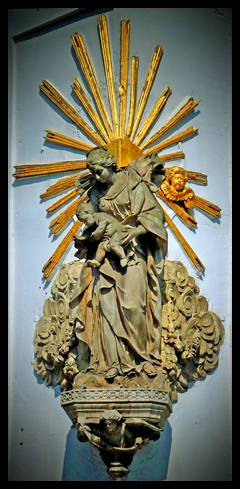
 The early church encountered difficulty in trying to reconcile the humanity and divinity of Jesus. In the 5th century, one group, from Alexandria, referred to the Virgin Mary as Theotokos, the one who gave birth to God, while the group from Antioch insisted that she was merely Anthropotokos, the one who gave birth to the human nature. Trying to bring about a compromise but pleasing no one, the bishop Nestorius suggested that the term Christotokos, the one who gave birth to Christ. The controversy, however, wasn’t about Mary; it was about the nature of Jesus. Did Mary give birth to a man who also was God or did Mary give birth to a man who later became God? The debate continued until 451 when the Chalcedonian Creed was adopted which confirmed the two natures of Christ (human and divine) in one person.
 There is much in Scripture, such as the subjugation of women, that I find troubling and would just as soon skip reading . For example, there’s no mention of their handmaid slaves’ consent when Sarah, Rachel or Leah offer them as surrogates to their husbands! Scripture may call them righteous because of their faith but Lot readily offered up his virgin daughters to a crowd of lustful men and Abraham twice gave Sarah to another man to save his own skin and benefitted financially both times he did it! There’s a word for a man who does that and it isn’t usually righteous. Then there was the Levite who pushed his concubine out the door to be raped by a gang of men. Many would consider David’s tryst with Bathsheba to be rape and even he tolerated the rape of his own daughter!
 We tend to think of our pastors as the ones who do the ministering and we, the congregation, as the ones to whom he or she ministers. Indeed, our pastors do care for, comfort, aid and support us but their main job is to equip us: to train, outfit and prepare us to go out and be Christ’s ministers to the world! Rather than them being the players in the game with us being the fans who show up on game day, our pastors are more like the coaches and athletic trainers who prepare their team to go out on the field and play with skill and enthusiasm! Too often, however, we act like onlookers rather than members of the team.
 Yesterday’s devotion about Indiana Jones and the Ark of the Covenant raises the questions of what was in it and what became of it. Constructed by the Israelites during the exodus, the Ark held the unbroken tablets of the Ten Commandments (representing God’s law), a golden pot of manna (representing God’s love and provision), and Aaron’s rod that miraculously budded (representing God’s power and leadership). Built in Mt. Sinai and carried all the way to Canaan, nearly 500 years passed before it finally found its home in Solomon’s temple. By the time the temple was built and Solomon brought it into the innermost chamber, only the stone tablets remained.
 Sorting through cabinets, I came across a video of Raiders of the Lost Ark. As I recall, archaeologist/adventurer Indiana Jones was authorized by the government to find the Ark of the Covenant before Hitler’s Nazis could obtain its supernatural powers and dominate the world. Indiana was told that the Bible speaks of the Ark’s power to level mountains, lay waste to entire regions, and that any army carrying the Ark is invincible.
 Devotions of the Heart